|
|
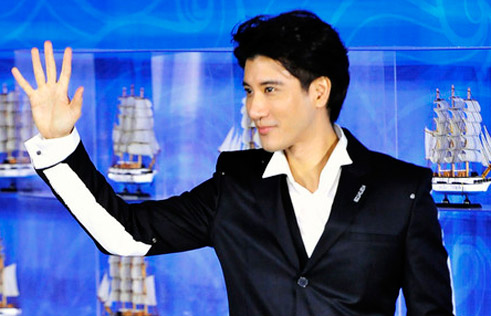
[Photo by Li Min/China Daily] |
I am neither of the East nor the West, and Beijing brings home to me painfully how tiny Singapore is.
With age, the anguish has lost its sharp edges, become less acute. Now there is only a dull ache.
In the 1990s, when I came to China regularly, on temple grounds and in parks like Du Fu's Thatched Cottage in Chengdu, confronted with the calligraphic inscriptions on steles that I could not make out, I was made to feel less Chinese.
I could not - and still cannot - read and write Chinese, and in China, more than back home in Singapore, I felt more keenly the loss and a sense of inadequacy.
My forebears had sailed to the Nanyang - South Seas - from a county near Xiamen in China's Fujian province, and settled in colonial Singapore. Although my childhood foundation is Chinese, growing up as I did in an extended household that spoke the Fujian or Minnan dialect, I was schooled in English and have used English as a tool of my trade since I became an adult. I think in English, even though it is not my native language.

In my youth in the 1960s and 1970s, the English-educated in Singapore generally sniffed at things Chinese, although we enjoyed the kung fu flicks that came out of Hong Kong at the time. The Taiwanese weepies and pop songs and the Chinese television drama serials on local television, some of us indulged as guilty pleasures.
I was very much influenced by the '60s counterculture in the West, and reading the literature popular at that time and listening to its angry rock anthems, I imagined myself one among the counter-cultural youths, a child of the West. I wore my hair long ("let my freak flag fly") and jeans a couple of sizes too large (there weren't jeans of Asian sizes yet).
It wasn't until I could afford to travel to San Francisco in the early 1980s that I found out that I did not actually belong in the West, as an ABC (American-born Chinese) perhaps would. I ventured into the clubs on North Beach that played high-decibel heavy-metal rock and, in my arrested adolescent naivete, expected to be welcomed by the crowds - they were my kind, weren't they? But I found myself unacknowledged and alone at the bar, nursing my Barcadi coke. I was like an extra who had wandered onto the wrong movie set.
I believe that when I began coming to China in the 1990s, I was unconsciously trying to reclaim my Chinese heritage. But without the language, the heritage was not mine to claim. I had read in English the works of the Tang poets like Du Fu, Li Bai and Wang Wei, but because I could recognize some Chinese characters, I realized how much was lost in translation.
So I was neither of the East nor the West - that was my anguish.
I could, of course, learn Mandarin, master it, and gain direct access to my heritage. But English is a harsh mistress. My hold on the language was tenuous, and I feared being abandoned should I learn Mandarin, something I could not afford since it was the medium of my work - and all my thoughts.
The late Chinese premier Zhou Enlai reportedly once remarked that Lee Kuan Yew, the founding father of independent Singapore, was a banana - yellow on the outside but white inside. Lee is a Straits-born Chinese whose family spoke Malay and English, and he went up to Cambridge after the Japanese Occupation. But he knew early the dangers of deracination. He sent his three children to Chinese-medium schools before switching them to English-language ones at the post-secondary level.
Lee himself started learning Mandarin when he became a politician - the majority of Singapore voters are Chinese and at the time many were uneducated or had gone to Chinese schools - and he has not stopped learning it since. On his 91st birthday last month, he refused to skip his Mandarin class. But he will be the first to admit that he has not mastered the language, in the way that his children have, because they had learned it when they were young. In recent years, Lee has been photographed in public events wearing the changsan, the traditional Chinese formal wear, perhaps as a nod to his Chinese roots, even though he has always believed in a multiracial Singapore.
He laid down too a strict policy for bilingualism, and today's young have benefited from it. The better-educated ones are effectively bilingual, and some are even bicultural. They suffer no crisis in identity, seeing themselves as Singaporeans and are comfortable in both East and West.
I envy them, but time has eased my earlier anguish. I am glad for my current job in Beijing, because it offers me the opportunity to at least learn to speak Mandarin more. In the office, I speak a mix of English and Mandarin with my colleagues. In my apartment in the evenings, I tune in to the dramas on television to soak up the language. And in order that I do not lose the touch of my mistress' hand, I keep up my regimen of reading.
Having been in Beijing for almost two months, I remain awed by its immensity. The sheer scale of it has brought home to me clearly and painfully again how tiny Singapore is. We are but a fleck in the awakened dragon's eye. So even though I am grateful that my leaders have transformed a former swampy colonial outpost into a thriving city-state, allowing me to live a relatively comfortable life, I am as anxious as the younger ones are about its future. From anguish to anxiety - the angst does not go away.
|
|
|
|
|
|
|
|

Copyright 1995 - . All rights reserved. The content (including but not limited to text, photo, multimedia information, etc) published in this site belongs to China Daily Information Co (CDIC). Without written authorization from CDIC, such content shall not be republished or used in any form. Note: Browsers with 1024*768 or higher resolution are suggested for this site.
License for publishing multimedia online 0108263 Registration Number: 20100000002731 


 Raymond Zhou:
 Pauline D Loh:
 Hot Pot
 Eco China
 China Dream
 China Face