'Kill line' an inevitable outcome of US system









Editor's note: Three institutes with Peking University, including the Institute of Area Studies and Institute of Studies on Law and Strategy, Chen Hansheng Center for Studies on World Politics and Economy, held a seminar in Beijing on Jan 12, where the participating experts offered insights on the phenomenon of the "kill line" in US society from their respective fields of expertise. Below are excerpts from some of the experts' remarks.
Finance is rewriting rules of survival
By Ma Jiahong
In the United States, the manufacturing sector temporarily alleviated the pressure of falling profit rates through technological innovation and industrial transformation after World War II. However, since the 1970s, intensified global industrial competition and rising domestic labor costs have led to a long-term decline in profit rates within the real economy. This decline has moved capital toward financialization.
Financial capital has since become the dominant force governing the economic system. It has not resolved the underlying tendency of the profit rate to fall but has instead displaced and amplified this contradiction. The distinctive feature of financial capital lies in its pursuit of profit primarily through the self-expansion of capital rather than through the creation of surplus value in the real economy. Consequently, the stability of the US economy no longer hinges on the development of its real economy but instead relies on risk management in the financial markets and sustained global confidence in dollar-denominated assets.
The core issue for capital is no longer how to expand employment and enhance the production of life's necessities, but rather how to avoid failure and evade costs amid increasingly unstable conditions for value realization. To shift these costs, the burden is transferred onto individuals.
During the industrialization phase, there was a relatively stable relationship between capital and labor, as capital had to bear the cost of workers' subsistence to maintain the balance between production and consumption. However, in the current financialization stage, capital can disrupt the stability of traditional employment through various means, transferring the risks of the labor process entirely onto individuals. Workers therefore face unstable income and a constant risk of unemployment.
Building upon this logic, the evolution leads toward a credit system that binds individual subsistence to the financial markets, ultimately making individuals the final bearers of risks associated with surplus value realization. By leveraging critical thresholds such as credit scores, income levels, and employment status, the labor force is segmented into the usable and the expendable.
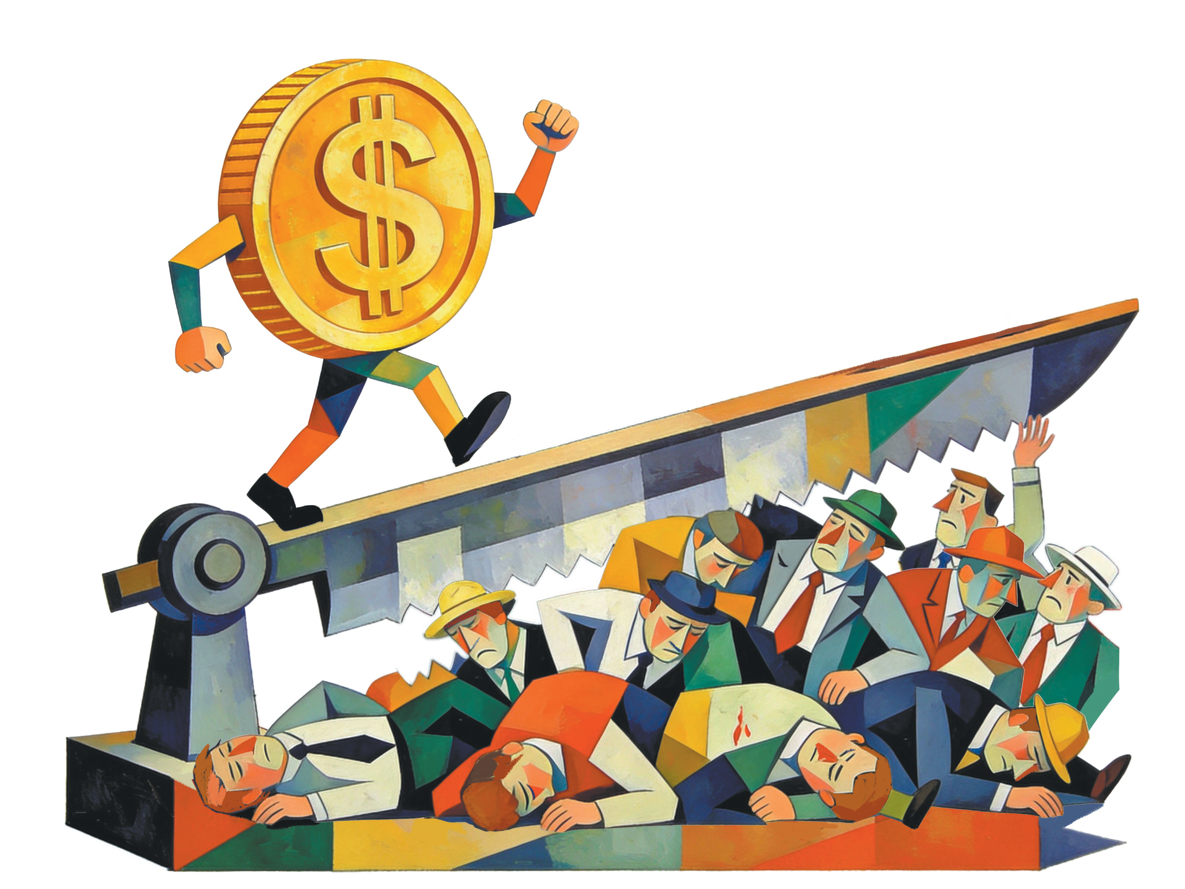
Furthermore, through mortgages, auto loans, student debt and medical loans, individuals are integrated into the consumption system, transforming them into vehicles for capital appreciation. However, those who fall below the critical threshold, the kill line, are abandoned by capital and excluded from the reproduction systems. The essence of this mechanism is that capital only remunerates labor that has already been successfully converted into profit, while externalizing all costs associated with labor that fails to generate appreciation. This way, the expenses of labor reproduction are passed onto individuals.
This intensifies labor exploitation and pushes it into an even more severe phase. By tethering access to education, health care and other essentials to personal debt and creditworthiness, the credit system directly links an individual's right to subsistence with their financial standing. Consequently, unemployment, illness or a damaged credit history results in the loss of not merely income, but also the eligibility to re-enter social reproduction. This constitutes the underlying logic of the kill line — the mechanism governing social reproduction.
The author is an associate professor at the School of International Studies of Renmin University of China. The views don't necessarily represent those of China Daily.