HK bets on integrated hub to enhance TCM profile









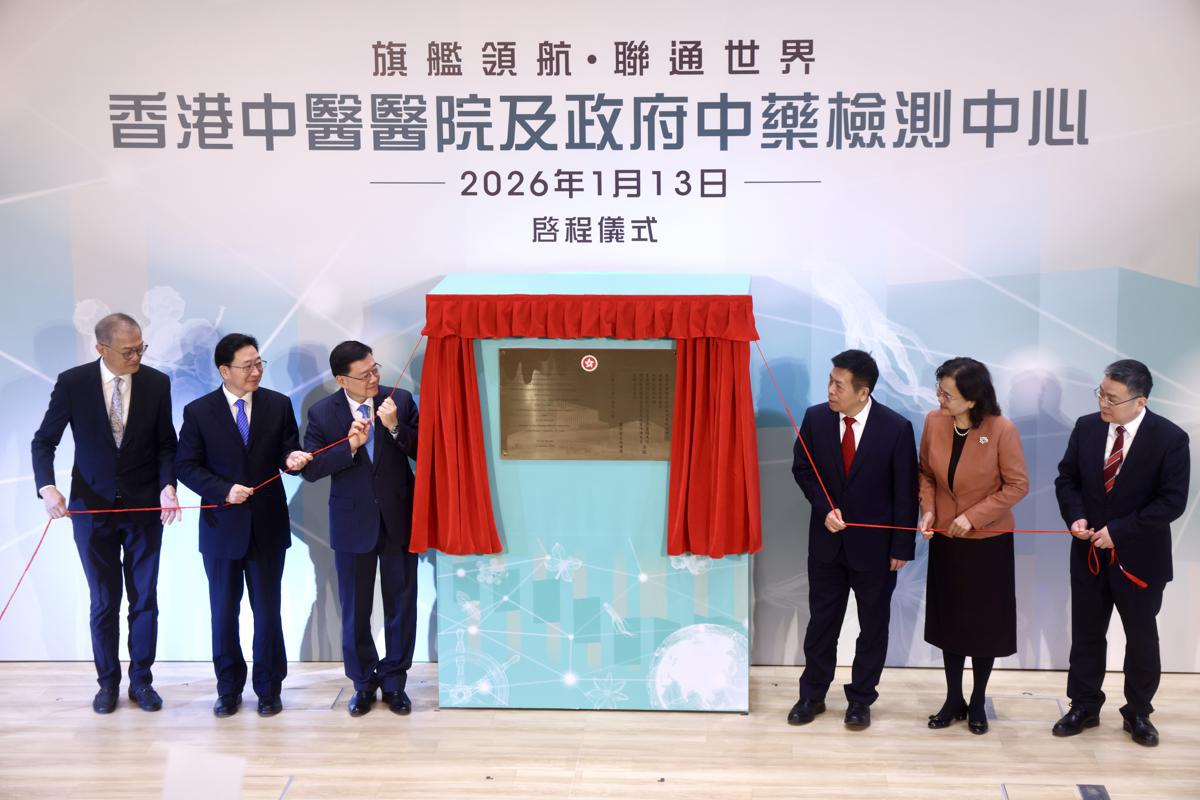
Government officials lauded the opening of an integrated hub for traditional Chinese medicine in Hong Kong — the Chinese Medicine Hospital of Hong Kong and the adjacent testing institute — saying that it would improve TCM services in the city and boost the sector's international profile.
More than 300 healthcare professionals, local lawmakers and officials from the central authorities and the Hong Kong Special Administrative Region attended a plaque-unveiling ceremony on Tuesday to officially launch the city's flagship TCM projects.
Located in Tseung Kwan O, the 42,900-square-meter TCM hospital and the 17,200-sq-m permanent building of the Government Chinese Medicines Testing Institute both began initial operations last month.
Addressing the launch ceremony, HKSAR Chief Executive John Lee Ka-chiu said the two flagship projects of Hong Kong's TCM sector will help foster a TCM ecosystem, integrating academia, hospitals and the industry to jointly advance scientific research and commercial application.
Lee said that the TCM hospital has been "very popular" since its opening and has received very positive reviews from patients.
He said that as the inheritance, innovation and development of TCM have been highlighted in national development strategies, particularly in the recommendations for formulating the 15th Five-Year Plan (2026-30), Hong Kong will fully integrate into and serve the nation's overall development goals for the TCM industry.
The HKSAR government will leverage the city's globally connected healthcare system, internationally compatible regulatory framework and standard-setting, as well as its strong clinical research capabilities to best support and contribute fully to the development of TCM in the country, and become "a bridgehead for taking traditional Chinese medicine global", Lee added.
At Tuesday's ceremony, Lei Haichao, minister of the National Health Commission, praised the opening of the permanent facilities as an "important milestone" for Hong Kong's TCM sector.
He noted that TCM has long been a part of Hong Kong residents' daily lives and TCM clinics and herbal stores are a common, "ubiquitous" sight on local streets.
Looking ahead, Lei said that Hong Kong's TCM sector should use the new facilities as catalysts to embed itself within the city, serve the local community and drive synergistic growth across industry, academia and research spheres.
He added that the local TCM sector should pool resources to help make the entire Guangdong-Hong Kong-Macao Greater Bay Area a TCM hub, and continue with its work toward creating a regional TCM medical consortium and a collaborative, integrated TCM hospital cluster.
"TCM institutions on the Chinese mainland are willing to share expertise and strengthen ties with their peers in Hong Kong," Lei said, noting that they share the common goal of enhancing "the positive role of TCM in promoting public health".
According to Lei, the central authorities will continue to advance the integration of TCM and Western medicine, encourage more Western medical professionals to learn TCM, deepen clinical collaboration between the two types of medicine for serious and difficult diseases and improve the integrated service system of TCM and Western medicine.
He said he hoped development of TCM in Hong Kong would serve global needs and accelerate the sector's global expansion. Specifically, he said he considers the city's distinct advantages in pharmaceutical testing and quality control key to its becoming a crucial "support pillar" for TCM's global expansion.
According to a Hong Kong Legislative Council document, the proportion of people seeking TCM services out of the total number of medical attendances in the city has surged from 7.5 percent in 1996 to 24.3 percent in 2023.
Last month, the HKSAR released its first-ever TCM development blueprint to further boost the development of TCM, setting a mission to carry forward its TCM legacy backed by national expertise and resources, and to apply TCM to provide better-quality, more comprehensive healthcare services.
Since 2019, the city's Chinese Medicine Development Fund has awarded grants to more than 9,800 applicants, which have benefited over 1,300 institutions.



- HK bets on integrated hub to enhance TCM profile
- China widens net in battle against graft
- New US dietary guidelines trigger widespread concern
- China eyes space leap with record satellite filings
- Team formed to investigate the loss of 29 cultural relics
- Investigation into school uniforms confirms safety of waterproof layer