How Beijing CBD rose from nondescript to noteworthy









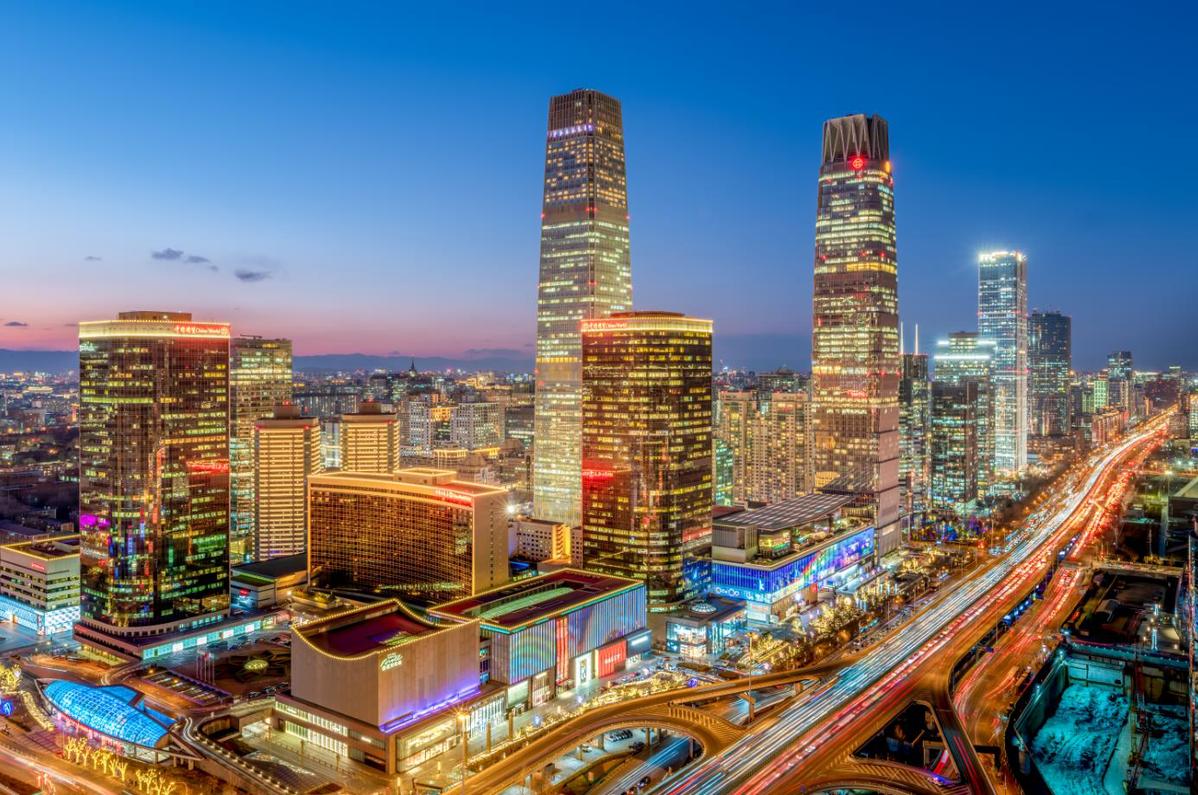
A report released in November ranks Beijing's Central Business District sixth in the world, an impressive jump from ninth place in 2017. The ranking, compiled by global consultancy firm EY and the Urban Land Institute, is the sort of thing I usually don't lift my eyelids to because I suspect their authoritativeness. Rankings are based on indicators, and selecting different indicators could lead to different results. But this report caught my attention because it played up Beijing CBD and I have witnessed its growth in the past four decades.
When I came to Beijing in the early 1980s, I used to pass the intersection of Dabeiyao on my way to work, either on my bike or on the way to the bus stop. What is now the center of Beijing CBD was then an industrial area with factories producing four-wheelers and machine tools, and a huge freight yard piled with timber near the railway that sliced through the East Third Ring Road. Nobody could have imagined that this area would one day become the center of a world-class CBD.
When reporting assignments took me to New York and Tokyo in the 1980s, I was fascinated by the skyscrapers of Manhattan and Marunouchi. That's when I got to know that CBD stands for central business district and that such areas have a high concentration of the headquarters of the world's biggest and richest companies. Having a bird's-eye view from atop a CBD skyscraper was a must for tourists in New York and Tokyo in those days, while the three letters were still alien to most Chinese, including me.
Did Beijing's city planners intend to turn Dabeiyao into the capital's CBD? I guess not. They could not have been so prophetic. The transformation happened quietly, and almost accidentally. In 1990, the 209-meter-high Jingguang Mansion rose in the district. It remained Beijing's tallest building for nearly a decade before fancy hotels and office buildings started coming up along the East Third Ring Road, dwarfing the Jingguang Mansion.
According to the EY report, spread over 7 square kilometers, the Beijing CBD is now home to seven Fortune Global 500 corporate headquarters and 11 unicorn enterprises. It boasts a complete industry chain and a dynamic innovation ecosystem. A few years back, I tried to locate the bus stop I once used in Dabeiyao but failed to find the spot. All past memories — the crowded bus stop, the factories and the stream of bikes — can only be seen in my dreams now, for better or for worse.
A prosperous and lively CBD has now become a standard configuration of first-tier or even second-tier cities in China. The CBDs in Hong Kong, Shanghai and Guangzhou rank 13th, 14th and 22nd respectively worldwide, according to the EY report. They must be closely followed by the ones in Shenzhen and Chongqing.
It is difficult to figure out how many CBDs there are in China because business districts are not an administrative concept. But at least 60 cities in the country claim they have CBDs, some even insisting they have more than one. Unless a city applies to the Ministry of Civil Affairs to officially change the name of a place, local people are free to call a cat a cat — or even a cat a dog. In fact, many people believe that CBD stands for China Beijing Dabeiyao. And it sounds fine.
People are free to call a cluster of businesses their CBD if that sounds fashionable, but when it comes to building a CBD, local decision makers should be cautious.
More than 10 years ago, a second-tier city not far from Beijing started building its CBD. Hundreds of families were moved out of a residential area to make way for two landmark skyscrapers as Phase One of a grand vision. But when the first skyscrapers failed to attract enough tenants, investment stopped flowing in and the area turned into a junkyard. It has taken the local government lot of effort and money to compensate the residents who were moved out 10 years ago with the promise that they would get new apartments within two or three years.
The lesson is clear. Turning an area into a CBD is something the market should decide rather than a local government. The best the government can do is to give it a push when the time is right.
The author is former deputy editor-in-chief of China Daily.
kangbing@chinadaily.com.cn