As US raises H-1B visa fee Canada faces test in talent race









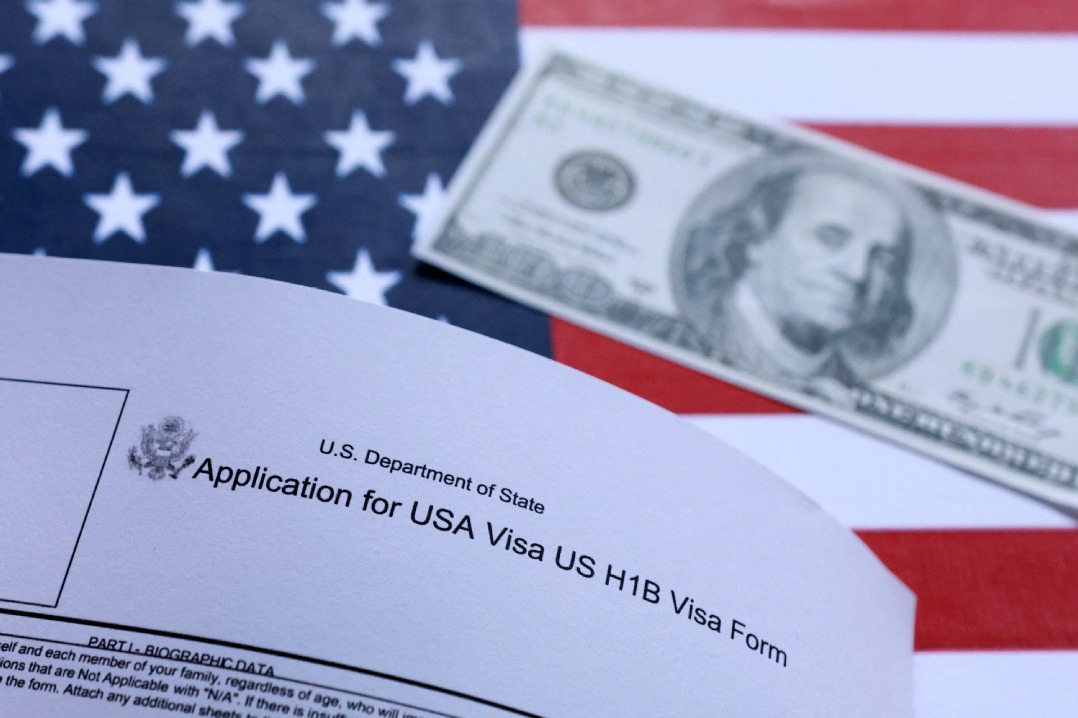
Washington's decision to raise the H-1B visa fee to $100,000 is fueling warnings from experts that the move could drive skilled workers away from the United States and expose Canada's own ambivalence over immigration.
The new fee went into effect as of Sep 21, and will greatly impact employers' ability to secure the highly educated foreign workers who come to the US on the H-1B visa.
Employers will now be required to pay a one-time $100,000 fee per new petition. Previously, it cost employers between $2,000 to $5,000 per petition, depending on the size of the employer.
Anna Triandafyllidou, Canada Excellence Research Chair in Migration and Integration at Toronto Metropolitan University, said the announcement was both disruptive and potentially advantageous.
"When their employer is told they have to pay $100,000 to keep the person to renew their visa … I'm really worried also about what happens to the people that will be affected, and of course the businesses as well," she told China Daily.
Triandafyllidou questioned the rationale behind Washington's approach.
"A lot of the people who graduate from the great US universities are actually not US citizens," she said. "They didn't seem to be aware of how their immigration policy works."
She also described the move as part of a broader anti-immigration trend.
"It's part of a whole strategy … we heard it also in Trump's speech in the United Nations," she said.
"How can you say that immigration is sending countries around the drain? This is the kind of fireworks without any substance," she said.
Canadian Prime Minister Mark Carney has shown interest in the debate over how changes to the H-1B visa in the United States could affect the flow of skilled workers.
Speaking at the Council on Foreign Relations in New York on Sept 22, he pointed to Canada's strength in research and artificial intelligence, but added that "unfortunately, most of them go to the US."
"I understand you're changing your visa policy," he added. "Maybe we can hang on to one or two of them."
Triandafyllidou said this could be positive for Canada, noting that in the past some skilled workers who ran into immigration problems in the US chose to move north.
But she noted that people should not celebrate too soon.
"This is not to say that it's good for Canada and we should do it, because I see the disruption this can cause to people and their lives," she said.
Canada, she argued, faces its own contradictions.
"We have two discourses that are partly contradicting each other," she said, pointing to the government's call to attract "the best and brightest" while also pledging to bring immigration down to "a level that is sustainable."
That tension is evident in debates over housing, infrastructure and the treatment of international students.
"In smaller and medium sized cities in Canada, we need more people. We shouldn't slow down the pace," she said. "At the same time, of course, there are neighborhoods in the big cities that feel the brunt of newcomers."
Triandafyllidou urged policymakers to broaden their definition of talent.
"Canada doesn't only need the nuclear physicists … We also need the middle level skilled people that work in different levels of the sector in health, in care," she said.
Looking ahead, she noted that the polarized debate in the US could complicate the picture.
"I'm really concerned about polarization within the United States … It's not facts, it's vibes," she said. "It's social media quotes that get likes, but it's not analysis that leads to good policies and good implementation."
The US decision to raise the H-1B visa fee to $100,000 will hit both foreign workers and employers hard, but Canada may not be ready to take advantage, according to Lori Wilkinson, a sociology professor at the University of Manitoba.
She said the US argument that higher costs will push companies to hire Americans misses the point.
"The reason these H-1B visas exist in the first place is there's a skill shortage of people," Wilkinson told China Daily.
"They're going to have a hard time filling a lot of these jobs, especially in places where the population maybe is a little bit smaller," she said.
Turning to Canada, she expressed doubt that the country will benefit in the short term. "If Canada wants to attract more skilled workers, they can put into place better pathways. But I think the current government also doesn't want immigrants to come here.
"For the first time in decades they've approved lower numbers of immigrants than in previous years," she said.
She pointed to past policies that once made Canada attractive. "Now those pathways are starting to close," she said.