Ethiopians train in AI medical imaging
Project highlights China's support for global advancements in radiology









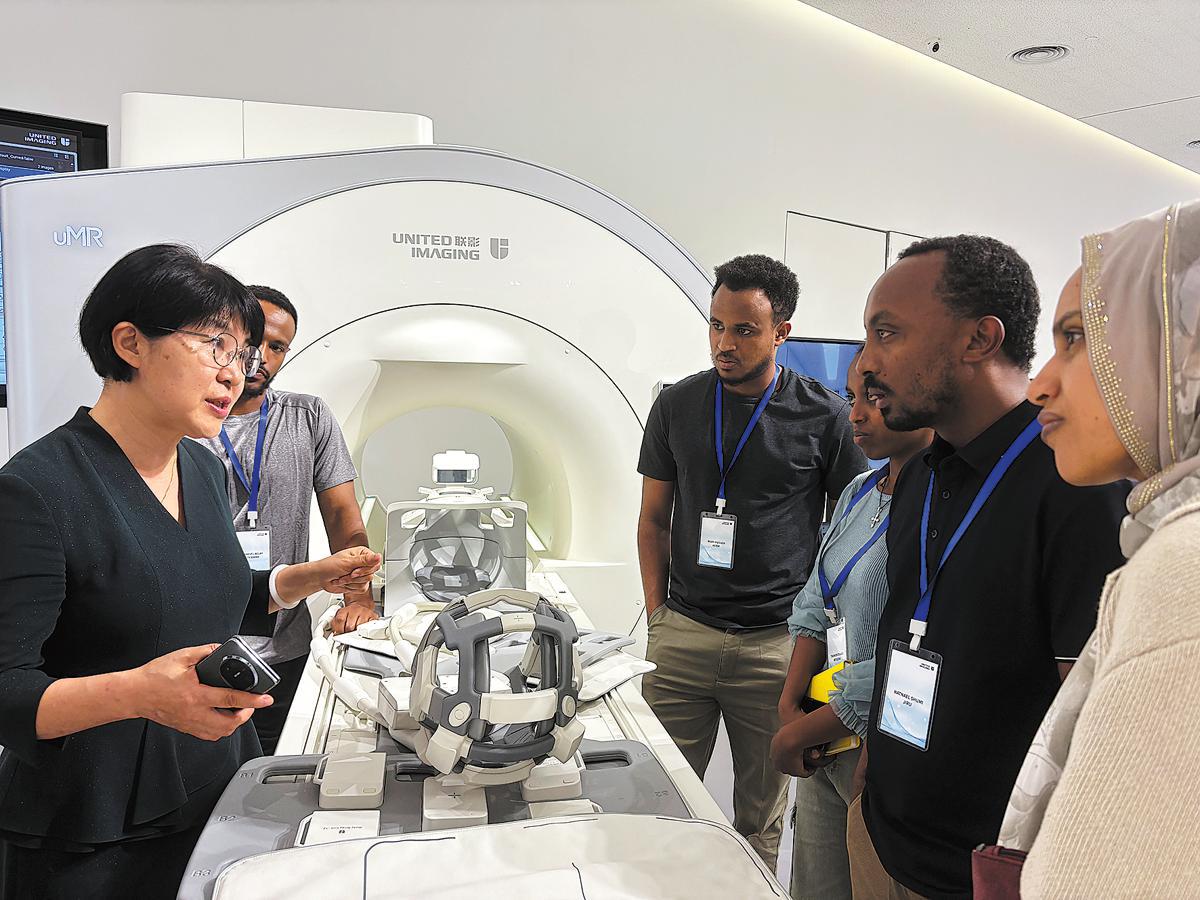
Twenty-four medical professionals from Ethiopia are taking part in a 21-day medical imaging technology training program in China, where they are visiting top-tier and district-level hospitals in Beijing, Shanghai and Jiangsu province and exchanging insights on imaging practices from both developed and developing regions.
The participants — who are among Ethiopia's top hospital leaders, clinical doctors and imaging technicians — said they were impressed by the cutting-edge radiology technologies and the use of artificial intelligence in clinical settings in China.
Some expressed optimism that adopting such technologies in Ethiopia could significantly enhance diagnostic and treatment capabilities, particularly in the acute management of conditions such as stroke.
The program, which began on Aug 15, is hosted by China's Ministry of Commerce and organized by the International Health Exchange and Cooperation Center of the National Health Commission. It aims to foster collaboration between hospitals in the two countries.
Chinese clinical experts contributed by presenting the latest advancements in CT, PET-CT, and MRI technologies.
Shi Zhang, a radiologist from Zhongshan Hospital affiliated with Fudan University in Shanghai, tailored his lectures to Ethiopia's challenges, where stroke treatment rates remain relatively low. His sessions focused on rapid identification of stroke using imaging modalities to prevent treatment delays.
He also emphasized optimizing existing equipment with AI algorithms to produce high-end diagnostic results with standard machines.
"It's kind of like taking a photo and then enhancing it with editing tools to produce sharper definition and clearer details," Shi said. "I believe such attempts will have practical value for improving medical services in hospitals at the grassroots and in remote regions."
In Shanghai, part of the program was held at Shanghai United Imaging Healthcare Co, which specializes in medical imaging, radiotherapy equipment and life science instruments.
"In big Chinese cities, AI has already been fully integrated throughout the entire medical imaging process — from patient positioning through diagnosis and follow-up," said Li Chenwei, vice-president of clinical application and clinical marketing for the international business department at Shanghai United Imaging Healthcare Co.
"While Ethiopia is at the nascent stage of adopting such technologies, the potential benefits, particularly in standardizing diagnostic procedures, were of great interest to the Ethiopian healthcare professionals," Li said. "Given Ethiopia's large population and the lengthy training period for doctors, AI could play a crucial role in helping establish standardized examination processes there."
Training participant Tsion Befekadu Beyecha, a medical radiology technologist at Washington Medical Center in Addis Ababa, said medical modalities in her country have not yet integrated AI.
"The advanced integration of AI in medical imaging here is new to me. Witnessing and experiencing such integration is exciting," she said.
She added that radiologists are in short supply in Ethiopia.
"In case of emergency, for example, a hemorrhagic stroke, the diagnosis for the patient requires a rapid result. I saw here that AI modality can detect any hemorrhage, which definitely adds value to patient care," she said.
Another participant, Yeraeifirae Sileshi, CEO of Waji Healthcare in Holeta, said most participants in the training program were on their first visit to China and were encouraged by the advancements they witnessed.
"The country is actually way more advanced in the healthcare sector than what we had expected," said Sileshi, who is also a general physician. "I look forward to visiting more public hospitals in China during the program to see their workflow and operations. Together with the advanced machines and technologies that function both accurately and swiftly, it makes it possible to manage the large population of local patients well."
As part of the effort to build a China-Africa community of health, the National Health Commission launched the China-Africa Hospital Alliance in Beijing on Aug 15.The event drew healthcare administrators, clinical experts, industry representatives, think tanks, and international organizations from both China and Africa, as well as representatives from African embassies and consulates in China.The Ethiopian medical professionals in the training program also attended the launch.
zhouwenting@chinadaily.com.cn