Xizang strides toward modernization
Infra development over six decades transforms lives in 'roof of the world'









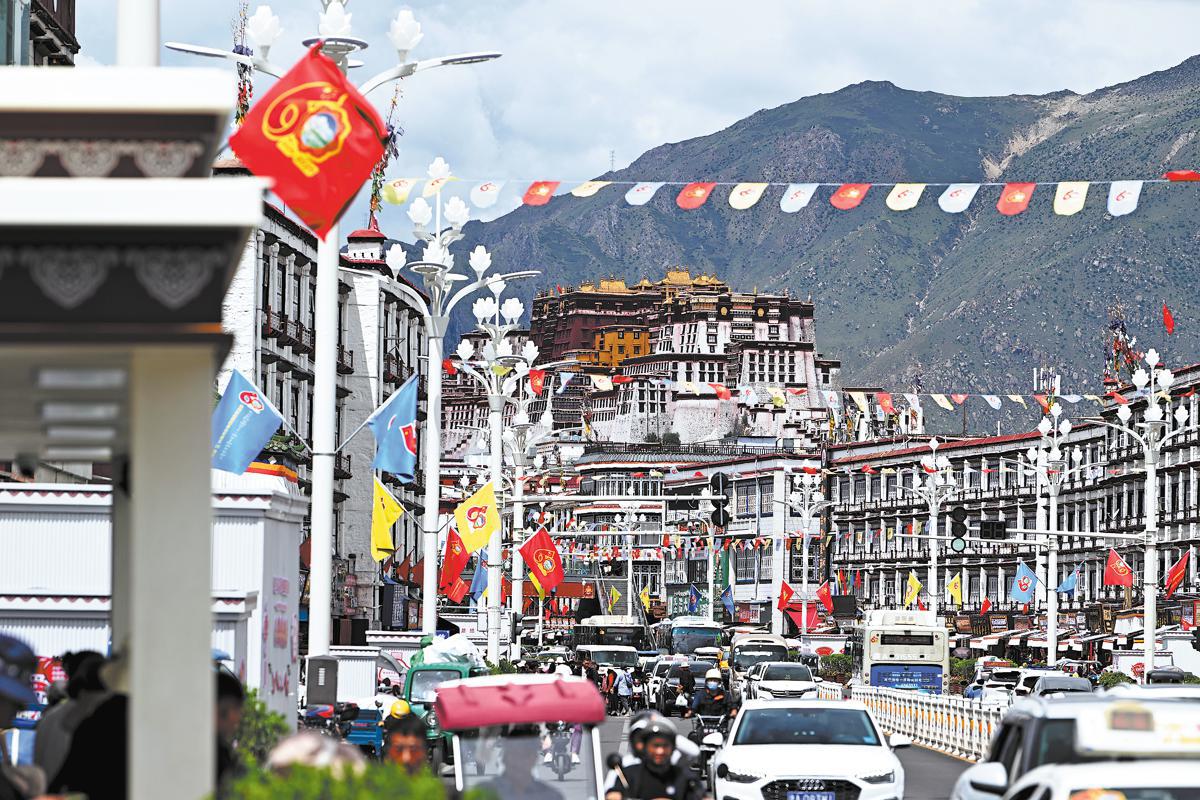
When Dondrak, in his 20s, began working in the early 1980s as a primary-level doctor in a remote village in the city of Nagqu, about 300 kilometers from Lhasa, regional capital of the Xizang autonomous region, his duties often meant riding horseback or trekking on foot at an average altitude above 4,500 meters.
"Buses were seasonal," he recalled. "In winter and spring, walking was the only option."
Back then, a trip from Nagqu to Lhasa would require an entire day on a bumpy dirt road, leaving at dawn and arriving deep into the night.
Known as the "roof of the world", Xizang is a land of extreme cold, towering mountains and thin air. For centuries, it had no modern roads.
But all that began to change in 1954, when the Sichuan-Xizang and Qinghai-Xizang highways — stretching a combined 4,360 km — opened to traffic in Lhasa.
In the six decades since the Xizang autonomous region was established in 1965, infrastructure development in the region has accelerated across the board, achieving historic breakthroughs. Today, Xizang boasts an integrated transportation network of highways, railways and air routes.
In 2006, the completion of the Qinghai-Xizang Railway ended the region's history without rail service and gave a powerful boost to its development.
President Xi Jinping has emphasized on many occasions the importance of building the region's second great rail artery — the Sichuan-Xizang Railway, an east-west high-speed route designed to link the plateau more closely with the rest of the country.
In an instruction made ahead of the beginning of the construction of the Sichuan-Xizang Railway's Ya'an-Nyingchi section in 2020, Xi called for efforts to advance the construction of the railway project with high quality, saying that the project would significantly contribute to the economic and social development of the western region, especially Xizang and Sichuan province.
Underlining the complex geological and climatic conditions, as well as the fragile ecological environment along the project line, Xi called for leveraging the Chinese socialist system's advantage of concentrating resources to get things done to accomplish this arduous but glorious task.
When Xi visited Xizang in 2021 for the 70th anniversary of the region's peaceful liberation, he took a train from Nyingchi to Lhasa along the Lhasa-Nyingchi Railway — a key segment of the Sichuan-Xizang line — that was completed and opened to traffic in June 2021.
The journey took just over three hours — a stark contrast to 1998, when Xi, then deputy secretary of the Communist Party of China Fujian Provincial Committee, traveled the same route by bus in a grueling day over treacherous roads.
"The roads were extremely dangerous back then," Xi recalled. "We were lucky that there were no landslides. In the narrowest spots, just two logs spanned the gap, and we had to get out and move them ourselves."
Aboard the train to Lhasa, Xi described the national transportation map as a painting, saying that the central, eastern and northeastern regions of China are like detailed fine brushwork, but the western region has too much blank space.
"In the future, a few strokes should be added to complete the picture, making the transportation of a beautiful China even more beautiful," he said.
By the end of 2024, Xizang had 124,900 km of open highways and 1,359 km of operational railways.
Changes in air travel have also been dramatic.
Xiong Zailin, deputy director of the air traffic management center of the Xizang regional office of the Civil Aviation Administration of China, has worked at Lhasa Gonggar International Airport for 30 years and witnessed the high-quality growth of the region's civil aviation sector.
According to Xiong, Xizang's complex and variable weather was once a major obstacle. In those early days, air traffic management was jokingly described as "blind and deaf" — controllers could neither see aircraft clearly nor hear them well.
"For example, at Lhasa Gonggar Airport, controllers mainly relied on pilots' position reports to coordinate flight intervals. This was inefficient and carried safety risks," he said.
Now, modern systems such as automated meteorological data collection and precise real-time warnings have eliminated the bottlenecks that once restricted flights during severe weather.
Today, Xizang has eight operational airports and 183 domestic and international air routes, with direct flights to major Chinese cities as well as countries including Nepal and Singapore.
From Lhasa, passengers can reach destinations across China within a single day.
Infrastructure is just one aspect that mirrors the sweeping transformation of Xizang over the past decades.
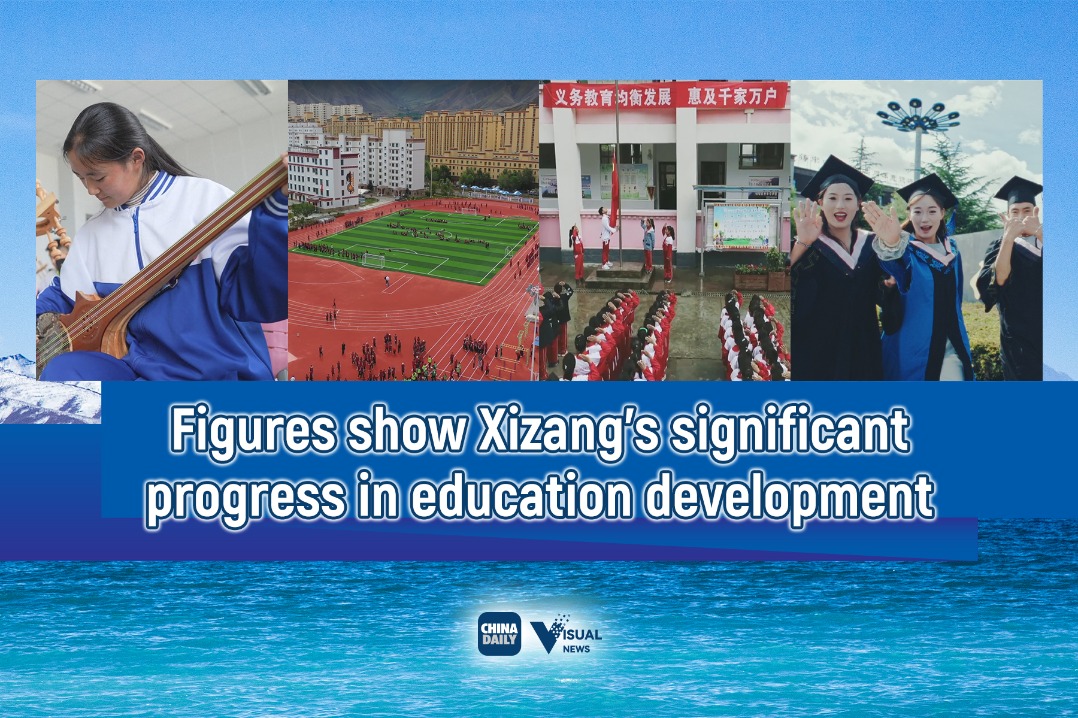
Since the 18th National Congress of the Communist Party of China in 2012, the region has achieved remarkable progress in economic growth, people's livelihoods, environmental protection and the development of Tibetan culture.
Xi attended the sixth and seventh national meetings on Xizang work in 2015 and 2020, respectively. And it was during the seventh meeting that Xi outlined the CPC guidelines for governing Xizang in the new era, which led to major projects and preferential policies that have solved the region's longstanding problems and achieved results once thought impossible.
During his 2021 trip to Xizang, Xi said he saw significant changes in people's lives and spirits. "Everywhere I went, I could feel their sense of happiness about living better lives and their heartfelt gratitude toward the Party and the country," he said.
In June this year, Xi replied to a letter from residents of a village in Nyingchi that he had visited in 2021.
"Learning that the village has undergone new changes in recent years and villagers' incomes have increased, I feel happy for you," Xi wrote, encouraging them to protect the plateau's natural beauty, strengthen their tourism brand and contribute to building a prosperous and stable border area.
The region's GDP reached 276.5 billion yuan ($38.48 billion) in 2024, 155 times that of 1965, reaching an average annual growth rate of 8.9 percent.
In addition, public health services now reach even the most remote villages, average life expectancy has risen to 72.5 years and incomes have soared. In 2024, the per capita disposable income of urban residents was 121 times that of 1965, while rural incomes were 199 times higher.
Guo Kefan, a researcher at the regional academy of social sciences, said that from the first two high-altitude highways of the 1950s to the newest airports in Ngari prefecture — known as "the roof on the roof of the world", Xizang's transformation reflects not only China's growing national strength, but also the central government's enduring commitment to the region.
"Xizang's progress is a textbook example of the whole-nation system powering major road, rail and air infrastructure projects in the region. At every stage of the country's development, the State has gone to extraordinary lengths — mobilizing more resources than anywhere else — to fully support Xizang's development," he said.
Now, at the age of 68, Dondrak, the retired doctor, and his wife live in a serene community in Lhasa. They usually start their mornings with a walk to the nearby park, enjoy Guozhuang, a traditional Tibetan group dance, for an hour, work out at the public fitness square, and end the day with tea and conversation at the local sweet tea house.
"Everything has changed for the better — our homes, our roads, our education and our medical services. I never imagined life could be this comfortable," he said.
mojingxi@chinadaily.com.cn






- Xizang strides toward modernization
- Envoys hail China's panda conservation, seek wider ties
- China's national park system hailed
- Guangzhou man detained for allegedly impersonating serviceman and State Council counselor
- China eases rules on private pension withdrawals
- Rainbow covers Beijing sky after rain