



US visa policy policing students









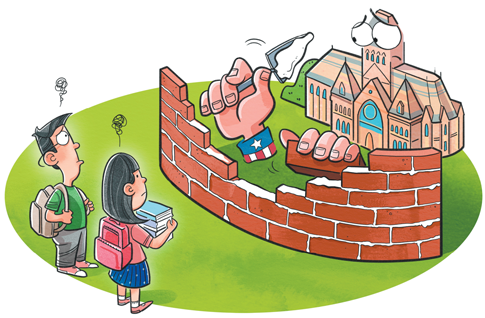
The US State Department has resumed processing student visas while mandating that all applicants make their social media accounts public for scrutiny. What began as a temporary suspension of students' visas has evolved into a policy shift that treats foreign students not as seekers of knowledge, but as potential threats — judged not by their academic credentials, but by their digital footprints.
As an economic growth driver, social equalizer and technological innovation catalyst, education has contributed immensely to the United States' rise as a global power after the end of World War II. In recent years, however, the US administration has been using education as a tool to fulfill its political goals on the pretext of making "America great again" but ending up harming its own interests by implementing "over the top" visa restrictions on Chinese students.
US Secretary of State Marco Rubio announced on May 28 that the administration will "aggressively revoke" the visa status of Chinese students, especially students the administration believes are "affiliated" with the Communist Party of China and those studying in "critical fields".
The US was once committed to education for all, as reflected in the vision of the Institute of International Education, which works with the US Department of State to promote international student exchange, and global peace and security. In its annual publication, Open Doors Report 2024, the IIE said the US is much ahead of other countries in terms of its willingness and capacity to host international students.
Chinese students, numbering about 280,000, comprised the largest foreign students' group (about 25 percent of the total) in the US during the 2023-24 academic year.
The new visa policy could damage the confidence of students across the world in the self-proclaimed "tower of democracy and freedom", and make Chinese students more doubtful about their academic future in the US.
The tuition Chinese students pay is a major source of revenue for many US universities, especially public research institutions.
The changed policy will also undermine the US' intellectual capability. Many college programs in STEM (science, technology, engineering and math) depend heavily on the enrollment of international students for sustenance and research output, with foreign students, including Chinese students, enriching the cultural and academic fabric of US campuses and fostering critical thinking.
The tightened policy on visa approval will also reshape the global perception about the US as an education powerhouse and tarnish its image as a global education leader.
The US was already facing growing competition from countries such as the United Kingdom, Canada and Australia in attracting foreign students, especially Chinese students, but now that those countries are offering more favorable work and residency pathways, the US seems to be losing its competitive edge in the global education sector.
According to ICEF Monitor, an increasing number of Chinese families view the US as less reliable and more politically uncertain compared with other countries with good universities.
Also, the "Trump effect" on the enrollment of foreign students extends beyond the education sector. That the US attracts about 1.1 million foreign students every year greatly contributes to US economic growth. During the 2023-24 academic year, they contributed between $43.8 billion and $50 billion, through tuition, living expenses and research, to the US economy.
In the Summit of the Future in New York in 2024, the US and other countries adopted the Pact for the Future, pledging to take bold, ambitious, accelerated, just and transformative actions to implement the UN 2030 Agenda for Sustainable Development Goals. The pact reiterates that the UN member states remain committed to realizing the SDGs, which include providing inclusive and equitable quality education and creating lifelong learning opportunities for all.
However, the tightened visa policy is having strategic implications for bilateral relations. Educational exchange has been a resilient factor in US-China relations, fostering personal connections, mutual understanding, and long-term trust. By turning that arrangement upside down, the administration's visa policy will erode the US' soft power and mutual trust with other countries.
Wang Yan is an associate research fellow at the Country and Area Studies Academy, Beijing Foreign Studies University; and Mu Ruoxi is an assistant professor at the same academy. The views don't necessarily reflect those of China Daily.
If you have a specific expertise, or would like to share your thought about our stories, then send us your writings at opinion@chinadaily.com.cn, and comment@chinadaily.com.cn.


















