US should improve ties for own good










The "Make America Great Again" rallying cry is vital for understanding US President Donald Trump's China policy. Among other things, the rallying cry tends to portray China as the primary ideological, geopolitical and economic rival of the United States. However, the self-centered nature of the slogan will not benefit the US; instead, it will likely harm it.
In contrast, the US' cooperation with China and the rest of the world will yield mutual benefit. This raises a question: How do economic relations evolve between the world's two largest economies? There are numerous stereotypes, most of which are misguided.
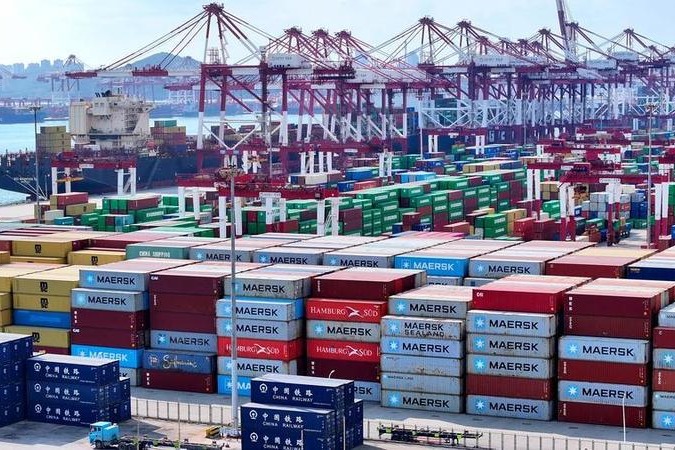
In 2024, China was the US' fourth-largest trading partner in goods, with a total trade volume of $582.5 billion; the third-largest source of imports ($438.9 billion); and the fourth-largest export destination ($143.5 billion). As for services, in 2023, China accounted for 4.6 percent ($46.7 billion) of the US' service exports and 2.7 percent ($20.1 billion) of its service imports.
But the two most prominent economies in the world are today hesitant to invest in one another. For example, in 2023, US foreign direct investment in China totaled $126.9 billion, accounting for 1.9 percent of the US' total investment abroad, while Chinese FDI in the US was $28.0 billion, representing just 0.5 percent of its total investments overseas.
According to the US Treasury Department, as of November 2024, US investors held $331.8 billion in Chinese securities, while China's holdings of US securities were nearly six times higher, at $1.9 trillion.
So it is imperative that the two countries improve their economic relations, because they bring tangible benefits to both. However, the negative public opinion about China in the US, cultivated there for a long time, has led, under a far-fetched pretext, to the implementation of discriminatory measures and various sanctions and tariffs against Chinese exports.
On Feb 27, US President Donald Trump announced an additional 10 percent tariffs on Chinese imports. Beijing responded with 10-15 percent tariffs on US farm equipment, cars, coal and liquefied natural gas, and imposed export controls on certain chemicals.
Trump has long argued that tariffs will be an integral part of his economic policy. During the Inauguration Day parade at Capital One Arena, he bluntly declared, "I always say tariffs are the most beautiful words in the dictionary to me", adding that God, religion and love are the first three in that order, followed by tariffs.
But most experts believe that tariffs will have the biggest negative impacts on the country imposing them and on end consumers.
A tariff is a domestic tax levied on goods imported into a country. The cost of that tariff is ultimately borne by a domestic company that imports certain goods, not the foreign company that exports them. Thus, a tariff is a direct tax domestic companies pay the government. Higher tariffs on products are passed on to the end consumers or importing companies, leading to higher prices for the consumers.
During Trump's first term, his administration imposed tariffs on hundreds of billions of dollars worth of steel, solar panels, medical devices and other goods made in China. At the time, the administration argued that the burden of these tariffs would primarily fall on China. However, an independent study found that that was not the case, as nearly all the tariffs on $362 billion worth of goods imported from China were passed on to the American companies and consumers that imported them or ultimately bought them.
The impact of these tariffs was particularly significant on low-income households, which typically spend their modest incomes on affordable goods from China. Most other professional studies have shown similar results.
In a September 2024 survey by the University of Chicago Booth School of Business, 98 percent of more than 40 leading global economists agreed that tariffs increase costs that are passed on to consumers.
Based on practical examples, modern economic theory posits that competitive trade enhances economic output and income while trade barriers hinder them. Recent evidence has shown that tariffs raise prices and reduce the quantity of goods and services supplied by the foreign country. This eventually diminishes the income of both businesses and workers. Higher prices lessen the return on labor and capital, discouraging American people from working and investing, leading to lower production and living standards.
Regardless of the global developments, China should prioritize three key areas in its domestic policy. First, it should enhance its competitiveness, adhering to the well-known Chinese saying: "To forge iron, one must be strong oneself." Second, it should stimulate domestic demand and foster the growth of the domestic market to reduce reliance on exports and external market conditions. And third, it should vigorously promote technological innovation, focusing on improving the synergy between innovation and industry.
The implementation of Trump's discriminatory policies will hinder the success of MAGA; in fact, it will undermine it. China and the US are interdependent economies, and their cooperation will enhance the wellbeing of their people and those in the rest of world. New tariffs will hinder the US economy's development and impact American people's life. More important, it is not too late for the US to reconsider and embrace wisdom and common sense.

The author, former prime minister of the Kyrgyz Republic, is a professor at the Belt and Road School of Beijing Normal University. The views don't necessarily reflect those of China Daily.
If you have a specific expertise, or would like to share your thought about our stories, then send us your writings at opinion@chinadaily.com.cn, and comment@chinadaily.com.cn.