Wiggle room
The EU should beware being trapped by the US as the Trump administration squeezes its strategic space









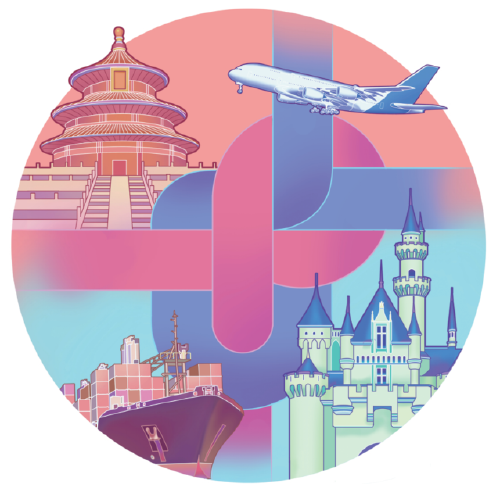
China, the United States and the European Union are the world's three major strategic powers, and their trilateral relationships are largely determining the development direction for the global landscape in the 21st century.
The three parties' relations are complicated, with their interests closely entwined. The UK political scientist Barry Buzan has noted that the relations between China, the US and the EU are a mix of friend and adversary, where competition and cooperation coexist.
In addition to the coexistence of cooperation and rivalry, there are two other prominent features of the China-US-EU triangle relations.
First, the US and the EU share common values, economic and political models, and similar goals in their long-term China strategies, thus leading to an unbalanced dynamic in the trilateral interactions. Second, the relationships among them are not static, and can be reshaped, which is particularly true of China-EU relations.
China-US-EU relations are in a period of intense collision, with China-US rivalry being the primary contradiction in the triangle of relationships. The future of China-US ties mainly depends on how the two view each other and the stability of bilateral relations. In this process, the EU is a key variable.
The EU plays multiple roles in the relationships among the three parties. It is a stakeholder and a mediator, a de facto ally of the US and a partner-cum-competitor of China.
On the one hand, both China and the US regard the EU as a crucial stakeholder and seek its support. On the other hand, the EU hopes to mediate the China-US rivalry to maximize its own interests.
As the EU shares similar values and political and economic systems with the US and relies on the US for security, the two parties are de facto allies. However, this does not mean that their respective interests concerning China are totally aligned.
As for the China-EU relations, the two parties see each other as both partners and competitors. In recent years, the bilateral relations have become more complicated, and entered a new period of adjustment, with the EU emphasizing the aspect of competition in the relationship.
The EU's multiple roles in the triangle have shaped its unique position in the triangle. The EU insists on not picking a side between China and the US, and seeks to balance and mediate their rivalry.
The EU bets on both sides to influence the China-US relations and avoid being marginalized or forced to take sides. But choosing "strategic autonomy" does not mean the EU takes a neutral position between China and the US. In fact, the EU remains closer to the US, and the challenges it has encountered within the bloc in recent years have pushed it even closer to the US.
As the US and the EU have no fundamental differences in their approach to China, the basic dynamic of the triangle is possibly evolving into the "EU and US against China".
To preserve the current global order and pursue their common interests, the US and the EU have strengthened the transatlantic coordination on China, seeking to curb China's tech and economic development through investment and export controls, interfering in China's internal affairs on the grounds of "human rights abuses", and increasing alignment in "Indo-Pacific"-related issues to counter the influence of China's Belt and Road Initiative.
During the Joe Biden administration, the EU and the US relaunched their bilateral dialogue on China, and established the Trade and Technology Council, which was designed to compete with China on trade and technology. In addition, interactions related to China among the US, the EU and NATO have also been strengthened simultaneously.
The return of Donald Trump to the White House has brought new uncertainties to China-US-EU relations. Under the "Make America Great Again" doctrine, Washington will continue to regard containing China as a foreign policy priority and make technological and economic rivalry the core of its China strategy.
Meanwhile, the upgraded "America First" and "transactionalism 2.0" will significantly disrupt the transatlantic relationship. Trump's political instinct to reshape US-EU ties coupled with the divisions his return has sown in European countries will further tilt the power balance within the transatlantic alliance toward the US, and increase the risk of Europe becoming a vassal of the US.
Other challenges to the transatlantic relations include an underlying divergence over how to deal with the Ukraine crisis, conflicting interests in several areas, and the growing mistrust in bilateral ties. In a word, the return of Trump poses a serious challenge to Europe's strategic autonomy, piling more pressure on the EU to pick a side in the China-US rivalry.
Against this backdrop, the influence of the EU "variable" on the trilateral relationships has become more prominent. The EU's increased dependence on Washington for security due to the outbreak of the Ukraine crisis, and the Trump administration's pressure on the EU to cooperate with the US on containing China will squeeze the EU's strategic space.
Some political observers have said that European countries may buy weapons from the US in exchange for the latter's security guarantee, or support the US' China policy in exchange for the US taking a pro-Europe stance in its Russia policy.
To summarize, the EU finds itself in a delicate situation in the China-US-EU trilateral relationships and under immense pressure to balance between the two powers. Europe's perception of China may fall under greater sway of the Trump administration, prompting the two parties to trade interests in coordinating their approaches to China.
But the EU should be aware that any expedient deal with the US on China offers no guarantee that the US will not harm European interests. The US and the EU are not equal partners, and Europe's concessions to the US will only deepen its reliance on the latter.
As for China and the EU, it is in their common interest to maintain their partnership, which can help mitigate the risks in their respective relations with the US and expand the space for cooperation.
China, for its part, should continue to try and build a stronger bond with Europe, while exploring the establishment of a China-US-EU trilateral interaction mechanism to push for a more stable and balanced development of their relationships.

The author is a professor at China Foreign Affairs University. The author contributed this article to China Watch, a think tank powered by China Daily.
Contact the editor at editor@chinawatch.cn.