Onus on new US president to improve ties









The ballots have been cast. The US presidential election is over. The result, for the popular vote, will be known soon. But the United States and the rest of the world will have to wait for a month or so to know the Electoral College vote result, which could decide the eventual winner.
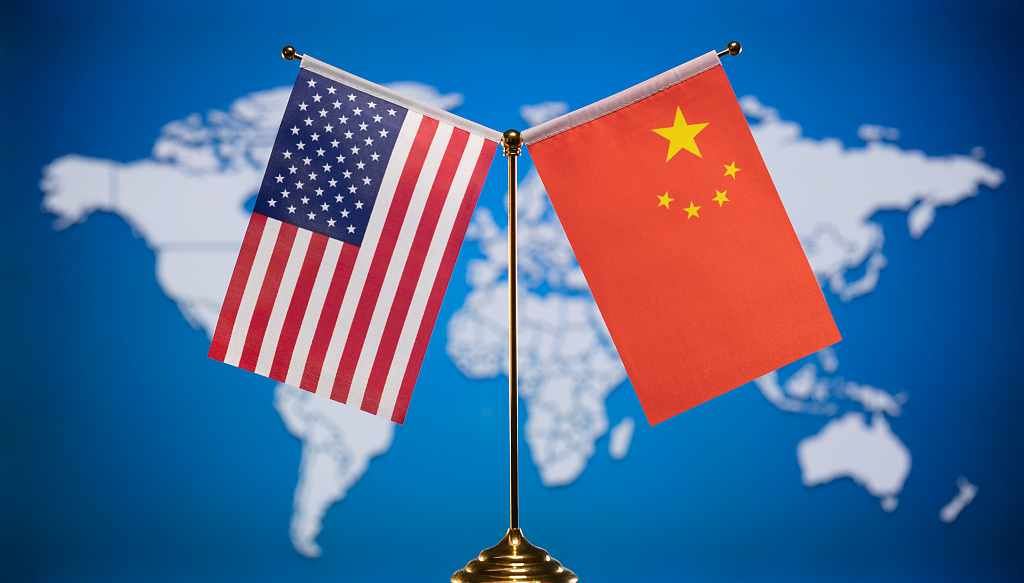
No matter who wins the election, the result will have a far-reaching impact on the world, not least because the winner will decide the US' China policy.
Both Donald Trump and Kamala Harris played the "China card" to win votes. Trump has asserted repeatedly that he would impose up to 60 percent tariffs on Chinese goods and revoke China's "most favored nation" trading status if he is elected US president for a second time. He has also vowed to further restrict US investment in and semiconductor exports to China. As for Harris, she is likely to continue the Joe Biden administration's China policy, including maintaining tariffs on Chinese imports and preventing China from obtaining key US technologies.
The deterioration in Sino-US relations in recent years has been largely caused by US hawks. The tragedy is that US voters generally do not understand or care about foreign policy; the country's elites have always formulated the foreign policy and shaped public opinion.
US politicians, strategists and special interest groups that have a negative attitude toward China provoke so-called strategic competition with China to fulfill their own narrow goals. They also take advantage of voters' disinterest in foreign policy and national security to spread the "China threat" theory, thus prompting them to develop a negative attitude toward China.
Both Democrats and Republicans make China a scapegoat for the US' domestic mess. Both try to win over the white working class, which is critical to their victory, because this group has been facing severe economic difficulties such as stagnant incomes and unemployment in recent years.
But many studies show these difficulties are mainly the result of high production costs in the US. The so-called China shock, even if it really happened, is only a very minor factor. Not to forget China, thanks to its rapid economic development, has provided a large number of high-quality, low-cost products for the US people, which have significantly improved their quality of life.
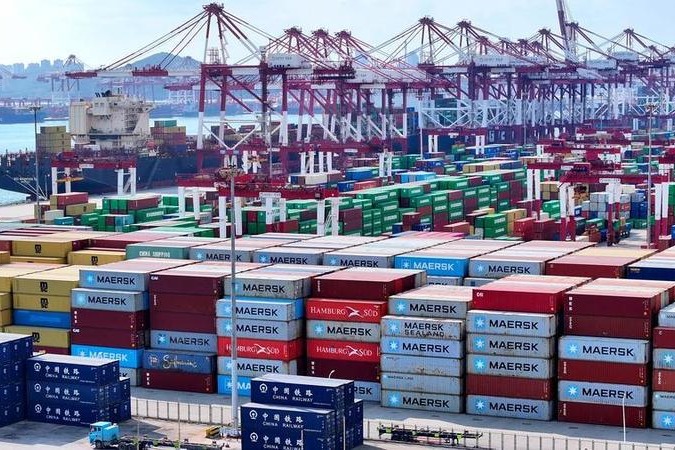
In this election, some US politicians tried to hype up the so-called overcapacity problem in China. In a bid to win over critical voters, such as autoworkers in the Midwestern states, they wrongly blamed the decline of the US auto industry on the import of Chinese-made electric vehicles.
The Biden administration has increased restrictions on the import of Chinese-made EVs, while Trump has repeatedly threatened to impose very high punitive tariffs on Chinese-made cars. But the truth is that the US imported just over 40,000 cars from China in the first half of 2024 and most of them were made by Tesla, Ford or other American automakers in China.
Instead of telling the truth, the US politicians tried to stir up anger against China among the American people to win their votes. By hyping up China's "overcapacity" problem, they tried to mislead the voters and cover up their inability to improve people's economic conditions.
Such irresponsible practices have worsened China-US relations. Those US politicians can make some personal gains, but the voters have to pay the cost of the deteriorating China-US relations. Studies show that more than 90 percent of the cost of additional tariffs on Chinese goods is borne by US consumers and businesses; the tariffs have also contributed to increasing inflation in the US.
But the US politicians' tricks are set to backfire. Most of the voters do not want the US to be involved in any global conflict after experiencing the results of the long-drawn "global war on terror". Instead, they want their leaders to use the precious resources for domestic development, including improving infrastructure, increasing people's incomes and boosting welfare.
As the competition between Washington and Beijing continues to intensify, the backlash against the US will also intensify and the US voters will have to pay an even bigger price for worsening Sino-US relations. Recently, Morgan Stanley economists estimated that an additional 60 percent tariff on imports from China will decelerate GDP growth by 1.4 percentage points over several quarters.
The Peterson Institute for International Economics has said that the additional tariffs will constrain investments in the US. Also, US exports will lose their global market shares, with US trade as a share of its GDP shrinking. The reckless competition with China will not only hurt the economy, but also exacerbate discrimination against Asian Americans and undermine democracy in the US.
In fact, many US politicians and strategists have considerable differences on the how to compete with China, meaning there is no consensus on China policy. Although the two candidates played the "China card" during the campaign, the new president will have to face a lot of harsh realities such as the high cost of competing with China, the emergence of a multipolar world and China's strong counterattack capability.
The new US administration, therefore, should give up the illusion of having a consensual China policy, and reflect on the costs of undermining Sino-US relations over the past eight years — and honestly tell the American people the truth about China.
As a responsible major country, China has always abided by the principles of peaceful coexistence and win-win cooperation, and promoted the healthy development of China-US ties. It has also always urged the US to work together to strengthen dialogue and communications, enhance mutual understanding and trust, expand areas of mutually beneficial cooperation, and jointly maintain the stability of China-US relations. Only in this way can the two sides better meet the needs of their peoples and make greater contributions to global peace and prosperity.
Fu Suixin is an associate researcher at the Institute of American Studies at the Chinese Academy of Social Sciences; and Ni Feng is director of the Institute of American Studies at the Chinese Academy of Social Sciences. The views don't necessarily reflect those of China Daily.
If you have a specific expertise, or would like to share your thought about our stories, then send us your writings at opinion@chinadaily.com.cn, and comment@chinadaily.com.cn.