It's time Washington reflected on its own problems









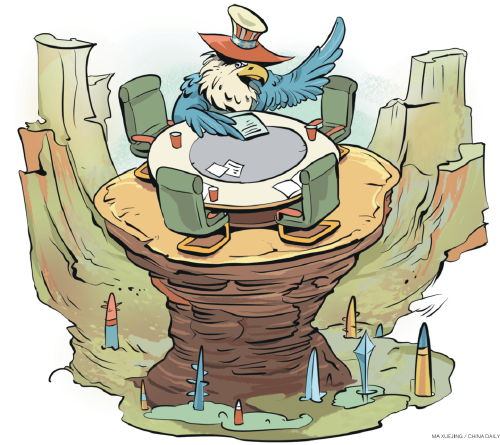
The United States is at it again. As it did in late 2021, the White House is gearing up to host the second so-called Summit for Democracy, an event that is neither a summit nor about democracy, but rather an outright attempt by the administration of US President Joe Biden to line up and indoctrinate key partners against countries it perceives as rivals.
Leaders from 110 countries and territories were invited to the 2021 event. Some, like former Brazilian President Jair Bolsonaro, who spurred the Jan 8 riots in Brazil that sought to overturn Luiz Inacio Lula da Silva's election as Brazil's president, chose to attend, while others, like the leaders of Pakistan and South Africa, declined the invitation in the face of discriminatory US policies. Still some others decided to politely accept the invitation but preferred to stay on the margins. That was the case for the leaders of 17 out of the 25 invited countries from Latin America and the Caribbean who participated but chose not to submit written commitments.
Washington is now hosting a second show. But as performative as this event may seem, it in fact comes with serious risks.
By reanimating the corpse of Cold War-era thinking that seeks to divide the world into competing blocs, events like the "Summit for Democracy" do not bring countries together; rather they set them apart.
The tragedy of this is twofold. On the one hand, it places the world on a collision course with the collective threats that no country, region, or bloc alone can face. As President Xi Jinping put it in his report to the 20th National Congress of the Communist Party of China, "the world has entered a new period of turbulence and change". We face common challenges like climate change, pandemics, and the specter of a global recession and, hence, we expect a great power like the US to responsibly promote trust and to set aside differences. Instead, we see the US doubling down on drawing ideological lines that are extinguishing any hope for dialogue.
On the other hand, this is tragic in that the "Summit for Democracy" is no more than a smokescreen for diverting public attention from the US administration's failure to address the serious challenges faced by American democracy. The Biden administration may play up alleged threats by outside actors, but the real threat to it is from within.
Recent polls conducted by Pew show that US democracy is indeed in crisis. In December 2022, 62 percent of American respondents said they were "not satisfied with the way democracy is working in their country", the third-highest figure for dissatisfaction among the 19 mostly developed countries. In another survey conducted last year, only 20 percent said that they "trust the government to do what is right just about always/most of the time", slightly above the historic low of 10 percent in 2011 but well below the average 26.4 percent of the past 20 years.
This sentiment is the reflection of years of mismanagement by American elites. The average life expectancy in the US is the lowest among G7 countries, with a significant decline over the past four years. Also, the US saw 100 mass shootings by the first week of March this year, breaking the previous record. And the FBI reported recently that hate crimes are on the rise in the US: with only 79 percent of police precincts reporting data, 2021 saw 9,065 instances of this type of crime, up 11.6 percent year-on-year, with most victims being targeted because of their ethnicity or race. These are just a few illustrative examples of the dire conditions an average American lives in.
But as grim as the outlook may seem, there is still hope. At the opening ceremony of "CPC in Dialogue with World Political Parties" Xi charted a course toward a brighter future. The Global Civilization Initiative, which Xi proposed on March 15, places openness over division, mutual learning over imposition, and dialogue over hegemony. In such a large, diverse world, no country should try to play God by attempting to shape all other countries in its image. Diversity is not a threat but an asset. History teaches us to listen to and learn from each other no matter which form of democracy we practice.
Rather than project its insecurities toward others, the US still has time to reflect on its own problems and use the "Summit for Democracy" to address them. This will be good for not only the American people, but also the people in the rest of the world.

The views don't necessarily represent those of China Daily.
If you have a specific expertise, or would like to share your thought about our stories, then send us your writings at opinion@chinadaily.com.cn, and comment@chinadaily.com.cn.