Can US interest rate hikes curb high inflation in new year?










Although the United States administration is satisfied with the state of the US economy, experts are worried about the continued strengthening of the US dollar because it has been affecting global development.
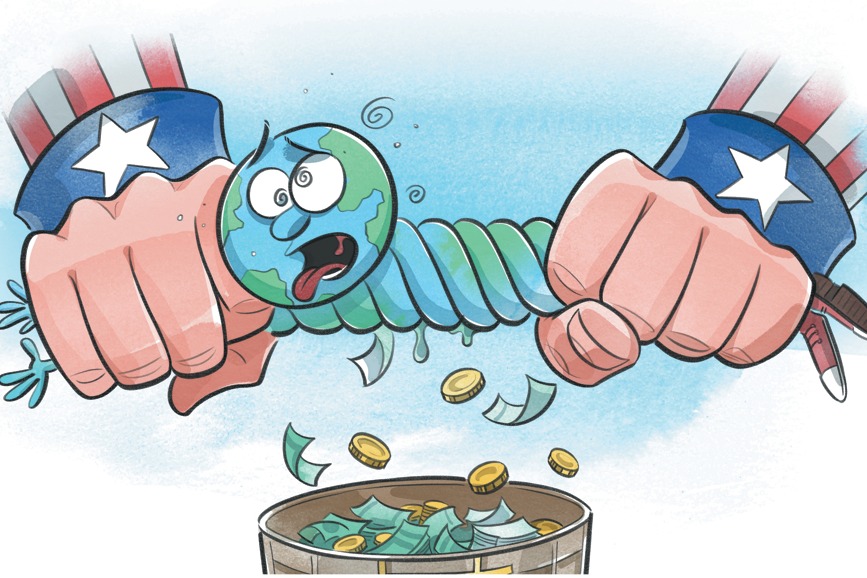
Faced with decades-high inflation, the US Federal Reserve has been aggressively raising the interest rate, which in turn is strengthening the dollar. Many central banks have been forced to follow in the Fed's footsteps to guard against rising inflation and maintain economic development.
The decades-high inflation in the US can be attributed to the imbalance in demand and supply. Due to the pandemic, general demand neither rose nor declined sharply. It remained almost at the pre-pandemic level, but general supply sharply declined.
To deal with the pandemic in the initial days, the Fed lowered interest rates for federal funds to 0-0.25 percent, and comprehensively expanded the balance sheet, while the US administration increased the issuing of currency in the name of rescue plans, such as the $2.2 trillion American Cares Act, the $900 billion Coronavirus Response and Relief Supplemental Appropriations Act, and the $1.9 trillion American Rescue Plan Act.
This helped raise general demand. But since the supply couldn't meet the demand, prices kept rising. At its highest, the US' Consumer Price Index reached 9.1 percent year-on-year in June. To deal with the high inflation, the Biden administration went from one extreme to another, from resorting to tightening fiscal policy to a series of interest rate hikes.
In 2022, the Federal Reserve has raised interest rates for seven times. And on Dec 14, the Fed's rate-setting committee hiked its benchmark rate by 0.5 percentage points, lifting its target rate into a range between 4.25 percent and 4.5 percent — the highest level in 15 years.
For the Fed, the final interest rate level is more important than the pace of its increase. And the Fed is on the way to realizing its 2 percent inflation target.
The prices of crude oil and other commodities have declined of late, and data show that the problems with supply chains have slightly eased. Yet the easing of inflation has not been to the Fed's satisfaction, mainly because the Fed's interest rate hikes and contractions have been suppressing part of the inflation caused by demand while having limited effect on inflation caused by rising costs and supply constraints.
By continuously raising the interest rate, the Fed has made the dollar stronger. On the one hand, the raising of interest rate has prompted investors to pour more and more money into the US and thus strengthen the dollar. On the other hand, the US economy's foundation is more stable than others, so investors worried about global recession are increasing their investments in the US, again making the dollar stronger.
Apart from the impacts of the pandemic, there are other reasons behind the decades-high inflation in the European Union. After the Russia-Ukraine conflict broke out, energy prices in European countries, which heavily depend on Russian oil and gas, soared, which pushed inflation up to decades-high levels. The high inflation in the US and the EU has extended to most other countries over time due to international trade.
Because of continuous interest rate hikes, concerns that the US economy is falling into recession are rising, and many market experts assume US inflation has peaked. In November, the dollar had not only weakened, but also had depreciated by 4 percent, which means the current round of dollar appreciation has almost reached its peak, and the room for subsequent surges is very limited.
The US Fed may raise the interest rate again in February 2023, after which the pace of increase will slow down. As for 2023, the benchmark interest rate may hover around 5 percent.
Finally, the interest rate will depend on the economy's performance and inflation in the US. And the long expected interest rate cuts by the Fed may not occur until 2024.
The author is deputy secretary-general of the Center for One Belt One Road of the Chinese Academy of Social Sciences.
The views don't necessarily reflect those of China Daily.
If you have a specific expertise, or would like to share your thought about our stories, then send us your writings at opinion@chinadaily.com.cn, and comment@chinadaily.com.cn.