Jockeying for position
The competition among countries for influence in Africa is becoming more complex and intense









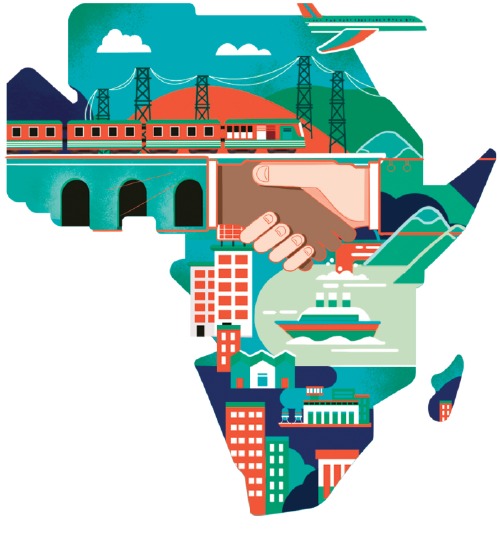
The competition among countries for influence in Africa is becoming more complex and intense
Africa has come to the fore in the diplomacy of many countries.
In recent years, the United States has been adjusting its strategy toward Africa in an all-round way, in a bid to contain China's growing influence and weaken China's "diplomatic foundation" in the region.
During the Donald Trump administration, the US launched its "new Africa strategy" and made counter-terrorism and economic cooperation the focus of US-Africa relations. It also promoted the gradual implementation of economic measures toward Africa with the support of new bills and new financial instruments. Since the Joe Biden administration took office, it has mainly used "value-oriented diplomacy" as a pretext to strengthen interaction with key African countries on issues such as trade, the anti-pandemic fight, climate change, democracy, as well as peace and security.
In 2021, Biden congratulated the African Union summit and met with the presidents of the Democratic Republic of the Congo and Kenya for the first time as the US president. In December that year, 17 African leaders were invited to participate in the so-called Summit for Democracy convened by the Biden administration, which obviously revealed its strategic intention to compete for influence in Africa. In August 2022, US Secretary of State Antony Blinken visited Africa for the second time after his first visit in November 2021 and announced the US' new strategy toward sub-Saharan Africa. The strategy aims to suppress the "threats" of China and Russia in Africa, and intends to elevate African nations' status from "shithole countries" in the Trump era to important partners related to the national security interests of the US.
In terms of economy and trade, the US has mainly adopted the Better Utilization of Investment Leading Development Act, or BUILD Act, Prosper Africa, the Prosper Africa Build Together Campaign and other bills, as well as the Partnership for Global Infrastructure and Investment and a new digital transformation initiative jointly launched by the US and the European Union. At the same time, the US has also increased support for its enterprises to invest in African agricultural development, healthcare, energy and minerals, commodity supply chains, and more.
In 2020, the EU released its strategy toward Africa, outlining the focus and direction for its relations with African countries in the future. At the sixth EU-AU summit held in February 2022, the EU promised to invest 150 billion euros ($150.15 billion) in Africa in the next six years to help develop a more diversified, inclusive, sustainable and resilient economy by promoting public and private investment in multiple key fields, such as infrastructure, digitization, energy and green transformation, sustainable growth and employment creation, public health and education.
In order to obtain Africa's resources and markets and realize its dream of "permanent membership of the UN Security Council "with the support of African countries, Japan has never been absent from the strategic competition among major powers in Africa. Since 2013, Japan has been holding the Tokyo International Conference on African Development alternately in Japan and Africa every three years, following the example of the Forum on China-Africa Cooperation. The Yokohama declaration issued at the seventh TICAD in 2019 proposed "investment in quality infrastructure" that ensures debt sustainability, revealing Japan's intention to wrestle with China in Africa. At the end of August 2022, China was targeted in the Tunis declaration and the speech by Japanese Prime Minister Fumio Kishida at the eighth TICAD Conference held in Tunisia.
Africa is also a "stage" for Russia's geostrategic interests. Following the first Russia-Africa Summit in 2019, Russia has deepened its cooperation with African countries in accordance with the established agenda for the comprehensive development of its partnership with Africa, and military cooperation between the two sides has been fruitful. After the outbreak of the conflict between Russia and Ukraine, Russian Foreign Minister Sergey Lavrov visited four African countries to counter the sanctions imposed by the West. He made it clear that Russia regards developing comprehensive partnerships with African countries as an important priority and he promised Russia would meet the orders of African food buyers.
India has made Africa a priority of its diplomacy. It responded quickly to the needs of African countries in their fight against the novel coronavirus and initiated anti-virus assistance to Africa. It has also strengthened economic, trade and defense cooperation with African countries. Although the India-Africa Summit planned to be held in September 2020 was postponed due to the COVID-19 pandemic, India held an economic forum with Africa via video links in November that year to stabilize its development of economic tries.
Turkiye, which straddles Eurasia, is also ambitious in Africa. Turkish President Recep Erdogan has visited Africa more than any other incumbent head of state. The Turkiye-Africa cooperation mechanism has also continued to advance despite the pandemic. In December 2021, Turkiye hosted the third Turkiye-Africa Partnership Summit. The two sides will expand their cooperation in more fields to improve Africa's infrastructure, maintain its peace and security, and further consolidate their partnership.
In addition, the Republic of Korea and Gulf states have also attached more importance to Africa and increased their investment in African resources, markets and production bases, making the competition among countries in the continent more complicated.
It is easy for big nations to compete in Africa, but the biggest challenge facing the world's major powers is how to benefit Africa with joint efforts. Therefore, China should continue to expand international cooperation with Africa through "China-Africa +third countries" and "China-Africa + international multilateral organizations" strategies based on the wills and needs of African countries. Such cooperation allows the parties involved to learn from each other's advantages and experiences in the African market in project cooperation, find a balance among the interests of various parties, and build Africa into a grand stage for global cooperation.
The author is a researcher and director of the Center for South African Studies at the China-Africa Institute of the Chinese Academy of Social Sciences. The author contributed this article to China Watch, a think tank powered by China Daily.
The views do not necessarily reflect those of China Daily.
Contact the editor at editor@chinawatch.cn