US makes vain attempt to win trade war









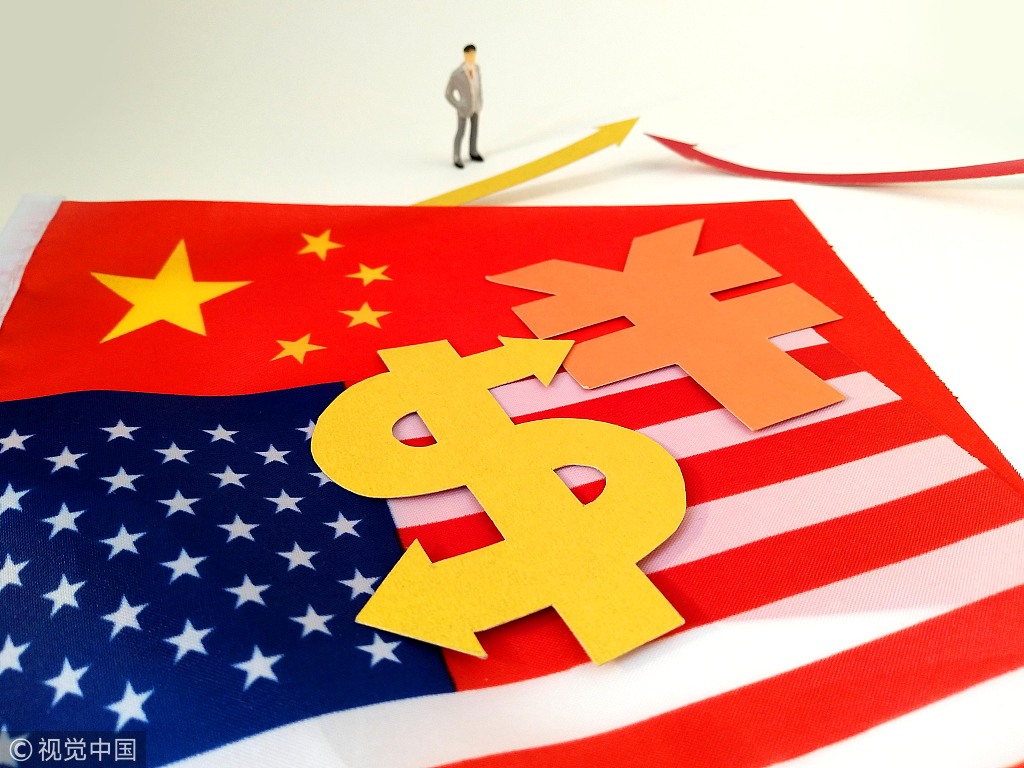
The day after the 12th round of Sino-US trade talks concluded on July 31 in Shanghai, the United States administration announced it would impose 10 percent tariffs on another $300 billion of Chinese goods starting Sept 1, ignoring the fact that the two sides had called the talks "constructive" and agreed to hold the next round of talks in Washington. Not content with that, the US administration later labeled China a "currency manipulator" to put "maximum pressure" on China in order to achieve its selfish, narrow goals.
To begin with, judging by the three standards the US Trade Facilitation and Trade Enforcement Act of 2015 sets to define a "currency manipulator", China is certainly not one. Changes in the yuan's exchange rate are normal fluctuations due to changing market expectations. The White House's unilateral and protectionist moves, including arbitrarily imposing additional tariffs on Chinese goods, have lowered market expectations. And the yuan weakened beyond 7 per US dollar in response to the market's reaction to the US' unilateral moves. As such, the US has no right to label China a "currency manipulator".
Second, since the 1997 Asian financial crisis, China, as a responsible major power, has endeavored to keep the yuan's exchange rate stable, that is, within a reasonable range. Neither during the Asian financial crisis nor during the 2008 global financial crisis did China manipulate its currency to sustain, let alone, boost the economy.
In fact, the yuan is one of the strongest major international currencies, and immediately after the US' unreasonable accusations, the People's Bank of China, the country's central bank, issued a statement saying China will maintain the yuan's exchange rate within a reasonable range.
The "maximum pressure" the US is trying to put on China by labeling it a "currency manipulator" goes against the consensus the two countries' leaders reached on the sidelines of the G20 Summit in Osaka in late June as well as the market expectations that the two sides would continue the trade talks to resolve their disputes.
Given the uncertainties of Sino-US relations, China should focus on its own development, by capitalizing on its steady economic growth, sound infrastructure, advanced internet technology and ever-growing international influence, especially because it has the strength and the confidence to compete and/or cooperate with the US.
For China, the most important thing in the bilateral negotiation is mutual respect and balance of interests. So China should deepen reform and opening-up in an all-round way while seeking solutions to nutty bilateral problems. Which will enable the US as well as the rest of the world to see China's inclusive and open attitude, and realize the US' unilateral and protectionist moves are detrimental to globalization.
And since the Sino-US trade negotiations cannot be completed overnight, both parties should strengthen communication, in order to gradually settle their trade conflicts.
From trade deficit and talent competition to disputes over technology and exchange rate, frictions between China and the US have increased, with bilateral relations becoming increasingly complicated. So while preparing for an all-round competition with the US, China should continue making efforts to resolve the bilateral disputes through peaceful negotiations.
Although the US administration has listed China as a competitor and the two countries could be competing with each other in the long run, trade and economic exchanges between the two sides are still very expansive.
According to the State Council Information Office's white paper on China's stance on Sino-US trade consultation on June 2, US companies' total sales in China in 2017 was about $700 billion, with their profits exceeding $50 billion. And the US-China Business Council's 2019 State Export Report said that from 2009 to 2018, US exports to China helped create more than 1.1 million jobs.
The trade disputes between China and the US would harm both sides considering that their economies are highly interdependent. So the two countries should adopt more inclusive and open stances aimed at stabilizing Sino-US ties and strike the right balance between cooperation and economic interests, in order to help the Sino-US trade talks reach an agreement acceptable to both sides.
The author is president of the Center for China and Globalization. The views do not necessarily reflect those of China Daily.