



US’ aggressive stance stuck in the past









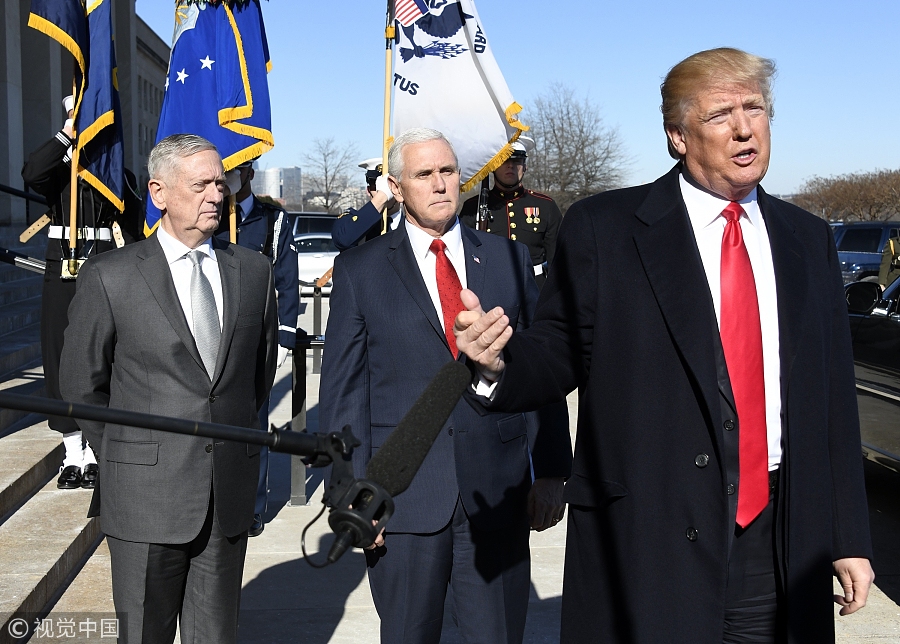
Last week’s release of the US National Defense Strategy could not have been better timed.
The strategy, as outlined in an unclassified summary released by the Department of Defense, has shifted the country’s priorities under the presidency of Donald Trump. The first such report published by the Trump administration, it asserts “l(fā)ong-term strategic competitions with China and Russia are the principal priorities for the Department,” a marked change from previous reports which named non-state entities like terrorist groups as primary threats.
I mention the timing because this change in policy comes after and during a period fraught with chaos in the United States. With domestic strife tearing the country apart and a government determined to renege on one international deal after another, it’s a little odd to see the US point the finger at other countries at a time when it can’t keep its own house in order. Given the circumstances, this change in strategy looks like a desperate measure, a wild stab at relevancy from an empire in decline.
Even the term the Defense Department chooses to describe China and Russia, “revisionist powers” with an “authoritarian model”, frames this supposed competition with an assumption the US’ dominance over world affairs is an indisputable force for good. Merely by standing up for themselves, the theory goes, China and Russia are “revising” the status quo and thus represent a threat.
This is the kind of position someone can only take if they are ignorant of the facts. Perhaps we could ask the people of Iraq or Afghanistan who they see as the greater threat — the country that invaded them, or the ones who stayed neutral? I imagine you’d get a similar answer from people in huge swathes of Africa, Southeast Asia and South America, where the United States has put its nose where it doesn’t belong and kept it there. Countless military invasions and destabilization campaigns have made clear to many in the developing world who really constitutes a threat.
Indeed, if anyone is responsible for heightening tensions and pushing an aggressive Cold War foreign policy, it is the United States, not China or Russia. The pattern is as follows: through the North Atlantic Treaty Organization, the US is able to exert its will under the guise of “international consensus” — a consensus which conveniently leaves out two permanent members of the United Nations Security Council — and encircle countries who dare take their own path. In another twist of irony, these accusations of threatening gestures from China and Russia come after decades of maintaining bases in 74 countries, concentrated mostly — where else? — near the Chinese and Russian borders.
China has no desire to tangle with the United States, neither economically nor militarily. But it will not sit idly by while a supposed partner takes a belligerent stance abroad to cover for an inability to govern at home.
This paradox was emphasized in the week following the Defense Department’s report, as the federal government was forced to shut down over an impasse which failed to fund the national budget for four days. A deal was reached, but only to reopen the government for three weeks before going through the whole ridiculous exercise again.
The cause of the logjam? A widely popular immigration measure which, if not passed, would mean the deportation of thousands of migrants who entered the country as minors. These “Dreamers” willingly gave their information to the government, in full faith the US would hold up its end of the bargain and defer action on their files. Instead, Immigration and Customs Enforcement agents are on standby to round them up, separating them from family and friends for an indefinite period of time. Many beneficiaries of the policy came over as infants or young children, and their adopted country is the only home they know. Yet due to the political chaos in Washington, they may soon find themselves forcefully relocated to a completely foreign land. And the US has the gall to call other countries “authoritarian”.
Downplaying the danger of terrorism is especially strange in light of the events of last year. Though extremist group Daesh’s influence has waned after successful campaigns in Iraq and Syria, 2017 saw the deadliest mass shooting in US history — 59 dead, an act of terrorism if there ever was one. Meanwhile the number of US civilians killed by China or Russia last year is holding steady at “zero”. The report does mention terror attacks, but as a secondary concern compared to state actors. This doesn’t line up with reality.
Ultimately, this ratcheting up of paranoia and distrust by the United States comes down to one central fear: Losing its status as hegemon. The report says so itself, admitting “the United States has [for decades] enjoyed uncontested or dominant superiority in every operating domain.” Rather than thinking on these changes and considering them a new opportunity for cooperation and peaceful coexistence, the US government appears to have decided the way of the future is saber-rattling and confrontation. With a $25 billion increase in defense spending last year — despite already having a military budget greater than the next seven countries combined — its path seems all but set in stone.
Why so combative? Why the commitment to divisiveness and global anxiety? I have a theory, sad but true: The US believes when, or if, it is no longer the earth’s uncontested military authority it will be treated the same way it treated everyone else.
China has done its best to show the US and the international community this is not so, that the path forward can be a different one. It must, even with these recent provocations, continue this path. In doing so China can prove to the world it is willing to walk the walk as well as talk the talk of peace. Some might continue to doubt or distrust. But if the US keeps up its policies of aggravation, the differences will become impossible to ignore — and the zero-sum game of the past will wind up in the dustbin of history where it belongs.
The author is a copy editor with chinadaily.com.cn.
The opinions expressed here are those of the writer and do not represent the views of China Daily and China Daily website.








