



Reforms key to a healthy agrifood sector









Editor's note: The Communist Party of China will hold its 19th National Congress on Oct 18. In the runup to the meeting, China Daily asked two prominent experts to provide their views on developments in China and the country's global leadership.
There are major emerging challenges facing China's agrifood sector.
For instance, the gap between low global prices and high domestic prices for certain commodities is widening. The minimum prices set by the government for rice and wheat rose between 2008 and 2014, despite international grain prices falling.
The domestic price of corn is also nearly double the price in the United States, leading to the expansion of corn production and potentially discouraging farmers from rotating crops, which is a risk to soil fertility.
Further, high domestic prices and production have resulted in large government stockpiles of corn and other grains - grain reserves in 2014 and 2015 were 46 percent of domestic consumption. The problems in the agrifood system have contributed to an imbalance, with millions of people undernourished while at the same time overnutrition is on the rise.
It's estimated that overweight and obese people made up 34 percent of China's population in 2014. Obesity is a main driver of noncommunicable diseases, including diabetes, which grew in prevalence from less than 1 percent in 1980 to 11 percent in 2013. As incomes continue to rise, diets now contain more meat, sugar, salt, fat and oil, refined grain, and processed foods.
Despite enormous efforts by the government, food safety concerns are also on the rise.
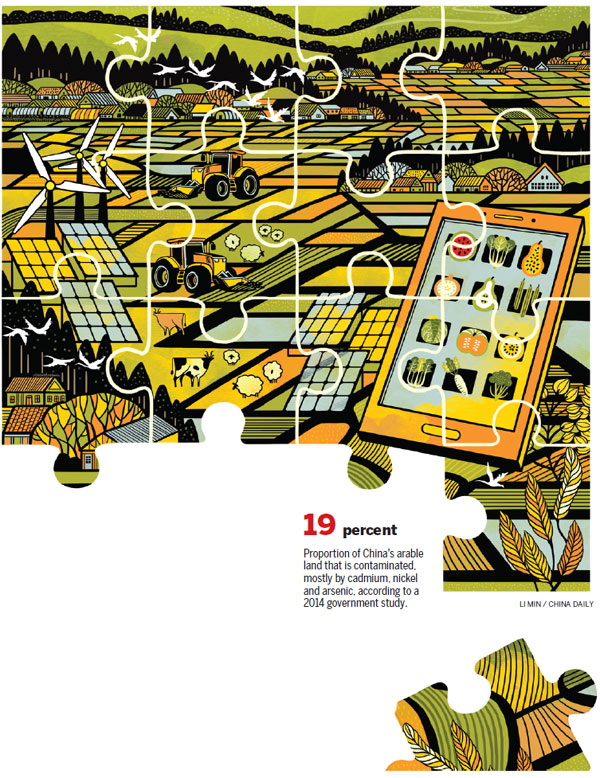
The intensification of agriculture threatens human health, starting with the health of the soil. A 2014 government study indicated that about 19 percent of China's arable land is contaminated, mostly by cadmium, nickel and arsenic.
The increasingly complex and long food value chains also have greater potential to introduce pathogens and spread agriculture-related diseases.
As urbanization continues, larger quantities of food are transported across longer distances to reach urban centers, increasing the risk of contamination.
The agricultural industry's push to produce more food has increased the pressure on the scarce farmland and natural resources. About 40 percent of arable land is degraded, in part due to overuse of subsidized fertilizers, while agriculture accounts for 65 percent of the country's water consumption.
At the same time, agricultural activities are vulnerable to the effects of climate change, including rising temperatures and extreme weather events, which affect crop yields, prices and trade flows.
China's agricultural support is driven partly by reducing rural-urban inequality. Yet despite overall growth in per capita incomes, inequality has risen, as the wealthier segments of society experience faster wage growth than the poor. Urban-rural income inequality is particularly notable, with the income ratio remaining above 3-to-1 in recent years.
To address these challenges and provide sustainable, safe and nutritious food, supply-side reforms are critical.
First, reforms need to focus on fixing the fundamentals of the agrifood system. Institutional reforms for a more efficient food-production system are essential.
Considering the dominance of smallholders (those with less than 2 hectares of land) in the farming sector, they should be supported to either move up to produce more nutritious and profitable foods, or move out to nonfarm employment.
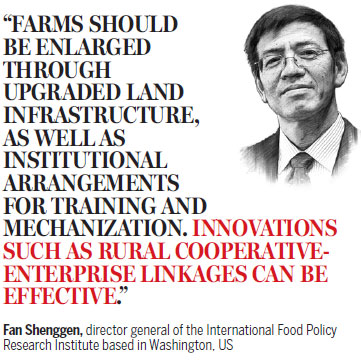
Considering recent evidence of a positive relationship between land yield and farm size, farms should be enlarged through upgraded land infrastructure, as well as institutional arrangements for training and mechanization.
Innovations such as rural cooperative-enterprise linkages can be effective.
Efficient and well-functioning land rental and sales markets will also be important for efficient food production, as is a solid legal framework for resource allocation, which has been shown to promote more efficient use of water and land.
China should also promote mutually beneficial trade and engage in more integrated international trade channels, with the focus on producing high-value agricultural goods, such as fruits and vegetables, and importing more land-and water-intensive products, such as cereals and vegetable oils.
Enhanced support for farmers to better access market information, training and financial services, while shifting away from harmful, distorting trade policies, will be key. Increased technology transfer, technical assistance and investments through South-South cooperation can help fill the gaps.
Second, policy innovations should be promoted. Climatesmart and resource-efficient investments, especially the cultivation of high-yielding, climate-ready, high-nutrient crop varieties through biofortification, as well as precision agriculture, are areas with great potential.
Policy innovations to support the production and consumption of more healthy and nutritious foods will also be important.
Reforming subsidies for agricultural inputs such as fertilizers and for staple crops will be critical, as the funds can be converted to support the production of fruit and vegetables and other more nutritious foods. Taxes placed on unhealthy foods can also be directed to subsidize the production of nutrient-rich foods.
Better-targeted social protection policies should also be promoted to provide more long-term autonomy in addition to short-term well-being, such as increasing the depth and width of protection in health, education and employment for vulnerable groups, especially elderly rural residents and migrants workers, as well as improving the living conditions in rural areas. Taking into account China's labor mobility, improving the portability of benefits and access to social protection resources will also be important.
Third, efficient and inclusive value chains should be supported, with improved legal, regulatory and institutional frameworks. Technological innovations, especially in information and communication and e-commerce, can support inclusive and safe value chains by connecting smallholders to urban markets. Reducing food loss and waste along the food value chain by ensuring that food prices reflect the true cost of inputs and natural resources will also contribute to the efficiency of the food system.
Agrifood systems will continue to play a major role in China's sustainable growth in the coming decades. With rapid changes in the global landscape and emerging climate challenges, the nation's supply-side reforms will be critical to ensuring sustainable, healthy and nutritious food systems.


- Hundreds of swans arrive at Hebei's Huangtai Lake for spring
- Dr. PAI platform launches to provide 24/7 personalized hypertension care
- Former Hubei Party chief charged with bribery
- Chinese scientists uncover drivers of divergent climate changes across Asia
- Former senior Chinese legislator indicted for taking bribes
- Latest Beauty of Tianjin video showcases city's urban spaces, aesthetic





