SCO boosts security, promotes prosperity









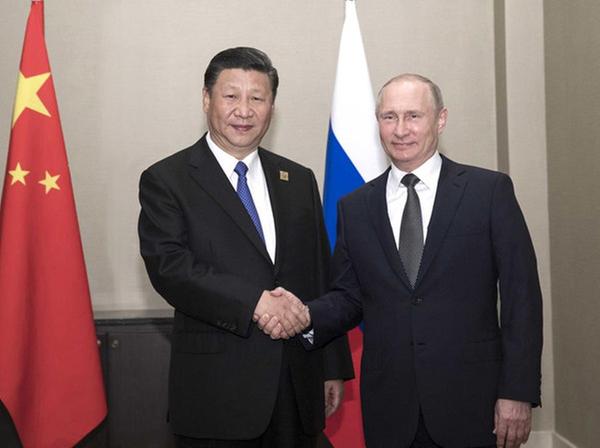 |
| Chinese President Xi Jinping shakes hands with Russian President Vladimir Putin during their meeting as part of the Shanghai Cooperation Organization (SCO) summit in Astana, Kazakhstan, June 8, 2017. [Photo/Xinhua] |
Over the past two decades, China has deemed Kazakhstan as one of its pivotal partners. In its neighborhood, China has maintained the most stable and constructive relations with Central Asia, building cordial and cooperative partnerships with all the countries in the region. To further this cause, China and Russia helped form the SCO as a pan-Central Asia security organization in which Kazakhstan plays a key role.
Kazakhstan is a regional heavyweight not only because of its size, but also as a major shaper of pan-Asian security. Kazakh President Nursultan Nazarbayev proposed at the United Nations in 1992 the idea of a "Conference on Interaction and Confidence-Building Measures in Asia (CICA)". He conceived it as an Asia-wide security and confidence-building framework, laying the foundation for the present CICA process.
After the disintegration of the Soviet Union and founding of Kazakhstan, Astana has envisioned a pan-Asian peace and security institution, which has been welcomed by Beijing and Moscow. China, in return, has accorded Kazakhstan a pivotal status in its foreign policy toward Eurasia. And Xi's three visits to Kazakhstan in four years show the importance China attaches to its crucial neighbor.
Over the past 25 years, China and Kazakhstan have forged robust ties to promote common goods. Under the SCO framework, Beijing and Astana have jointly combated terrorism, extremism and radicalism. Of late, the China-Kazakhstan partnership has extended to the economic and energy sectors. China's aggregate investment in Kazakhstan is about $42.8 billion, making the Central Asian country the top destination of Chinese capital along the Silk Road Economic Belt. In addition, China has offered Kazakhstan loans of more than $50 billion to help propel its economic development.
The progress of the 51 Sino-Kazakh projects in energy collaboration has brought benefits to both countries. With help from China's financial and technical resources, Kazakhstan has expedited its economic modernization drive and raised the living standards of its people. In return, China has got access to the energy resources that are crucial to its supply-side structural reform. Given China's determination to honor the Paris climate change agreement despite US President Donald Trump withdrawing the United States from the pact, Beijing is more dependent upon the energy supply from Kazakhstan to build a green future.
Over the years, China and Kazakhstan have viewed each other as pivot countries. In partnership, they are using the SCO to make Central Asian countries more secure and prosperous. At the Astana summit, the SCO inducted India and Pakistan as new member states, which means the bloc will now cover South Asia. Given the importance of India and Pakistan in the regional and global fight against terrorism, the SCO is now in position to more effectively combat the common threats of terrorism, extremism and radicalism.
China and Russia played critical roles in bringing India and Pakistan to the SCO, while Kazakhstan played the role of host country to expand the organization. To some extent, this is to fulfill the mission of CICA, so as to expand cooperative security to large parts of Asia, thanks to the efforts of Kazakhstan and other SCO member states.
The mission and attraction of the SCO have prompted India and Pakistan to join the bloc, in order to take forward the common mission of security and prosperity, while making their contributions according to their capacities. Such a quest for widened and enhanced collaboration could be better served by the introduction of Belt and Road Initiative, which facilitates infrastructure connectivity and helps building mutual trust among countries, and is thus committed to promoting Asia's integration.
The author is a professor at and associate dean of the Institute of International Studies, Fudan University, Shanghai.