Japan can't buy pride by fabricating its history of war crimes









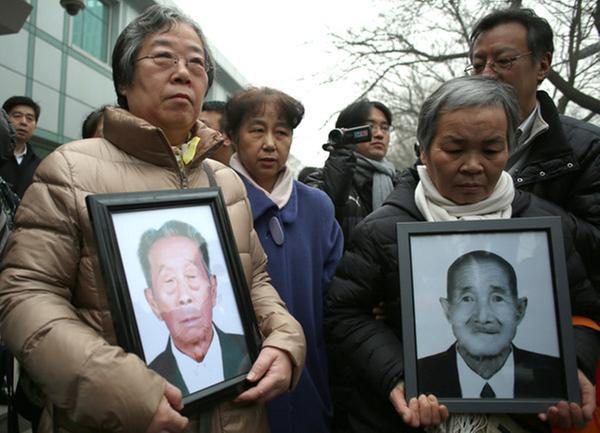 |
| Relatives of deceased Chinese forced laborers, accompanied by lawyer Kang Jian (center, in blue coat), attend Beijing No 1 Intermediate People's Court on Feb 26, 2014, to sue two Japanese companies over forced labor during World War II. The lawsuit seeks printed apologies to be carried in Chinese and Japanese newspapers as well as compensation from the Japanese companies. WANG JING / CHINA DAILY |
His previous book, The Real History of Japan: Theoretical Modern History II, says the Nanjing Massacre is "fabricated" history. Motoya's books, along with other right-wing literature, are provided for free in the rooms of APA's 400-plus hotels in Japan, which infuriated Chinese people, especially those visiting Japan, early this year. In protest, China and the Republic of Korea pulled their athletes out of the APA hotels during the Asian Winter Games in Hokkaido in February.
On Friday, Motoya said he would not remove his books from the group's hotels when Tokyo hosts the Olympic Games in 2020. Such historical revisionism shows how rightwing forces eager to whitewash Japan's war crimes are becoming emboldened with the tacit help of hawkish Japanese Prime Minister Shinzo Abe.
Neither has the Japanese government nor the country's media and public condemned Motoya's books. In fact, the conservative newspaper Sankei Shimbun praised the Abe administration for "neither pressuring APA nor urging self-restraint".
During World War II, Japan and Germany were the aggressors and part of the Axis. In 1945 they shared defeat and occupation. But the two countries have dealt with their war history very differently. Nazi symbols and sympathizers trigger crackdowns in Germany. As recently as last year, an 87-year-old German woman was sentenced to 10 months in prison for denying the Holocaust.
Germany has potent anti-Nazi laws. German counterintelligence officers are investigating 280 cases of pro-Nazi personnel in the armed forces, according to German public broadcaster Deutsche Welle. And 18 members of the German armed forces were dismissed for their extremist views between 2012 and 2016.
In his book, Germany: Memories of a Nation, Neil MacGregor, British historian and former director of the British Museum, says that for all of us some memories are so painful, so shameful, that we will suppress them, and the act of recovering those leads to disorientation and distress.
"Many of the huge questions surrounding the Holocaust, and the role in it of so many Germans as perpetrators, went until the 1990s not just unanswered, but unasked. It gives a very sharp edge to the decision by the German government over the last decades to force remembering by researching archives, by introducing vigorous programs of public education, and by the building of monuments like the Holocaust Memorial," MacGregor says. "In this also can be said that German monuments are not like those in other lands," he adds. "I know of no other country in the world that at the heart of its national capital erects monuments to its own shame."
In contrast, every year on Aug 15-the anniversary of Japan's surrender in World War II in 1945-right-wingers are free to march in Imperial Japanese Army uniforms at Yasukuni Shrine, where a museum presents the revisionist depiction of Japan's "Pacific war" with its narrative of liberating Asian peoples from Western colonialism and downplays Japanese aggression and war crimes. The shrine also honors 14 Class-A Japanese war criminals.
Chinese research shows more than 300,000 Chinese people were butchered in Nanjing in a six-week spree of killing, rape and destruction by the Japanese army that began in December 1937. And scholars across the world have no doubt the heinous war crimes were committed by the Japanese troops.
Motoya's attempt to deny the Nanjing Massacre is thus an affront to not only the survivors of the massacre but also people at large.
Germany's approach toward its Nazi past has earned it the admiration of countries around the world. And by fabricating his country's war history, Motoya can't build Japan's pride.
The author is China Daily Tokyo bureau chief.