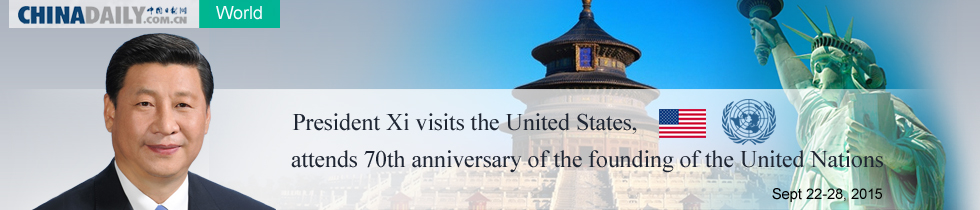
With President Xi Jinping continuing the visit to the United States, we have been reading daily about the difficult and contentious issues that may arise in the important meeting between President Obama and President Xi. These issues are important, as the relationship between the United States and China has never been more critical, whether in economics or global security.
It may be easy to overlook in those circumstances the very positive aspects of the US-China relationship. I took my first trip to China as a newly minted law school graduate almost exactly 35 years ago. China has changed remarkably during that time, and the US-China relationship has evolved along with those changes.
One of the growing bright spots in the US-China relationship has been in the realm of higher education.
This relationship was very much on display this past June, when Rice University co-hosted with Peking University a US-China roundtable of university presidents on Rice's campus in Houston. Convened by Vice-Premier Liu Yandong and sponsored by the China Scholarship Council, the roundtable drew more than 50 presidents from top tier research-intensive universities in both the US and China.
The connections between these two groups of universities run deep. Many of the presidents from the US and China already knew each other well, and had visited each other's campuses. Their faculty members have participated in joint research projects. Several of the US universities have constructed or are planning campuses or other physical presence in China. Working together, top scientists from these universities, often with graduate students and other researchers participating in research projects in both countries, are advancing fundamental knowledge and addressing global issues.
But this is not just a matter of institutional relationships and common projects; it is about individuals. Last year there were five times as many students from China in the United States as there were in 2000, and today nearly a third of the international students in the US are from China. And China is an ever more popular destination for US students. In 1999, China hosted less than one of every 50 US students studying abroad, and was not among the top ten destinations. Today, China hosts one in 20 US students studying abroad, and is the only destination among the top five not in Europe.
These exchanges are much more than enriching experiences for the individual students. They are building the bridges of the future between our two countries. In the next decades, an ever greater percentage of Chinese leaders will have studied in the United States at some point, and the same will be true of US leaders having studied in China. The growth in Chinese students has been especially rapid at the undergraduate level, with over 100,000 students today, well over 10 times the number a decade ago. These are students who will gain a deep understanding of the United States. The inauguration of the Schwarzman Scholars program at Tsinghua, modeled on the wildly successful Rhodes scholars program in England, will bring some of the United States' most promising college graduates to an immersive experience in China. That will have a lifelong impact.
None of this is to say there aren't problems. Leaders of US institutions at the roundtable expressed deep concern about a proposed new Chinese law on non-profits that would appear to intrusively regulate the activities of universities in China and the relationships they build. Leaders of Chinese universities commented on the difficulties they so frequently face in getting timely visas for their travel; indeed, several presidents of major Chinese universities were unable to attend the US-China Roundtable because they couldn't secure a visa in time. Issues of intellectual property protection have arisen in the context of research relationships, as they do in others.
As deep and robust as this relationship is, there is potential for so much more. If we are to make progress, we must both break down barriers, and find more ways to support joint projects that will lead to discoveries that will benefit all mankind. Rarely, if ever, have two countries had such capacity to contribute to solving problems and building bridges between peoples. I hope President Obama and President Xi will put the continued building of academic relationships - both teaching and research - high on their agenda.
The author is president of Rice University in Houston.
(China Daily 09/28/2015 page11)
Copyright 1995 - . All rights reserved. The content (including but not limited to text, photo, multimedia information, etc) published in this site belongs to China Daily Information Co (CDIC). Without written authorization from CDIC, such content shall not be republished or used in any form. Note: Browsers with 1024*768 or higher resolution are suggested for this site.
License for publishing multimedia online 0108263 Registration Number: 130349 


