June 12
[ 2007-06-12 08:00 ]
 |
| The judge rejected
charges of bribery |
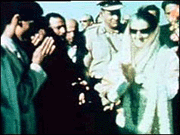
| 1975: Indira Gandhi found guilty of
corruption |
England have
Indian Prime Minister Indira Gandhi has been barred from holding office
for six years after she was found guilty of electoral corruption.
But Mrs Gandhi rejected calls to resign and announced plans to appeal
to the Supreme Court.
The verdict was delivered by Mr Justice Sinha at Allahabad High Court.
It came almost four years after the case was brought by Raj Narain, the
premier's defeated opponent in the 1971 parliamentary election.
Mrs Gandhi, who gave evidence in her defence during the trial, was
found guilty of dishonest election practices, excessive election
expenditure, and of using government machinery and officials for party
purposes.
The judge rejected more serious charges of bribery against her.
"The leadership of Mrs Gandhi is indispensable ."said in a Party
statement.
Mrs Gandhi insisted the conviction did not undermine her
position, despite having been unseated from the lower house of
parliament, Lok Sabha, by order of the High Court.
She said: "There is a lot of talk about our government not being clean,
but from our experience the situation was very much worse when
[opposition] parties were forming governments".
And she dismissed criticism of the way her Congress Party raised
election campaign money, saying all parties used the same methods.
The prime minister has retained the support of her party, which issued
a statement backing her.
"The leadership of Mrs Gandhi is indispensable," the statement read.
After news of the verdict spread, hundreds of supporters demonstrated
outside her house, pledging their loyalty.
Indian High Commissioner BK Nehru said Mrs Gandhi's conviction would
not harm her political career.
"Mrs Gandhi has still today overwhelming support in the country," he
said.
"I believe the prime minister of India will continue in office until
the electorate of India decides otherwise". |
|
|
|
 |
| Nelson Mandela: "I do
not deny I planned sabotage" |
|
1964: Nelson Mandela jailed for
life | Artificially 1969:
The The leader of
the anti-apartheid struggle in South Africa, Nelson Mandela, has been
jailed for life for sabotage.
Seven other defendants, including the former secretary-general of
the banned African National Congress (ANC), Walter Sisulu, were also given
life prison sentences.
Crowds gathered silently outside the court building in Pretoria's
Church Square waiting for the verdict to be handed down. Hundreds of
police patrolled the area.
The Rivonia trial - named after the suburb of Johannesburg where the
defendants were arrested - began eight months ago, with Mandela, 46, and
his co-defendants proudly confessing their guilt to plotting to destroy
the South African state by sabotage.
As members of the ANC - the main African nationalist movement - they
have campaigned for an end to the oppression of black South Africans.
But the movement was banned in 1960 following the Sharpeville massacre
and campaigners decided they had no choice but to resort to violent means.
Struggle for equal rights
Mandela - a lawyer by training - told the court earlier: "I do not deny
that I planned sabotage. I did not plan it in a spirit of recklessness nor
because I have any love of violence. I planned it as a result of a calm
and sober assessment of the political situation that had arisen after many
years of tyranny, exploitation and oppression of my people by the whites."
His co-accused included: Walter Sisulu, Dennis Goldberg, Govan Mbeki,
Raymond Mhlaba, Elias Mosoaledi, Andrew Alangeni - all ANC officials and
Ahmed Kathrada, the former leader of the Indian National Congress.
Lawyer for the defendants, Harold Hansen QC said: "These accused
represent the struggle of their people for equal rights. Their views
represent the struggle of the African people for the attainment of equal
rights for all races in this country."
But the judge, President Quartus de Wet, said he was not convinced by
their claim to have been motivated by a desire to alleviate the grievances
of the African people in this country.
Judge de Wet said: "People who organise revolution usually plan to take
over the government as well through personal ambition."
However, he stopped short of the imposing the supreme penalty of death.
The convicted men were cheered as they left court in a police lorry.
The crowd was dispersed without any serious incident. |
|
| Vocabulary:
|
| |
|
unseat: to remove from
office(免去席位)
sabotage: deliberate
destruction(蓄意破壞)
|
|


