June 7
[ 2007-06-07 08:00 ]
June 7, 1942: Battle of
Midway ends
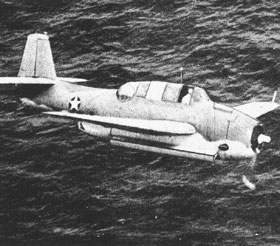 On June 7, 1942, the Battle of Midway--one of the most decisive U.S.
victories in its war against Japan--comes to an end. In the four-day sea and air
battle, the outnumbered U.S. Pacific Fleet succeeded in destroying four Japanese
aircraft carriers with the loss of only one of its own, the Yorktown, thus
reversing the tide against the previously invincible Japanese navy. On June 7, 1942, the Battle of Midway--one of the most decisive U.S.
victories in its war against Japan--comes to an end. In the four-day sea and air
battle, the outnumbered U.S. Pacific Fleet succeeded in destroying four Japanese
aircraft carriers with the loss of only one of its own, the Yorktown, thus
reversing the tide against the previously invincible Japanese navy.
In six months of offensives, the Japanese had triumphed in lands throughout
the Pacific, including Malaysia, Singapore, the Dutch East Indies, the
Philippines, and numerous island groups. The United States, however, was a
growing threat, and Japanese Admiral Isoruku Yamamoto sought to destroy the U.S.
Pacific Fleet before it was large enough to outmatch his own. A thousand miles
northwest of Honolulu, the strategic island of Midway became the focus of his
scheme to smash U.S. resistance to Japan's imperial designs. Yamamoto's plan
consisted of a feint toward Alaska followed by an invasion of Midway by a
Japanese strike force. When the U.S. Pacific Fleet arrived at Midway to respond
to the invasion, it would be destroyed by the superior Japanese fleet waiting
unseen to the west. If successful, the plan would eliminate the U.S. Pacific
Fleet and provide a forward outpost from which the Japanese could eliminate any
future American threat in the Central Pacific.
Unfortunately for the Japanese, U.S. intelligence broke the Japanese naval
code, and the Americans anticipated the surprise attack. Three heavy aircraft
carriers of the U.S. Pacific Fleet were mustered to challenge the four heavy
Japanese carriers steaming toward Midway. In early June, U.S. command correctly
recognized a Japanese movement against Alaska's Aleutian Islands as a
diversionary tactic and kept its forces massed around Midway. On June 3, the
Japanese occupation force was spotted steaming toward the island, and B-17
Flying Fortresses were sent out from Midway to bomb the strike force but failed
to inflict damage. Early in the morning on June 4, a PBY Catalina flying boat
torpedoed a Japanese tanker transport, striking the first blow of the Battle of
Midway.
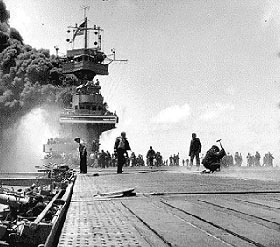 Later that morning, an advance Japanese squadron numbering more than
100 bombers and Zero fighters took off from the Japanese carriers to bomb
Midway. Twenty-six Wildcat fighters were sent up to intercept the Japanese force
and suffered heavy losses in their heroic defense of Midway's air base. Soon
after, bombers and torpedo planes based on Midway took off to attack the
Japanese carriers but failed to inflict serious damage. The first phase of the
battle was over by 7:00 a.m. Later that morning, an advance Japanese squadron numbering more than
100 bombers and Zero fighters took off from the Japanese carriers to bomb
Midway. Twenty-six Wildcat fighters were sent up to intercept the Japanese force
and suffered heavy losses in their heroic defense of Midway's air base. Soon
after, bombers and torpedo planes based on Midway took off to attack the
Japanese carriers but failed to inflict serious damage. The first phase of the
battle was over by 7:00 a.m.
In the meantime, 200 miles to the northeast, two U.S. attack fleets caught
the Japanese force entirely by surprise. Beginning around 9:30 a.m., torpedo
bombers from the three U.S. carriers descended on the Japanese carriers.
Although nearly wiped out, they drew off enemy fighters, and U.S. dive bombers
penetrated, catching the Japanese carriers while their decks were cluttered with
aircraft and fuel. The dive-bombers quickly destroyed three of the heavy
Japanese carriers and one heavy cruiser. The only Japanese carrier that
initially escaped destruction, the Hiryu, loosed all its aircraft against the
American task force and managed to seriously damage the U.S. carrier Yorktown,
forcing its abandonment. At about 5:00 p.m., dive-bombers from the U.S. carrier
Enterprise returned the favor, mortally damaging the Hiryu. It was scuttled the
next morning.
Admiral Isoruku Yamamoto still had numerous warships at his command, but
without his carriers and aircraft he was forced to abandon his Midway invasion
plans and begin a westward retreat. On June 5, a U.S. task force pursued his
fleet, but bad weather saved it from further destruction. On June 6, the skies
cleared, and U.S. aircraft resumed their assault, sinking a cruiser and damaging
several other warships. After the planes returned to their carriers, the
Americans broke off from the pursuit. Meanwhile, a Japanese submarine torpedoed
and fatally wounded the Yorktown, which was in the process of being salvaged. It
finally rolled over and sank at dawn on June 7, bringing an end to the battle.
At the Battle of Midway, Japan lost four carriers, a cruiser, and 292
aircraft, and suffered 2,500 casualties. The U.S. lost the Yorktown, the
destroyer USS Hammann, 145 aircraft, and suffered 307 casualties. Japan's losses
hobbled its naval might--bringing Japanese and American sea power to approximate
parity--and marked the turning point in the Pacific theater of World War II. In
August 1942, the great U.S. counteroffensive began at Guadalcanal and did not
cease until Japan's surrender three years later.
|