|
Home>News Center>Life | |
|
|
|
|
|
|
|
|
|
|
||||||||||||||||||||||||||||||||||||||||||||||||
|
|
US approves human brain-implant device For years, futurists have dreamed of machines that can read minds, then act on instructions as they are thought. Now, human trials are set to begin on a brain-computer interface involving implants.
If successful, the chips could allow patients to command a computer to act — merely by thinking about the instructions they wish to send.
It's a small, early step in a mission to improve the quality of life for victims of strokes and debilitating diseases like cerebral palsy or Lou Gehrig's. Many victims of such ailments can now survive for long periods thanks to life support, but their quality of life is poor.
"A computer is a gateway to everything else these patients would like to do, including motivating your own muscles through electrical stimulation," said Cyberkinetics chief executive Tim Surgenor. "This is a step in the process."
The company is far from the only research group active in the field. An Atlanta company, Neural Signals, has conducted six similar implants as part of a clinical trial and hopes to conduct more. But for now, its device contains relatively simple electrodes, and experts say Cyberkinetics will be the first to engage in a long-term, human trial with a more sophisticated device placed inside a patient's brain. It hopes to bring a product to market in three to five years.
A number of research groups have focused on brain-computer links in recent years.
In 1998, Neural Signals researchers said a brain implant let a paralyzed stroke victim move a cursor to point out phrases like "See you later. Nice talking with you" on a computer screen. The next year, other scientists said electrodes on the scalp of two Lou Gehrig's disease patients let them spell messages on a computer screen.
Cyberkinetics founder Dr. John Donoghue, a Brown University neuroscientist, attracted attention with research on monkeys that was published in 2002 in the journal Nature.
Three rhesus monkeys were given implants, which were first used to record signals from their motor cortex — an area of the brain that controls movement — as they manipulated a joystick with their hands. Those signals were then used to develop a program that enabled one of the monkeys to continue moving a computer cursor with its brain.
The idea is not to stimulate the mind but rather to map neural activity so as to discern when the brain is signaling a desire to make a particular physical movement.
"We're going to say to a paralyzed patient, 'imagine moving your hand six inches to the right,'" Surgenor said.
Then, he said, researchers will try to identify the brain activity associated with that desire. Someday, that capacity could feed into related devices, such as a robotic arm, that help patients act on that desire.
It's misleading to say such technologies "read minds," said Dr. Jonathan Wolpaw, of the New York State Department of Health, who is conducting similar research. Instead, they train minds to recognize a new pattern of cause and effect, and adapt.
"What happens is you provide the brain with the opportunity to develop a new skill," he said.
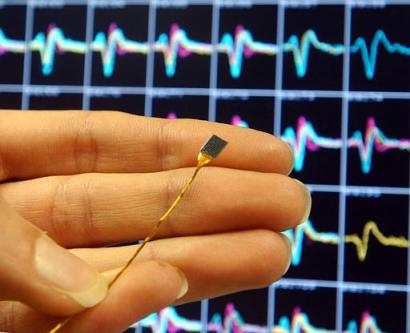
Moving the experiment from monkeys to humans is a challenge. Cyberkinetics' "Brain Gate" contains tiny spikes that will extend down about one millimeter into the brain after being implanted beneath the skull, monitoring the activity from a small group of neurons.
The signals will be monitored through wires emerging from the skull, which presents some danger of infection. The company is working on a wireless version.
But Richard Andersen, a Cal Tech expert conducting similar research, said the field is advanced enough to warrant this next step. "I think there is a consensus among many researchers that the time is right to begin trials in humans," Andersen said, noting that surgeons are already implanting devices into human brains — sometimes deeply — to treat deafness and Parkinson's disease. "There is always some risk but one considers the benefits." Wolpaw said it isn't clear that it's necessary to implant such devices inside the brain; other technologies that monitor activity from outside the skull may prove as effective. But, he said, the idea of brain implants seems to attract more attention. "The idea that you can get control by putting things into the brain appears to have an inherent fascination," he said. Andersen, however, said that for now devices inside the brain provide the best information. "It would be nice if in the future some technology comes along that would let you non-invasively record from the brain," he said. "MRIs do that. But unfortunately, it's very expensive and cumbersome, and the signal is very indirect and slow." |
|
|
|
|
|||||||||||||||||||||||||||||||||||||||||||||
|
|
|
|
||||||||||||||||||||||||||||||||||||||||||||||||