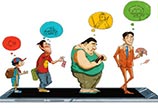
Growing Muslim market requires food prepared in a certain manner but labeling can be confusing, Cui Jia reports in Beijing.
With shopping basket in hand, Hu Yi and his young son went through the shelves at a supermarket in Beijing's Niujie Street. For Yicheng, 5, it was just a regular grocery trip with his father, but Hu, a member of the predominantly Muslim Hui ethnic group, had another agenda - to teach his son how to shop for halal food.
Niujie Street, or Ox Street, lies in the center of Beijing's Muslim quarter. Under the section headed "Muslim supplies", the supermarket also sells taqiyah, the distinctive skullcaps worn by many believers, and small carpets for them to kneel on while praying.
"Let's see if you can find us some tasty beef jerky," Hu, 32, encouraged his son.
Yicheng jogged off happily and searched through the aisles. A few minutes later, he returned with three packets of jerky.
"Remember, what's the first thing we have to check before putting them into the basket?" asked Hu. "The sign of qingzhen (halal)," replied Yicheng, pointing at the back of the packet, where a round, green logo displayed the word "halal" in Chinese characters and Arabic script.
 |
|
Customers select halal food at a supermarket in Urumqi, the Xinjiang Uygur autonomous region. Wang Jing / China Daily |
Dietary guidelines
In Arabic, halal means permitted or lawful. Halal foods are those that are allowed under Islamic dietary guidelines based on the Quran, the holy book of Islam. Muslims are prohibited from consuming alcohol, pork, blood and blood products, and meat from animals that have died accidentally or from natural causes, or have been slaughtered in the name of any god other than Allah.
One of the packs of jerky Yicheng had collected didn't bear the stamp of approval, and so he was instructed to put it back on the shelf. "Halal food is extremely important to us. It is never a small issue. For us, the first priority is whether the food is halal or not. Quality is a secondary issue," said Hu.
There are more than 23 million Muslims in China. Combining Islamic dietary guidelines and local culture during the past 1,200 years, they have adopted some culinary traits from the Han Chinese and created their own style of halal food. More than 97 percent of China's cities and counties have halal food manufacturers, according to China Inspection and Quarantine magazine earlier this year.
"The logos look a bit different," said Yicheng, as he placed the packets in the basket. His father explained that it's because the goods were produced in different provinces.
In China, halal food producers must have their products certified by local ethnic affairs commissions under regulations passed by provincial and regional lawmakers. If they meet the standards, producers are allowed to display a halal logo, designated by province or region, on their packaging and products.
Revised regulations
The Ningxia Hui autonomous region, where Muslims account for more than 35 percent of the population, implemented its local halal food regulations in 2003, before revising them in 2011.
The revised regulations are stricter than the original version. In addition to the original requirement that the owners of halal food producers and key staff members who deal with food must be Muslim, the updated regulations require that all those in managerial positions must also follow the faith to guarantee the food chain won't contaminated by the introduction of non-halal products. The regulations also prohibit the presence of non-halal food and ingredients in halal food factories or restaurants.
The regulations vary from place to place and region to region, but all are based on Islamic dietary guidelines. The regulations in Ningxia and the Xinjiang Uygur autonomous region, implemented in 2005, require that when an animal is slaughtered, the jugular vein must be cut and the blood allowed to drain freely from the animal. Moreover, staff must ensure that they do everything possible to reduce the amount of pain the animal endures believers claim that slaughtering an animal in the halal fashion cuts off the oxygen supply to the brain and inhibits pain receptors. The animals are also blessed with prayers.
"In collaboration with the local administration for industry and commerce, we conduct random inspections, covering everything from large slaughterhouses to small noodle restaurants, to ensure that no one carries out non-hahal activities in these places," said Ding Yi, director of the halal certification management office in Ningxia. He said the region now has more than 10,000 certified halal producers and restaurants.
"The halal logos can be confusing, because there are so many designs on the market. Why can't there be just one?" asked a perplexed Hu.
 |
|
Butchers at work at a halal food processing unit in Wuzhong city in the Ningxia Hui autonomous region. Ningxia, where Muslims account for more than 35 percent of the population, has its local halal food regulations. [Photo/Xinhua] |


Copyright 1995 - . All rights reserved. The content (including but not limited to text, photo, multimedia information, etc) published in this site belongs to China Daily Information Co (CDIC). Without written authorization from CDIC, such content shall not be republished or used in any form. Note: Browsers with 1024*768 or higher resolution are suggested for this site.
License for publishing multimedia online 0108263 Registration Number: 130349