'Dead to Rights' smashes box office records, raises awareness
Film set during Nanjing Massacre tells of unsung heroes' courage to reveal atrocities










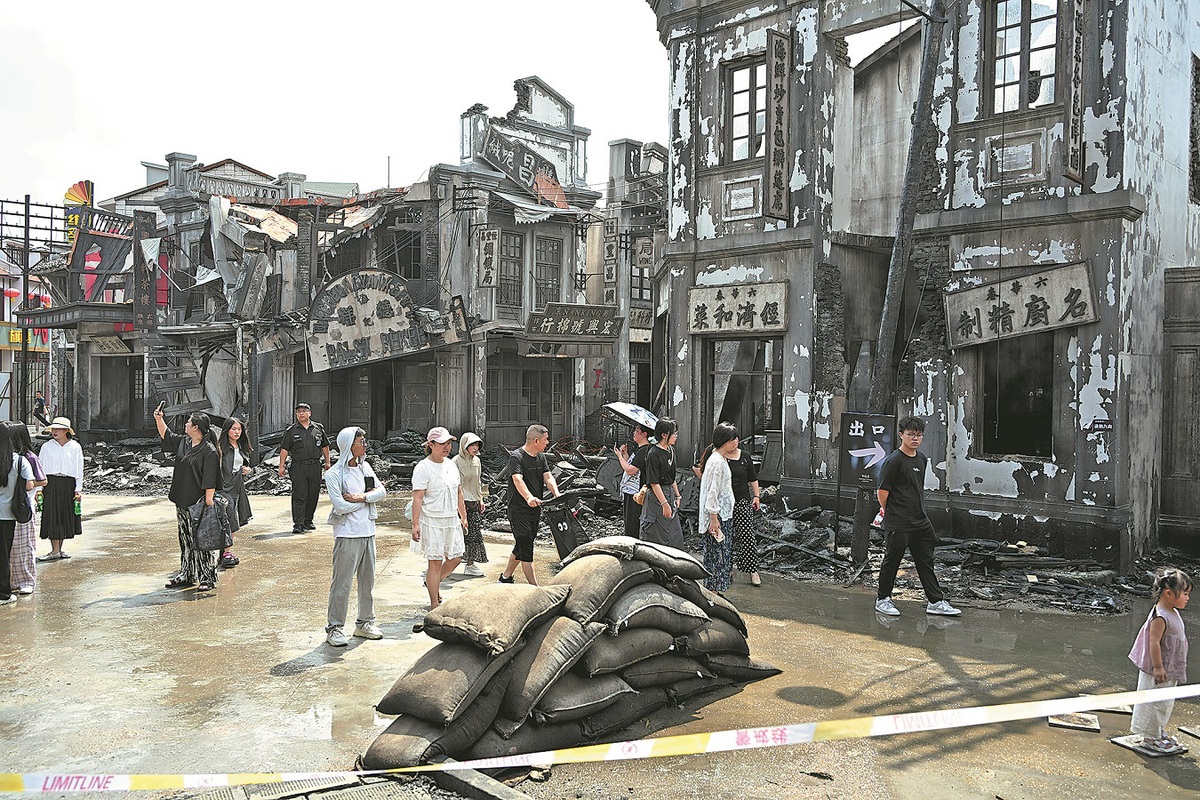
Respecting history
Drawing on the true story of Luo, Wu and the photos, Dead To Rights centers on a group of Chinese civilians who take refuge in a photography studio during the Japanese occupation of Nanjing.
In a desperate attempt to stay alive, they are forced to assist a Japanese military photographer in developing film only to discover the negatives contain evidence of atrocities committed by Japanese forces across the city. They secretly keep the negatives and risk their lives to deliver them to the outside world, in the hope of revealing the truth.
When discussing his inspiration for the film, director Shen Ao said he was deeply influenced by the 1987 movie Massacre in Nanjing, which is also based on historical accounts.
In 2023, after meeting screenwriter Zhang Ke, they decided to retell this part of history for contemporary audiences. The film's preparation took a full year, with the most critical task being the meticulous collection and restoration of historical details.
Shen said much of the Japanese soldiers' dialogue was sourced directly from interviews after the war.
"Our suffering was twisted into a trophy of militarism in their eyes," said Shen. "What's even more infuriating is how they staged 'goodwill photos' — smiling with children, pretending there was harmony — while committing atrocities. This hypocrisy must be exposed."
During the film's Nanjing premiere on July 22, Shen juxtaposed authentic historical "goodwill photos" with scenes from the film. Nearly identical in their composition and angles, they exposed how invaders staged images to whitewash atrocities.
"Beneath every war lies propaganda battles. I hope this film inspires audiences to uncover historical truths," he said.
During its Beijing premiere on July 24, Shen said that as a graduate of the Beijing Film Academy he had a special bond with film reels.
The opening sequence of Dead to Rights, for instance, links bullets being fired from a chamber and camera shutters clicking. "Shooting" applies to both guns and cameras, connecting violence with its documentation, he said.
"A photo was a bullet on that battlefield. The click of a shutter echoed the crack of gun. The negatives pierced invaders''goodwill' lies," Shen said.
He compared today's skyscraper-filled Nanjing with the war-torn city depicted in the film. "Everything has transformed, but no Chinese will forget the horrors Japanese troops inflicted here 88 years ago," he said.
The production team did extensive research for the film — consulting publications, documentaries, photos, and material from the memorial hall.
"We discovered something profoundly admirable in that generation: conviction surpassing life itself," Shen wrote in an article in People's Daily. "Countless unsung heroes left no names in history books. This film is focusing on their resistance."
In his view, a film must have dramatic elements, be thrilling, and ensure that it never distorts history. It is paramount to balance drama and historical accuracy.
"To educate through truth demands utmost responsibility," Shen stressed in describing the team's approach to content.
Zhang Guosong, a researcher at the memorial hall, called the massacre "not only an unprecedented catastrophe for China but also humanity's darkest chapter", and a warning for all humankind that requires perpetual remembrance.
The film counters historical nihilism and revisionism, Zhang said. By showcasing citizens risking lives to preserve evidence, it upholds truth while underscoring remembrance.
"Only through truth can we correctly evaluate history," he said, noting that Japanese right-wing forces still deny the massacre and glorify aggression.
In 1982, Japan's Ministry of Education altered textbook accounts of imperialist invasions, sparking protests across Asia.
"War harms both the victims and the perpetrators. Only by remembering lessons and thorough perpetrator reflection can future tragedies be prevented," said Zhang.