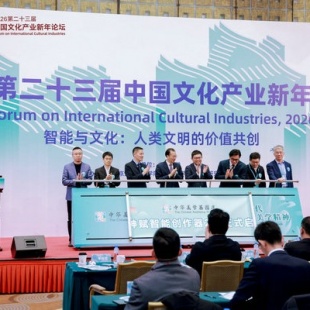



AI powers cultural innovation at Peking University forum









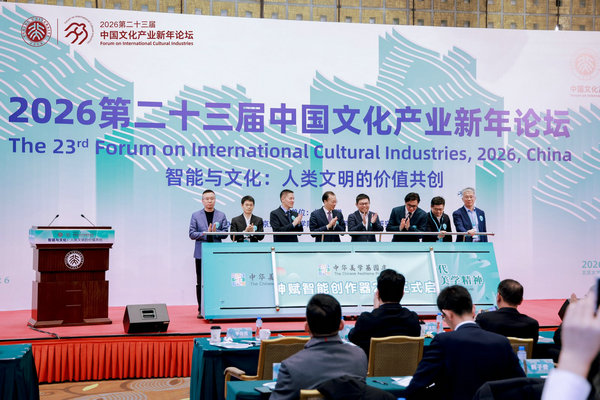
The 23rd Forum on International Cultural Industries of China opened on Jan 10 at Peking University, bringing together politicians, scholars and practitioners to explore how artificial intelligence can empower cultural development.
The forum was themed "Intelligence and Culture: Co-Creating the Values of Human Civilization" and was hosted by Peking University, with organization by its School of Arts and Institute for Cultural Industries.
Founded in 2003, the forum is one of China's earliest high-level platforms dedicated to cultural innovation and development. Over the past two decades, it has closely followed the country's cultural revitalization, offering policy insights and intellectual support for the sector's high-quality growth.
This year's event featured a main forum, parallel sessions and seminars for young scholars. Discussions focused on the opportunities and challenges brought by AI technologies, particularly their role in reshaping cultural creation, industrial models and value systems.
Ning Qi, deputy Party secretary and vice-president of Peking University, noted that AI is driving profound changes in scientific research and industrial development, while also posing risks such as ethical concerns and cognitive homogenization.
"Embracing technological innovation must go hand in hand with safeguarding cultural roots and ethical boundaries," Ning said, adding that cultural and industrial development should remain people-centered to ensure that technological progress serves humanity.
Li Fengliang, Party secretary of South China Agricultural University and a professor, introduced the concept of "intelligent culture", describing it as a new cultural form based on AI architecture and data elements.
He emphasized that intelligent culture emerges from human-machine interaction and the integration of virtual and real worlds, rather than being a simple extension of technology.
Drawing on his experience with AI systems, Li highlighted the irreplaceable value of traditional artistic creation rooted in personal talent and inspiration. He said future intelligent creation will rely on human-defined themes and aesthetic standards, evolving through continuous interaction between humans and machines.
Li Yang, dean of the School of Arts at Peking University, raised the question of whether large language models are reshaping human aesthetics. Based on a research project analyzing social practice reports from undergraduates at 2,715 universities, his team found notable changes in students' expression of personal experience after using AI tools.
He called for greater attention to Eastern and Chinese aesthetics in the development of large models, stressing the need to protect aesthetic security and cultural inheritance in the AI era.
From an economic perspective, Li Xiangmin, deputy Party secretary of Nanjing University of the Arts, cited the video game Black Myth: Wukong as an example of how cultural products can boost tourism and regional development. He said influential cultural works can enrich supply chains and enhance productivity.
The forum also featured presentations on AI-driven cultural globalization, ethnic art in the digital era, new media restructuring, and the integration of culture and traditional industries. A key highlight was the launch of the AI content creator, Luoshenfu 2.0, which supports the intelligent generation of multimodal content while contributing to the Chinese Aesthetic Gene Database.
Parallel sessions addressed topics such as AI-era cultural landscapes, digital protection of intangible cultural heritage, and new rural tourism models.
The forum outlined a forward-looking vision for China's cultural industry during the 15th Five-Year Plan period, emphasizing intelligent empowerment and value co-creation.
Bai Shuhao contributed to this story.