


Liangzhu exhibition answers the question of defining civilizations










An epic about civilization always starts with an ode to the ground. A stone soil-breaking tool carries profound meaning. It was with the tool used by the people of the Liangzhu culture, a Neolithic culture that existed in China's Yangtze River Delta region 5,300 to 4,300 years ago, that they embarked on a journey toward civilization.
The artifact now rests in a glass cabinet of the ongoing exhibition A Journey of Jade: The Liangzhu Culture at The Museum of Shanghai University. As a side event of the recent sixth Shanghai Archaeology Forum, the exhibition aims to highlight Chinese archaeologists' ideas about civilization through 126 artifacts related to the Liangzhu culture.
According to Mei Haitao, curator of the exhibition, the Archaeological Ruins of Liangzhu City, a UNESCO World Heritage site in Hangzhou, Zhejiang province, is a demonstration of Chinese civilization's over 5,000-year history.
When discussing Liangzhu's significance, Chinese archaeologists have provided China's answer to the question of defining civilizations: the development of productivity, an increase in population, the appearance of cities, social differentiation, and the emergence of kingship and the state.
"People often compare civilization to an epic. In some ways, the exhibition symbolizes three poems that honor the Liangzhu culture," he says.
The first is a poem of foundation — a tale of how they adapted to the environment, harnessing rivers and lands to develop rice-based agriculture and build a water management system, thereby boosting productivity.
A highlight is the stone soil-breaking tool, which helped Liangzhu people plough fields and marks the high-level agriculture of its time.
"As agricultural development was an important driver for Liangzhu society, the civilization can be said to start from a farming tool. The productivity development laid a solid foundation from its beginning to its zenith," says Mei.
The second part is a poem of order. With the development of social productivity, some Liangzhu people were freed from the necessity of agricultural production and turned to other professions. The division of labor led to social differentiation, social status, and finally, the birth of the monarchy.

"A memorable item on display is a top-shaped wooden artifact. People debate its functions, but mostly believe it was a toy," says Mei.
"We showcase the artifact and a highly similar modern toy to show the skills of processing wooden artifacts and the highly developed productivity of that time, which allowed people to engage with producing entertainment objects," he adds.
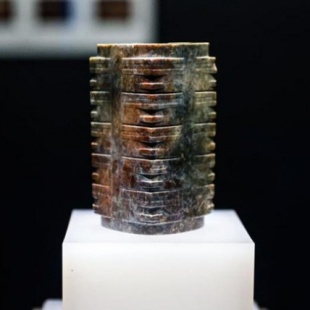
The final part is a poem for the Liangzhu people's spiritual world, which is widely believed to be symbolized by their jade artifacts.
"More than decoration, they formed an exclusively controlled symbolic system of faith, which shaped cosmology and social order. Through symbols, the ruling group of Liangzhu forged a cohesive spiritual order and united people under common gods," says Mei.
This part highlights a large jade cong, a square tube with a circular bore, from the Zhejiang Provincial Institute of Cultural Relics and Archaeology.
"As a Liangzhu cultural symbol, jade cong integrated into the torrent of Chinese culture and significantly influenced the entire nation. Archaeologists discovered, after Liangzhu declined, in sites spanning a wide area, that people still made jade cong or cong-shaped artifacts from different materials," he says. "This marks the lingering influence of Liangzhu culture."
Xu Tianjin, director of Liangzhu Museum, says the exhibition clearly demonstrates the deep connection between handicrafts, agricultural techniques, and social development. Xu says he was especially impressed by the exhibition's poetic layout.