



Birds of a feather flock together across Strait










For Lin Liting, the Minjiang River estuary that connects the Taiwan Strait to the east and faces the Matsu Islands across the sea, is more than a vast expanse of silt and reeds; it is a living bridge. As a third-generation Taiwan compatriot born and raised in Fuzhou, Fujian province, with ancestral roots in Chiayi, Taiwan, Lin has turned her heritage into a mission.
As a member of the Minjiang River estuary national nature reserve administration, she uses the flight paths of endangered birds to stitch together the hearts of people across the Taiwan Strait. "I carry a deep mission: how to use this land beneath my feet to build an ecological bridge," she said.
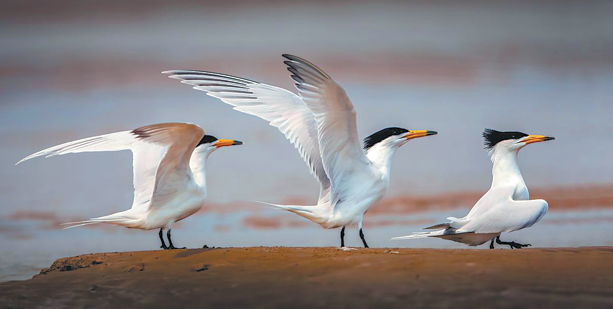
Lin's journey has been defined by the Chinese crested tern. The tern is listed as critically endangered on the International Union for Conservation of Nature's Red List, as its global population is estimated to be around 200 individuals. It was once believed to be extinct from 1937 to 2000. Due to its elusive nature, it has been nicknamed the "mythical bird".
The Minjiang estuary wetlands and coastal wetlands in Taiwan are geographically adjacent and ecologically connected, serving as vital stopovers for birds traveling along the East Asian-Australasian Flyway migration route. Every year from March to September, the bird can be spotted in the region.
The species' survival became a shared cause in 2008 when a bird was spotted with its beak trapped in a plastic tube. The bird was documented first in Fuzhou and later in the Matsu Islands administered by Taiwan, scientifically proving that the two regions share the same population. People nicknamed the bird "Xiaoguan", literally meaning the tube, wishing to save it someday.
"That heartbreaking moment was like a bolt of lightning, illuminating the path we must walk together to protect the birds as a shared destiny," Lin said.
The terns forage in Fuzhou by day and fly just 12 minutes to sleep and breed in Matsu by night. This "commuter" lifestyle mirrors the historical movement of people between the two shores, many sharing the same origins and customs.
Leveraging her identity as a "natural translator", Lin has spent years fostering cooperation between the two sides. The annual seminar on cross-Strait Chinese crested tern conservation has become a platform for experts from the two shores to share data and experiences.
In 2023, the seminar announced that the global population of the species had surpassed 200. "That moment of excitement and pride belonged to every cross-Strait colleague who contributed," Lin said.
In April, Lin launched a program to recruit bird surveyors from the mainland and Taiwan for scientific monitoring, bird surveys and image documentation, bringing researchers from Taipei, Matsu and other places in Taiwan into the wetlands of the Minjiang estuary to observe the birds.
In November, she participated in organizing an exhibition at the Taiwan Guild Hall in downtown Fuzhou, featuring the collaborative efforts from both sides of the Taiwan Strait to protect the rare birds. The event featured a 7-meter-long scroll of the tern migration route painted by families from both sides. "When the scroll unfolded, I felt deeply that we were protecting not just birds, but our shared cultural memory and spiritual home," she said.
Juan Jin-song, former chairman of the Wild Bird Society of Taipei, said the cross-Strait collaboration on bird protection has covered sharing environmental data, co-authoring bird breeding management manuals, alternating patrols on uninhabited islands, and crackdowns on the theft of eggs.
Lin's advocacy now extends to the Fuzhou-Matsu integrated living circle. Just as the birds commute, many Matsu residents now live and work in Fuzhou. Lin actively uses her platform to propose policies that make their lives more convenient, ensuring the "shared destiny" of the birds is reflected in the ease of human exchange.


Today's Top News
- Scripting a false South China Sea drama
- Forests forge path to a green future
- Chinese games shift focus to cultural experiences
- Shanghai island hosts sleep-in-forest competition
- China targets corruption at the grassroots
- US authorizes 30-day window for Iranian oil sales at sea amid supply concerns





