


China sure-footed in carbon peak goals
Nation set to expand its 'west-to-east' power transmission capacity to over 420 GW by 2030










UBS raised its outlook for China's annual electricity demand growth to 8 percent for the 2028-30 period in a recently released report on energy transition, up from a previous estimate of 4 percent, citing a reevaluation of structural growth drivers for the increase.
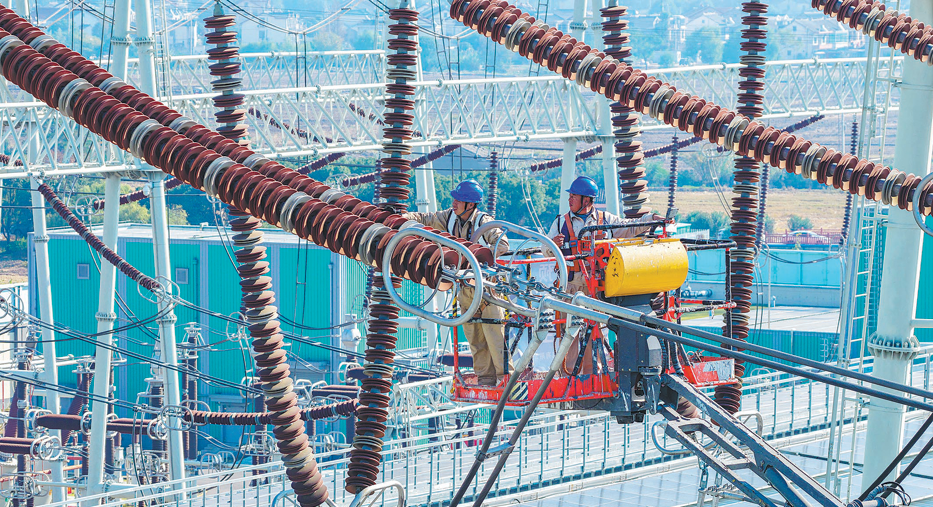
To keep pace with this demand, domestic grid operators are stepping up efforts to modernize the national network with ultrahigh voltage "power highways" and digital smart grids, transforming the utility system into a high-tech backbone capable of supporting both high-density computing and a transition toward a net-zero future.
State Grid Corporation of China said its fixed-asset investment rose to a record high of over 650 billion yuan ($93.2 billion) in 2025. This brings total investment during the 14th Five-Year Plan (2021-25) to more than 2.85 trillion yuan, it said.
The nation's primary utility has been escalating its investment in UHV projects to enable efficient, long-distance power transfer to boost the nation's capacity to efficiently optimize and distribute renewable energy resources across vast geographical areas.
China Southern Power Grid said its "west-to-east" power transmission volume reached a record 261.5 billion kilowatt-hours in 2025, an increase of 31 billion kWh compared to 2020 levels.
Throughout the 14th Five-Year Plan period, the utility's cross-regional channels delivered a cumulative 1.14 trillion kWh of electricity, it said.
The country's extensive UHV grid has profoundly reshaped its energy landscape, said Ye Xiaoning, a senior engineer at the new energy department of the State Grid Energy Research Institute.
China's utilization of renewable energy has either reached or exceeded advanced international levels, with a utilization rate of 97.6 percent, surpassing 95 percent for six consecutive years since 2018, comparable to the levels seen in developed countries such as Germany, Ye said.
Industry experts believe that by moving from a static network to an AI-enabled, highly reactive platform, China is building the infrastructure necessary to support a fully decarbonized economy, a strategic pivot intended to cement China's position as the global standard-setter for the next generation of power.
China's power grid is undergoing a fundamental transformation, shifting from a traditional one-way transmission model toward a sophisticated, multidirectional hybrid structure, said Zhang Lin, director of planning and development at the China Electricity Council.
Zhang said that strengthening the synergy between the backbone grid, local distribution networks and microgrids is now a strategic necessity.
This deeper integration is essential to support emerging energy business models and ensure that renewable energy providers can participate on a level playing field within the national power market, she said.
China currently holds the world record for the longest safety run of a major power grid and operates at the highest voltage levels globally, including its signature UHV DC lines that are capable of transporting electricity across thousands of kilometers with minimal energy loss — a feat comparable to sending power from New York to Los Angeles.
While the domestic focus is on energy security and decarbonization, the move also solidifies China's role as the global standard-setter for grid technology.
From high-end transformers to sophisticated dispatching software, Chinese State-owned enterprises like the State Grid Corporation of China and China Southern Power Grid are also increasingly exporting these technologies to emerging markets.
However, the transition is not without hurdles. Integrating such high proportions of volatile renewable energy requires massive investments in long-duration energy storage and AI-powered demand-side response.
To accommodate this shifting energy landscape, grid operators are evolving from traditional infrastructure providers into high-tech digital managers by embedding AI and specialized operating systems into the heart of the smart grid.
Major utilities are investing heavily in digitalized platforms to manage the massive streams of real-time data generated by millions of sensors and internet of things devices.
For instance, China Southern Power Grid has pioneered the Dianhong IoT operating system. Developed in collaboration with open-source ecosystems, this system creates a unified "digital soul" for power equipment, breaking down data silos across the entire energy chain.
The implementation of systems like Dianhong is fundamentally transforming maintenance and efficiency. Tasks that once required four hours of manual commissioning can now be completed remotely in just 30 minutes, while equipment upgrades have been slashed from three hours to merely 20 minutes.
This shift not only accelerates the grid's responsiveness, but also significantly reduces safety risks for front-line employees by minimizing the need for hazardous on-site visits.
On the other hand, by leveraging Beidou satellites for millimeter-level tower displacement detection and drones for automated patrolling, the grid can now identify wildfires or hardware faults in real time.
This level of precision — locating faults within 300 meters over a 30-kilometer range — is essential for maintaining stability as AI-driven demand and intermittent renewable energy become the new norm, the company said.
Ultimately, the goal is to build an expansive industrial ecosystem, it said.
Data from China Southern Power Grid show that the Dianhong ecosystem has expanded to include over 500 supply chain manufacturers. These partners are currently adapting the operating system to more than 3,000 different types of terminals, ranging from smart meters to industrial sensors.





