



Mushroom farming in Zhejiang reduces rural poverty









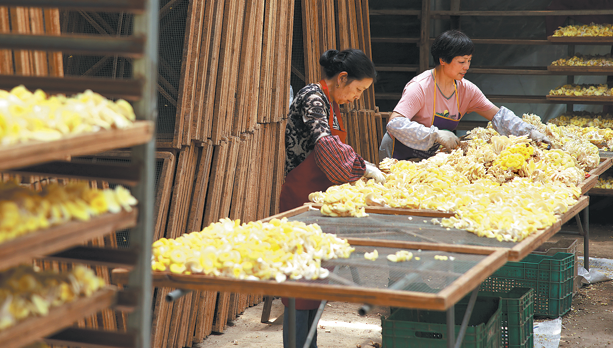
HANGZHOU — Nestled in the remote mountains of East China's Zhejiang province, Qingyuan county has transformed its lush forests into a source of sustainable wealth through edible fungi cultivation, blending centuries-old tradition with modern technology in harmony with nature.
A notable example is Qingyuan County Junbo Biotechnology Co, which has brought over three decades of experience in shiitake mushroom production and sales, and has invested in smart technologies to boost productivity.
"We have phased out traditional drying and sorting methods and deployed 53 intelligent drying units," said Yang Tao, the company's deputy general manager, noting that the machines are tailored to local mushroom varieties and allow for automated drying with remote monitoring.
Yang said the latest process significantly reduces defects such as deformation, cracking and discoloration. With artificial intelligence-powered color sorters, grading accuracy has risen to 95 percent. Each metric ton of fresh mushrooms dried now saves 370 kilograms of firewood and reduces carbon emissions by 230 kg, he said.
"Technology is driving the industry forward by cutting costs and boosting efficiency," said Yang Yingkun, a technical researcher at the Qingyuan County Edible Fungus Industry Center. The center has partnered with universities, including Jilin Agricultural University, to develop new mushroom varieties suitable for industrialized cultivation.
While companies like Junbo are leading technological innovation, the county — widely recognized as the birthplace of shiitake mushroom cultivation in China — is aiming even higher. Nearby, an industrial park focused on edible fungi research, processing and agritourism is under construction and is slated to open by the end of 2027.
The park will adopt smart technologies such as energy-efficient dryers that reduce both fuel use and fire risks. Official estimates suggest the facility is expected to save about 7,500 tons of firewood annually while cutting carbon dioxide emissions by 3,000 tons, along with substantial reductions in sulfur dioxide and nitrogen oxides.
Once operational, the park is expected to generate an annual output value exceeding 400 million yuan ($56.7 million), support over 5,000 local agricultural households, and help mushroom farmers earn an extra 200 million yuan each year.
Junbo also offers regular training for local growers, boosting the average annual income of residents by over 30,000 yuan and creating more than 200 jobs in the community.
Such efforts are part of Qingyuan's broader strategy to build the edible fungus sector into an engine for common prosperity. As of last year, the industry has provided employment and increased income for over 40,000 people, with annual per capita earnings reaching approximately 36,000 yuan.
These compact, forest-grown crops have also increased incomes for farmers in more than 400 counties across over 20 provincial-level regions in China. A major driver of this expansion has been the remote hill county's pioneering certification program for skilled mushroom farmers, which had trained 706 technicians as of last year. These experts share their knowledge nationwide, helping others boost both yields and earnings.
The harmony between people and ecology in the region dates back to the 13th century and has gained global recognition. In 2022, the Food and Agriculture Organization of the United Nations designated the Qingyuan Forest-Mushroom Co-culture System as a globally important agricultural heritage system.
The system is a sustainable agroforestry model that integrates forest management, mushroom cultivation and cyclic resource use in high-altitude mountainous areas. Through these efforts, local communities have ensured food and livelihood security and developed a unique forest and mushroom co-culture technique system. "The system fosters harmonious coexistence between humans and nature. Agricultural heritage is not a relic of the past, but a living form of production with relevance for the present and future," Yang Yingkun said.
Xinhua


Today's Top News
- Scripting a false South China Sea drama
- Forests forge path to a green future
- Chinese games shift focus to cultural experiences
- Shanghai island hosts sleep-in-forest competition
- China targets corruption at the grassroots
- US authorizes 30-day window for Iranian oil sales at sea amid supply concerns





