


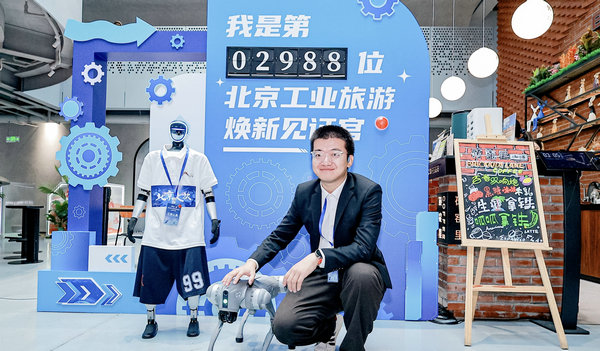
Today, longtime residents proudly bring friends and family to Brickkiln Lane, treating it almost as a local landmark, Liu notes.
"They introduce it as their community's own cultural living room."
Brickkiln Lane is among 11 new industrial tourism demonstration sites recently accredited by the Beijing Municipal Bureau of Culture and Tourism and the Beijing Municipal Bureau of Economy and Information Technology.
"As an emerging format within the cultural and tourism convergence, industrial tourism is radiating vigorous vitality and unlimited potential," says Zhang Jing, director of the resource development department of the Beijing Municipal Bureau of Culture and Tourism.
To date, the capital city has cultivated and officially designated 30 industrial tourism demonstration sites.
"They represent the essence distilled from Beijing's rich industrial heritage, and advanced technological manufacturing," Zhang says, adding that the city plans to deepen this transformation. "We aim to optimize products, strengthen resource coordination, and encourage integration with creative, technological, and educational sectors."
In Beijing, an increasing number of industrial heritage sites have been transformed into cultural, commercial, and technology parks, shifting from "industrial rust" to "vibrant life belts".
In the well-known 798 and 751 art zones of Chaoyang district, visitors board bright yellow smart sightseeing vehicles equipped with intelligent audio guides.
These mobile "guides" carry guests through a landscape of striking Bauhaus-style architecture, narrating the area's storied past.
Spanning more than 500,000 square meters, the 798 area was originally an electronics factory, while the 751 section once served as one of Beijing's three major gas supply plants.
"After more than two decades of development, the zone is now home to over 100 top galleries, artists' studios, and design centers, as well as tech enterprises like the Volkswagen R&D center and GeekPark (an innovator community platform), building a unique creative ecosystem," says Yan Mingdan, general manager of 798 Culture and Technology Company that runs the two art zones.
Former industrial landmarks such as redbrick workshops and towering chimneys have been preserved, forming a distinctive visual identity. Building on this heritage, the zone has introduced diverse formats including art, design, technology, retail, and exhibitions, turning into a vibrant cultural and creative hub.
For instance, the former iconic gas storage Tank 79 has been redesigned as an international fashion venue hosting major events such as China Fashion Week and brand launches.
Similarly, disused train carriages and tracks have been reimagined as dining and cultural retail spots that particularly appeal to younger audiences.
Outdoor heritage routes allow visitors to explore historical industrial equipment and learn how the factories once functioned. Educational programs introduce younger participants to intangible cultural heritage crafts and garment design, bridging artistry with historical context.
Yan emphasizes that when organizations move into the zone, the administration provides guidance to ensure the integrity of architectural heritage.
"Whether it's a gallery, a pop-up exhibition, a trendy cafe, or a restaurant, each space retains the imprint of industrial history. Walking through the area feels like exploring a large, living museum of industrial heritage," she adds.
Visitor numbers in the first three quarters of this year have already approached 12 million, according to local administration data.
In 2024, the zone welcomed 12.57 million visitors, with international guests accounting for about 30 percent.
According to Li Peng, director of the industrial economy research center under the Beijing Municipal Bureau of Economy and Information Technology, approximately 15 million tourists engaged in industrial tourism in Beijing in 2024, accounting for approximately 4 percent of the city's total tourist visits and generating around 1.7 billion yuan ($240.9 million) in revenue.








