CCUS seen as smoother path to CO2 goals
Experts: Without it, 2060 target effectively unreachable given nation's energy security demands









In its bid to balance sustained economic growth with its pledge to achieve carbon neutrality before 2060, China is betting on a technology that traps and buries carbon dioxide emanating from fossil fuels via carbon capture, utilization and storage.
Faced with an energy system still dependent on coal and heavy industry — sectors difficult to decarbonize — Beijing and State-owned energy giants are channeling resources into CCUS, moving the nation rapidly from small pilot projects to the planning and construction of multi-million-metric-ton industrial clusters.
The push is formal and comprehensive. Beijing has integrated CCUS into its national 14th Five-Year Plan (2021-25) and recently updated its technology roadmap, defining CCUS technology as "crucial not just for the large-scale, low-carbon use of fossil fuels, but also a vital part of the overall technology mix needed to realize the goal of carbon neutrality".
For major industrial nations like China, CCUS is not optional. It is a vital safeguard technology to bridge the emissions gap. Without it, the 2060 target is effectively unreachable given our energy security demands, said industry experts and company executives.
Lu Junling, chief economist at the National Energy Administration, said CCUS has built an indispensable bridge between ensuring energy security and achieving carbon goals.
In recent years, the NEA has promoted CCUS to achieve a leap from exploratory beginnings and pilot experimentation to industrial demonstration and scaled development by strengthening policy guidance, accelerating technological innovation and deepening project implementation, Lu said.
"Moving forward, it is essential to accelerate planning and top-level design and initiate demonstration project construction, to provide support for green, low-carbon, high-quality development," he said.
The oil and gas industry is expected to operate over 90 CCUS projects this year. There are more than 10 CCUS-EOR (enhanced oil recovery) projects, and the annual carbon dioxide injection volume recently reached 4 million tons, Lu added.
The country's progress is visible in the rapid increase of project numbers and scale. As of the end of 2024, China had 126 CCUS projects planned or operational, with an annual capture capacity of 6 million tons and an annual CO2 injection volume reaching 4 million tons, led by the energy conglomerates.
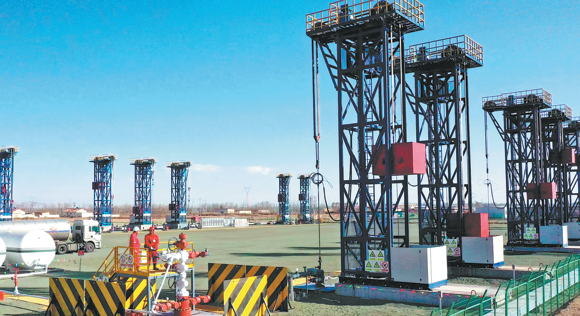
China Petroleum and Chemical Corp (Sinopec), the country's largest refiner, operates the country's first CCUS initiative at the million-ton scale, capturing 1 million tons of carbon dioxide a year at its Qilu petrochemical plant in Shandong province and injecting it into the Shengli oilfield for EOR, a process that boosts oil production while permanently storing the carbon.
The project serves as an engineering benchmark, providing valuable experience and technical insights to support the large-scale rollout of CCUS initiatives nationwide.
As a green and low-carbon technology, CCUS plays a crucial role in promoting the transformation and upgrade of traditional industries and cultivating new quality productive forces, said Hou Qijun, chairman of Sinopec.
"The scale of CCUS demonstration projects that are operational and under planning and construction has clearly expanded, with multiple million-ton projects underway and planned," Hou said.
He said Sinopec has carried out a series of practices in the CCUS field and is willing to join hands with foreign partners to focus on technological breakthroughs, consolidate the industrial foundation and further promote cluster development.
China National Petroleum Corporation is forging ahead with ambitious CCUS hubs in the Daqing, Changqing and Dagang oilfields in Heilongjiang province, Gansu province and Tianjin, respectively, aiming to aggregate emissions from nearby power and industrial facilities.
Globally, the CCUS momentum is accelerating rapidly as nations recognize its role in the energy transition.
While much of the CO2 captured today is used for EOR, State firms are increasingly exploring dedicated geological storage in deep saline aquifers, particularly in coastal areas.