



'Field poetry' gives voice to rural children's hopes, fears
'Left-behind' youngsters empowered to express inner thoughts, feelings









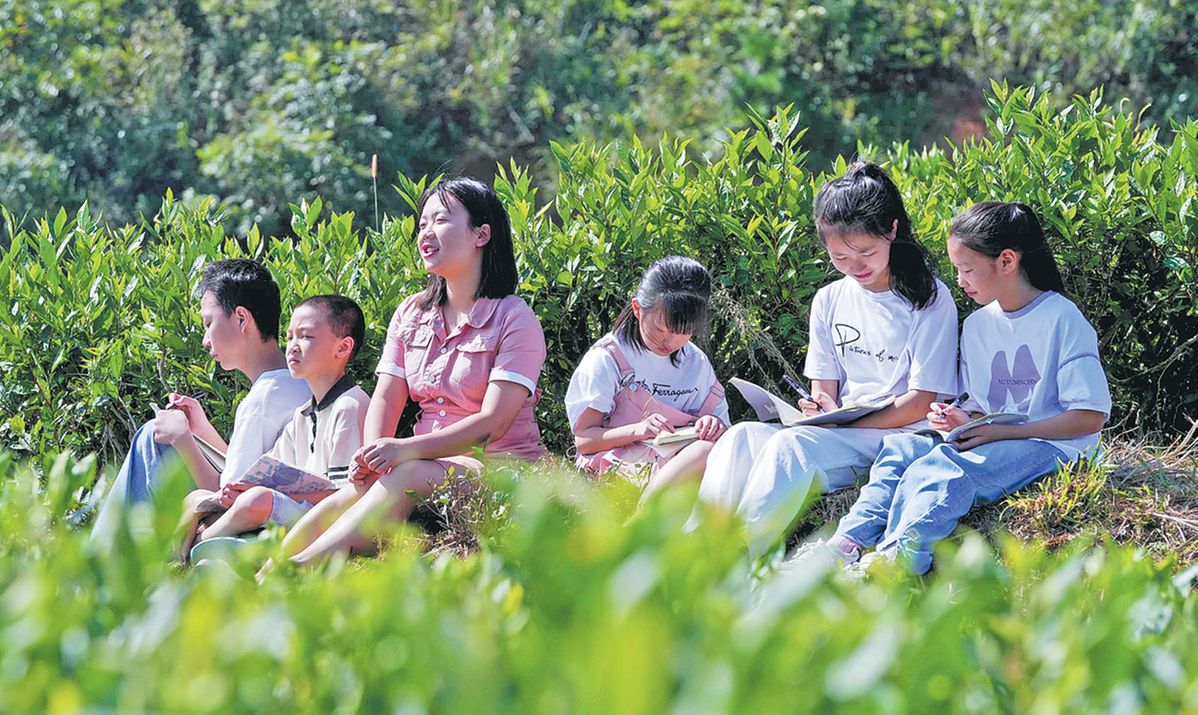
"Dad is like a bird — he flies out to find food, but seldom returns to the nest."
These lines come from a poem written by a 10-year-old girl from Huitong, a small county in Huaihua, Hunan province.
Her work is featured in The Field Poetry Class, a collection published last year that includes more than 80 poems by her and her classmates.
"It is a loneliness rendered in a way only those intimately familiar with both solitude and nature could express," said Li Bailin, the girl's teacher at Su Yu School of Hope, who introduced her to poetry.
For the past eight years, Li — a Chinese language teacher at the primary school — has guided her students in writing poetry, a pursuit that might seem unlikely for children whose parents, mostly migrant workers, have journeyed to faraway cities in search of a living, leaving their young ones behind in the quiet of their distant "nest".
"They are known as 'left-behind children'. While public concern for their welfare has been widespread, little has been done to provide these children with an inner channel for emotional expression or relief," Li noted.
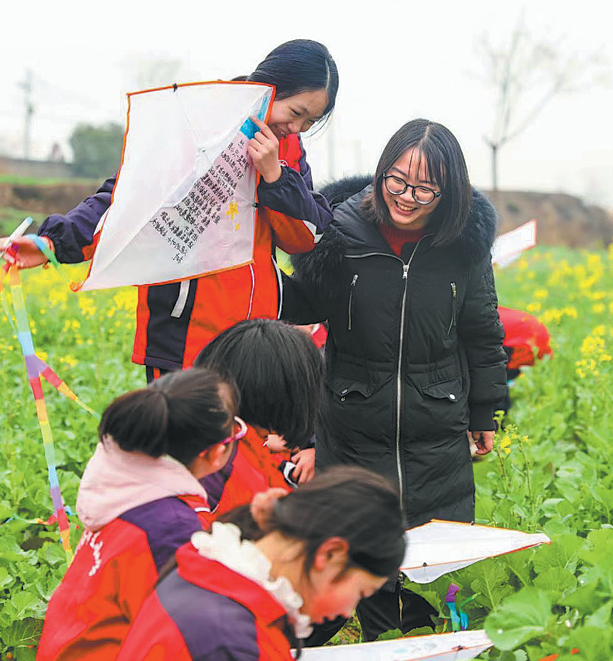
As a language teacher, Li once devoted nearly all her energy to her students' academic performance until a letter written by one girl to her father changed everything.
"The letter was a simple class assignment," Li recalled. "This girl wrote only two sentences: 'Dad, can you stop beating mom? I'll stop being your daughter if you don't.'"
"I was stunned," Li said. "A deep sense of guilt washed over me for having been so blind to what this child, and so many of my students, had been through. I had been wrong all this time, with my attention fixed on their test papers when it should have been on them — their lives, their pain, their hopes."
Not long after, Li had a revelation that would guide her toward poetry.
"I was teaching the children about metaphor, showing them an example: 'The grapes are like strings of purple pearls.' One student wrote his own version: 'The cotton bursts forth its snowy harvest.' Technically, it was not a metaphor, yet it carried its own vibrant poetry."
Li regards poetry as the perfect way to inspire children whose access to literature has been constrained by limited resources and modest family circumstances.
"Poems are short," she reflected, "yet precisely for that reason, they are easy to grasp, easy to echo, and open a doorway into the vast world of imagination."
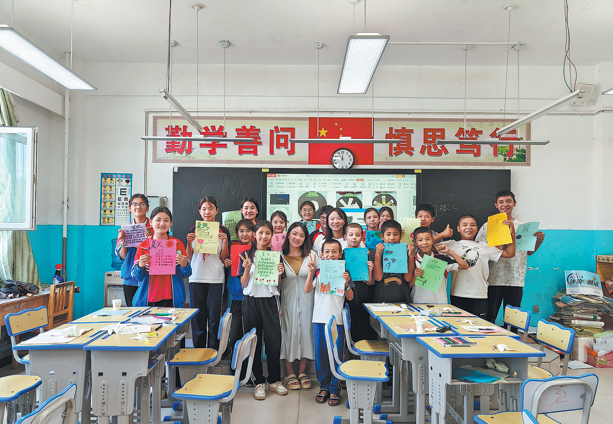
Her students — so attuned to nature and the quiet rhythm of the seasons — soon showed their teacher that imagination was the one thing they possessed in abundance.
One child wrote of rain as "the tears of a cloud that slipped while climbing the rainbow's slide";another likened snow to "the shorn tufts of hair that fell as the cloud trimmed her locks"; yet another saw dusk "settling on the mountain's back, as I leaned against grandma's shoulder".
About a crescent moon, a 9-year-old girl wrote: "A moon hangs above/I pick it down for a bite — only to find it tasteless/so I put it back."
Su Yingqi, 14, who studied under Li, said: "She urged me to inhabit whoever or whatever I wrote about — a flower, a blade of grass — and to feel that itch within, the stirring that could awaken an entire world for them."
In one of her poems, Su wrote of "growing up stealthily, like a seed cradled by the soil".
"My father is a migrant worker who returns only once a year," she explained. "I grow up largely unseen — that's what I meant by 'stealthily'."
The poems that cut beams of light into the dimmer corners of a child's heart have left the deepest mark on Li.
One 10-year-old girl wrote about visiting her grandmother, ending with the lines: "My eyes hurt as if they were burning/but for once, grandma didn't comfort me."'
"The girl was visiting her grandmother's final resting place during Qingming Festival, which falls on April 4th or 5th each year — a time when the Chinese honor those they have loved and lost," Li said.
"She comes from a family where boys are prized over girls, (which is) not uncommon in this remote part of the country, yet her grandmother had always loved her with all her strength. This poem is a tender, heart-wrenching homage to a gentle soul who has departed from the girl's life."
The prolonged absence of parents often places grandparents, as the children's primary caregivers, at the center of their emotional lives. Yet, as loving as most grandparents are, the limits imposed by age and understanding can sometimes render a casual remark hurtful.
"Once, a boy in my class, whose parents had gone to work in faraway cities, wrote: 'People say those without parents are orphans/I am an orphan.' I was struck by the power of his words and duly commented. But the boy told me he would never write again.
"Later, I learned that he had shared the piece with his paternal grandfather, who responded, 'What's your problem? Your parents are well and alive!'" Li recalled.
"I didn't argue with him about his grandfather," Li said. "Instead, I encouraged him to write another poem and submit it to a competition. It won a prize, and the old man was so pleased that he told his grandson to never stop writing."
For Li, the gateway to the world of poetry lies in opening the heart — a formidable task for children long accustomed to keeping it to themselves.
"Poetry will flow naturally from an unlocked heart. For that reason, I must be relentlessly encouraging and nurturing, both inside and outside the classroom," she said.
"You have to affirm the person as a whole if you wish to convince them that you believe in the brilliance of their mind and the hidden genius of their words."
One student who appears to possess a touch of genius is 15-year-old Su Liyu who once wrote about the changing seasons:
"The snow buries the wounds of the past year/quietly retreating beneath the gentle sun/yet in the depths of the heart it plants a seed of hope/waiting for the next spring to bloom again."
Li said after Su Liyu's father was recently diagnosed with terminal-stage uremia, she began to sense a profound shift in the tone of the teenager's poetry. The teacher pointed to lines such as, "I do not like the hemp rope/yet only it can help my mother/bind those bundles tight/the ones we trade for money."
With the family sinking into hardship and the girl's future uncertain, Li is seeking donations to help them weather "life's winter", as the father's life draws toward its end.
"There is no pain more excruciating than to watch the seed of hope in a child's heart wither before it can bloom," said Li.
She began teaching her students how to write poetry in 2017, a few months after she became a primary-school teacher at the age of 19.
"Thanks to this ongoing experiment, I have grown tremendously, both as a teacher and as a person. That, in the end, is the one thing I wish for my students," Li said, reflecting on the harsh realities that poetry offers no guarantee of college, nor an escape from poverty.
"They are constantly reminded of this — sometimes even by their own teachers. Heightened sensitivity allows them to feel deeply, yet it also leaves them exposed and vulnerable; still, their survival depends on the quiet, steadfast strength to persevere," Li continued.
"There are, of course, countless examples of those who never went to college yet wrote extraordinary poetry. My students are aware of this. And yet, they remain first and foremost themselves. What the work we do today will mean in the long run is a question only time can answer."
In a field outside the school, she once asked her students the question — "What is poetry?"
One student answered, through a poem:
"Poetry is the paper, and I am the crayon —
the paper holds within it everything the crayon can draw."
zhaoxu@chinadaily.com.cn


- Report blames management for deadly Yunnan tunnel flood
- Companies flock to Shanghai home appliances expo
- Three people perish in Guangdong house fire
- Experts: too early to tell if super El Nino will hit this year
- China recovers $4.95b in medical insurance funds in 2025
- China launches remote sensing satellite





