Remembering the forgotten front of World War II









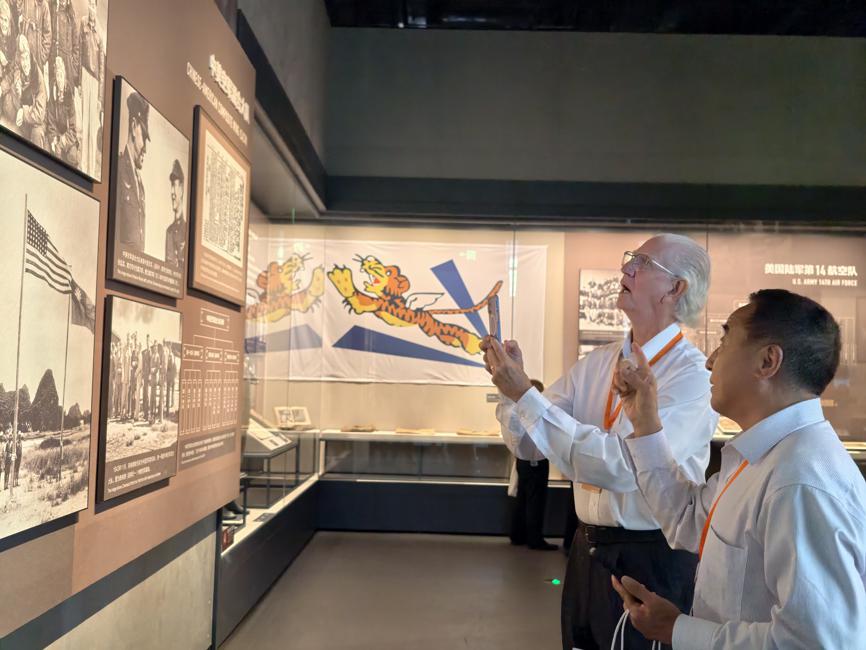
Editor's note: At an international seminar titled "The Chinese People's War of Resistance Against Japanese Aggression from a Global Perspective", held at Peking University on Sunday and Monday, Lu Fang-sang, a researcher at the Institute of Modern History in Taiwan's Academia Sinica, spoke with China Daily about the heavy costs the Chinese nation bore during the war and the long underestimation of its role in the World Anti-Fascist War. Below are excerpts from the interview. The views don't necessarily represent those of China Daily.
History is a dialogue with the past that never abandons its concern for the present. In 2025, 80 years after the end of the Chinese People's War of Resistance Against Japanese Aggression (1931-45), one truth remains uncomfortable in much of global scholarship: compared with Europe, the China theater of World War II was one of the main battlefields, yet it still sits in the shadows, too often underestimated, understudied and misunderstood.
For the Chinese people, it meant so many years under the thunder of war. Smoke on the frontiers, tens of millions of casualties, a state forced to reinvent itself under fire. War did not simply scar China — it transformed it. Against the odds, a country militarily weaker, industrially behind and dismissed by many as a "semi-modern weak state", fought its way into the ranks of the world's major powers. China's ascent into the four wartime powers — alongside the United States, the United Kingdom and the Soviet Union — was unprecedented in more than a century of Chinese history.
From the outset of the war, the imbalance was stark. On every metric of "combat power" — troops, weapons, logistics — Japan enjoyed overwhelming superiority. In the early years, China fought almost alone. The strategy was grim but clear: stretch the battlefield, trade space for time, absorb the blow until the tide shifted. As, eventually, it did.
Japan surrendered in August 1945. That victory was not inevitable; it was endured into existence. The cost was staggering. A prolonged war hurts the invader, but it also wounds the defender to the marrow. By 1944, during Japan's "Operation Ichigo", collapse felt frighteningly close. Families starved, and officials and intellectuals were crammed into damp quarters. Hope thinned to its final threads. One more month of despair, one more broken front and China's victory might have slipped away. Yet the Chinese people never surrendered.
As historian Lloyd E. Eastman wrote, China resisted a better-trained and better-equipped army for eight full years. France held out for only six weeks. The UK survived with US supplies. China's stand, he argued, was a miracle of determination and self-reliance.
China's resistance was not only military but also diplomatic. In the mid-19th century, the world forced its way into China. But, through the crucible of war, the country earned its place in the world. China cosigned the 1942 Declaration by the United Nations. In 1943, the US and the UK abolished unequal treaties and signed new ones that soon led other powers to do the same. These were milestones in China's recovery of national sovereignty and international status.
By late 1943, China sat at the Cairo Conference shaping Allied war aims. By April 1945, in San Francisco, it stood as a founding member of the UN and a permanent member of the Security Council. China thus played a vital role in the creation of the postwar peace framework.
But US support for China as a "major power" was also a strategic investment for shaping Asia, including China, in ways consistent with US interests. The Yalta Agreement, brokered by the then leaders of the US, the UK and the Soviet Union, without China present, carved into Chinese sovereignty.
That is the paradox worth remembering in this anniversary year: China's wartime rise was real, hard-earned and profoundly consequential. Yet it unfolded in a world still dominated by other powers. To get this history right is not flattery — it is clarity.
A stable future requires an honest accounting of how the last world order was built, who paid the price and who truly shaped victory.