Yangtze River Delta at forefront of innovation drive
Pioneering models set pace for nation's other regions to follow









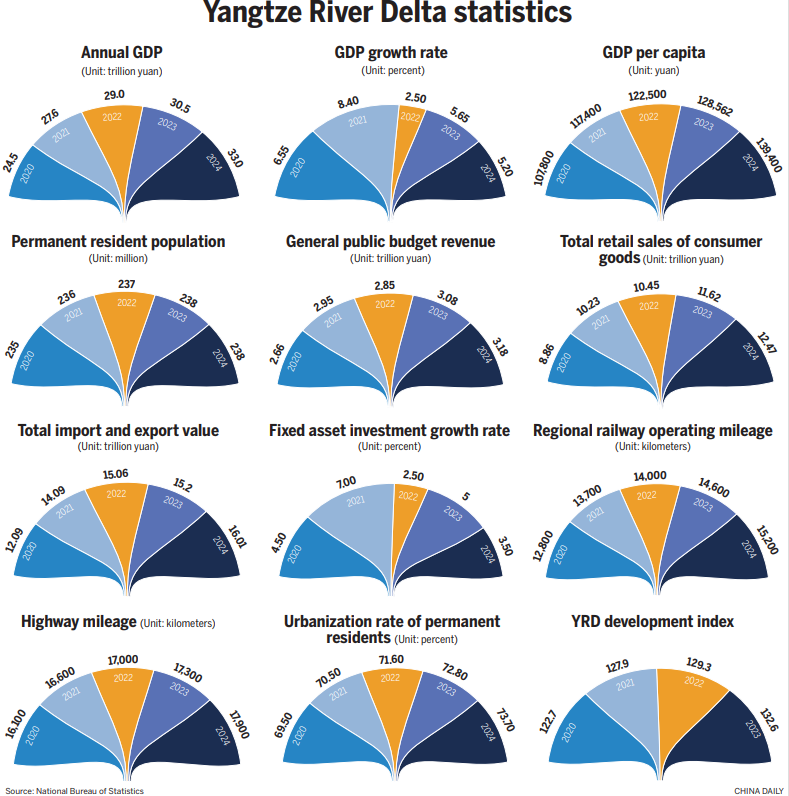
Leading by example
The Yangtze River Delta region — comprising Shanghai, and Jiangsu, Zhejiang and Anhui provinces — has seen its leading position in China's technological innovation become increasingly evident, according to a report released by the Chinese Academy of Science and Technology for Development in late September.
The region accounted for over 30 percent of China's research and development expenditure, industry experts, high-value patents, and high-tech exports. Nearly half of the country's international technology income is generated in the region, the report said.
Liu Dongmei, the academy's Party secretary, said coordinating technological innovation is never the job of one government department. Various industries should be included and resources efficiently directed across different administrative regions, she said.
One example in the Yangtze River Delta region is the production of Tesla electric vehicles. While Shanghai provides the chips for the smart-driving technology, Jiangsu supplies the batteries, Zhejiang does the body casting, and Anhui is responsible for the final vehicle assembly.
The region is home to industrial clusters of three emerging technologies — integrated circuits, biomedicine and AI. Nearly 60 percent of China's IC industrial output, one-third of the AI industrial output, and one-third of biomedicine are all generated in the region.
The emphasis on technological innovation, which has been a common approach among local governments, has paid off.
The region's GDP topped 33 trillion yuan ($4.64 trillion) in 2024, surpassing that of Japan. Taking up just 4 percent of China's total area, the region contributed nearly 25 percent of the country's GDP.
Other regions have also noticed the power of coordinated technological innovation. The Beijing-Tianjin-Hebei region saw its combined R&D expenditure reach 445.8 billion yuan last year, according to the CASTED report. The area's R&D expenditure intensity, or the ratio of R&D expenditure to GDP, approached 4.3 percent — 1.6 times the national average.
Similar examples can be found in the Guangdong-Hong Kong-Macao Greater Bay Area.
Guangdong province's R&D expenditure hit 510 billion yuan in 2024, according to National Bureau of Statistics data, topping the 500-billion-yuan threshold for the first time and securing its position as the largest R&D spender among all provincial-level regions for the ninth consecutive year.
The Qianhai Shenzhen-Hong Kong Youth Innovation and Entrepreneur Hub, located in the western part of Shenzhen, Guangdong, is only 30 minutes drive from central Hong Kong. It has served as the first stop for many Hong Kong startups aiming to expand their footprint in the Chinese mainland.
Since the hub's establishment in 2014, a total of 1,450 startups have been nurtured there, with 1,028 of them originating in Hong Kong, Macao and other places.
The progress in the Yangtze River Delta region is reliant on the shared targets of the local governments, which are translated into coordinated development plans and co-working mechanisms.
The coordinated development of the Yangtze River Delta region was elevated to a national strategy in 2018, but its inauguration in November 2019 as demonstration zone for the region's green and integrated development was a major step toward it coming up with concrete measures.
By the end of 2024, over 112 coordinated institutional innovations had been nurtured in the zone. Among those, 38 have been promoted nationwide, in areas covering ecological conservation, land management, cross-regional flow of production factors, and integrated tax collection and administration.
In July 2022, a collaborative plan to seek technological breakthroughs in the Yangtze River Delta region was released, encouraging new systems for innovation and allowing multiple entities to invest in technologically advanced projects.
So far, the plan has supported 87 projects, including fundamental research projects.
Up to 1.7 billion yuan of investment has been directed to projects under the plan, of which 340 million yuan came from the fiscal budgets of local governments.



- Cross-Strait Chinese New Year bazaar unites cultures in Fuzhou
- Emergency Management Minister Wang Xiangxi under investigation
- Overseas-Chinese group tours Xinjiang as special guests
- China launches satellite for Algeria
- Capital accelerates humanoid robot mass production
- Video series unveils Hebei's breathtaking ecology, landscape