'Bird facial recognition' aids avian conservation









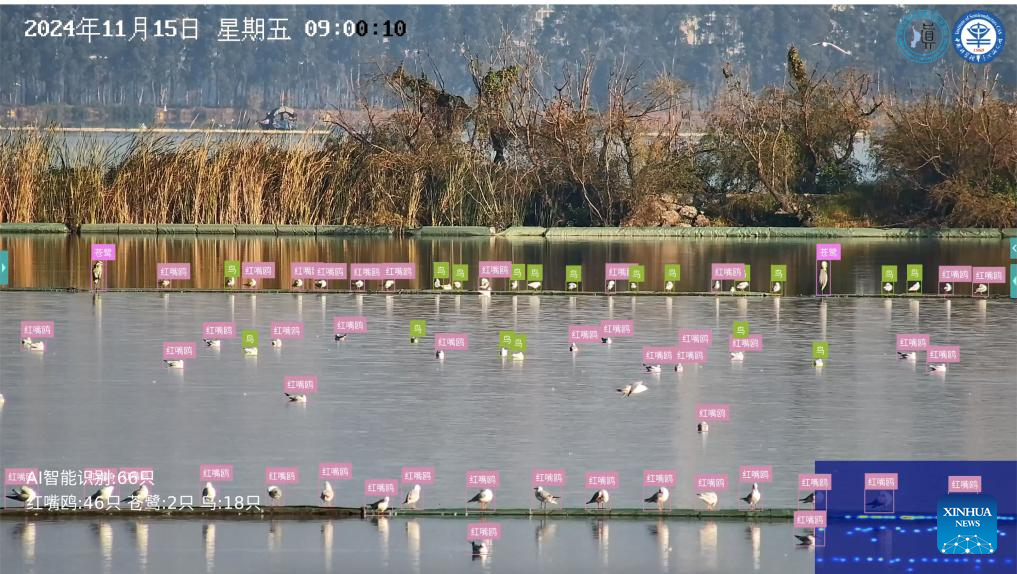
KUNMING — Every winter, tens of thousands of black-headed gulls complete their long journey from as far away as Siberia to Kunming, the capital of Yunnan province, where it is renowned as the "Spring City".
This year, these regular visitors will be greeted not only by enthusiastic Kunming residents, but also high-definition cameras and drones stationed at the city's Dianchi Lake, ready to monitor them using AI-powered "bird facial recognition" technology.
The enduring bond between the people and the gulls is a distinctive ecological and cultural feature of Kunming. Now, this relationship is being redefined by technology, as research teams collaborate with institutes and tech firms to integrate artificial intelligence deeply into bird protection — creating an intelligent observation system centered on this novel identification method.
Since October 2022, the Kunming Dianchi Plateau Lake Research Institute has used an intelligent observation program for gulls at a monitoring station near Haigeng Dam.
After two years of continuous tracking, this system revealed that the main flock's arrival in Kunming in 2024 was about 10 days later compared to 2022 and 2023. The system will continue monitoring arrival times and population numbers this year, accumulating crucial data for migratory bird research, according to the institute.

Unlike traditional manual observation, the system utilizes high-definition cameras, drones, microphones and deep neural network algorithms to identify birds.
Distinctive features such as plumage, body size and beak shape serve as unique "identity markers", enabling real-time species identification, population counting, tracking of migration routes and the creation of a dynamic Dianchi bird archive.
"Previously, manual monitoring of the same area required at least two professional birders for a full day. Now, the AI system accomplishes this in just hours with 90 percent accuracy, while simultaneously recording behavioral data such as feeding and roosting," said Pan Min, deputy director of the institute.
Traditional methods, reliant on human observation, were labor-intensive, required high-level expertise and struggled to ensure consistent accuracy. The integration of AI is now driving a digital transformation in bird surveys across China.
Employed at several demonstration sites in Kunming, the AI system has identified 17 bird species, building a database containing hundreds of thousands of images, videos and audio recordings. The team has also deployed acoustic recognition systems that identify species such as the night heron and magpie via their unique call signatures.
According to Zhang Zhizhong, an engineer at the institute, the AI system allows researchers to not only monitor long-term changes in bird communities but also to study activity patterns, breeding habits and migration routes. This provides vital data for assessing wetland ecological health and biodiversity levels.
The reliability of this "bird facial recognition" technology was validated in a paper published by the research team in the Journal of Environmental Management in May 2025 — offering new perspectives for future biodiversity investigations.
Notably, the application of AI monitoring of birds is expanding beyond Kunming. In Chongqing Liangping Shuanggui Lake National Wetland Park, a big data platform uses ultra-high-definition cameras for real-time multi-target bird capture and identification. Similarly, at the Yellow River Delta National Nature Reserve in Shandong province, an AI system operational since 2022 has recorded over 1,200 birds, including oriental white storks and whooper swans, thereby providing robust data support for reserve management.
"The use of technological means allows us to understand and protect nature more scientifically and gently," Zhang said.
Zhang added that while minimizing human disturbance, the introduction of AI and intelligent monitoring systems also addresses the shortcomings of incomplete and inaccurate data inherent in traditional methods, thus creating new possibilities for biodiversity conservation.
Xinhua






- Beijing West Railway Station marks 30th anniversary
- Taiwan businessman: Taiwan compatriots will see more opportunities in next five-year plan
- Xinjiang reports highest foreign trade growth in China
- Harbin authorities demand return of pensions paid out to deceased
- Global research project on AI guardrails launched in Beijing
- Partnering with China, embracing opportunities