


The riddle of the missing palaces









Footprints of exchange
It is said that the iconic Venetian traveler Marco Polo was commissioned by Kublai Khan, the Yuan founding ruler, as an official to serve the dynasty.
As Yuan-era canals and ruins of earthen city walls give modern Beijing a unique identity, the whereabouts of the Khan's imperial palaces, mentioned in Marco Polo's poetic descriptions, remain shrouded in myth.
"The roof is very high. The walls of the halls and chambers are all covered with gold and silver, and decorated with pictures of dragons, beasts, birds, knights and idols, and other things," according to a quote from The Travels of Marco Polo. The traveler hailed Beijing as Khanbaliq, or Khan's city.
"The exterior of the roof is colored with vermilion, yellow, green, blue and other hues, which are covered with a varnish so fine and exquisite that they shine like crystal, and lend a resplendent luster to the palace as seen for a great way round..."
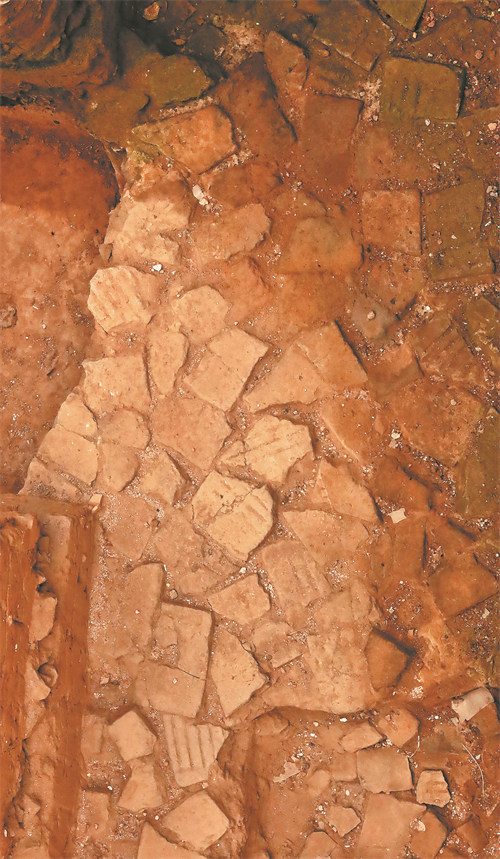
For Xu's team, discoveries of broken "peacock blue" glazed pieces from the excavation pits, in spite of their imperfect condition, seem to crystallize the ostentatious lines.
This ceramic variety originating from West Asia was primarily used as vessel decoration, Xu explains. Archaeological evidence indicates that these wares were imported to China during the Tang Dynasty (618-907) and the following Five Dynasties (907-960). But their influence on domestic porcelain manufacturing only became crucial centuries later, after their localized production emerged under Mongol rule.
"This shift was fundamentally enabled by its vast Eurasian territory," Xu says. "It facilitated trade exchanges and cultural communications."
Yuan-era Mongol elites thus favored the vibrant azure hue reminiscent of celestial depths. That not only saw surging popularity for the signature blue-and-white ceramic vessels, but also led to extensive application of the peacock blue glaze in palace complexes and ceremonial architecture.
"Our scientific analyses of unearthed artifacts from the Forbidden City revealed that material of their bodies matches loess that is widely distributed in northern China," Xu says. "And the glaze formula is identical to architectural elements excavated from local glazes in Beijing."
That echoes a description in the 14th-century documentation History of Yuan: "Four glazed ceramic kilns existed in the city of Dadu."