AI 'waifus' pose grave emotional risks









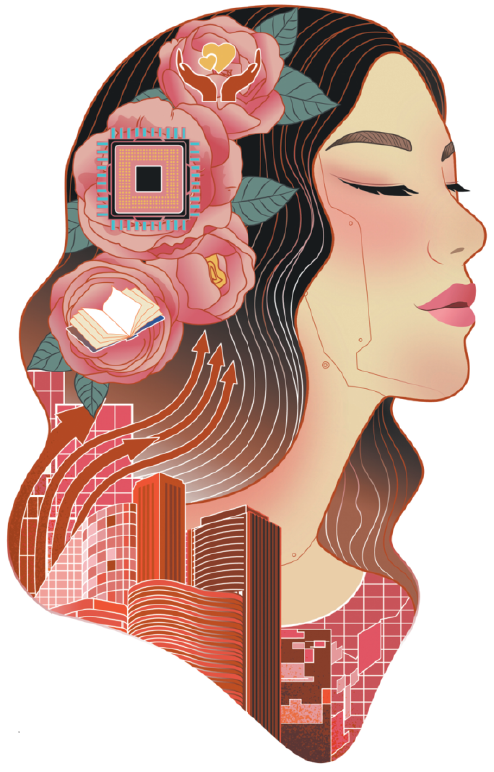
Our everyday life is being increasingly shaped by artificial intelligence, and the line between reality and fantasy is becoming ever blurrier. Recently, Grok, a free AI assistant designed by xAI to "maximize truth and objectivity", introduced a "waifu" character — a virtual anime-style character designed to gain user affection, potentially at the expense of real-life relationships.
This raises deep concerns: Is technological innovation now outpacing ethical regulation? Are we witnessing Big Tech racing to the bottom?
While this feature may seem harmless entertainment or, more cynically, Grok's marketing strategy to compete with OpenAI's new AI Agents, which can plan and organize your trip to attend a wedding party, it raises bigger questions about AI companies' emotional manipulation, their impact on social well-being, and the future of human relationships.
Leshner et al. (2025) have studied how people form intimate connections with fictional characters, particularly within the anime fandom where "waifus" (idealized female characters) and "husbandos" (idealized male characters) are prominent. Their study revealed that men tend to form sexual connections, often driven by physical appearance, while women are more likely to form emotional connections, shaped by personality traits and perceived similarity.
These findings suggest that the psychological mechanisms underpinning human-human relationships, such as attraction, emotional bonding and even love, can extend to fictional entities. The study underscores the human capacity to form meaningful connections, even when the "partner" exists only on a screen or in a narrative.
But what happens when these connections are no longer one-sided? When AI characters like Grok's "waifu" are designed to actively engage, flatter and adapt to users' desires, the line between para-social relationships (one-sided emotional bonds with fictional characters) and real-life intimacy becomes dangerously ambiguous. As Leshner et al. highlight, these connections can be deeply meaningful and, in some cases, rival or displace real-life relationships.
While the idea of a personalized AI companion is evocative — recalling films like Her — the ethical implications of such technologies are serious. By exploiting well-documented psychological tendencies, such as men's preference for physical attractiveness or women's desire for emotional connection, AI systems risk fostering unhealthy emotional dependencies. AI "waifus" are not just characters on a screen; they are tools explicitly designed by leading AI companies to engage, manipulate and blur the lines between authentic human connection and commercial profit.
The stakes are particularly high for educators and parents. Such systems have the potential to distort young people's understanding of relationships, intimacy and consent. As Leshner et al. observe, para-social relationships, while often harmless, can teach individuals about intimacy. Yet when such relationships are shaped by profit-driven AI systems, they risk promoting distorted and idealized models of human interaction, potentially undermining relational skills and emotional development.
As AI technology evolves, it becomes imperative to critically examine their implications. If AI developers cannot be persuaded by civil society to adopt an ethical approach, regulation must step in. But what can we, as linguists, educators and parents, do in the meantime?
One immediate step is to foster critical AI awareness among our students and communities. Open conversations about the distinctions between real and fictional relationships, as well as the psychological impact of para-social bonds, are essential. Educators can incorporate discussions of AI's ethical implications into their curriculums, helping young people critically evaluate their interactions with these systems.
At the same time, we must raise our collective voices to question AI companies: Are we steering AI innovation in a direction that enhances humanity, or are we creating tools that erode the very fabric of human connection? The answers will depend on the values we choose to uphold and the vigilance we maintain against this rapidly advancing field.
As Leshner et al. show, humans have an extraordinary capacity to form meaningful connections, even with fictional characters. But with this capacity comes a profound responsibility: ensuring that these connections enrich our lives rather than replacing them. As Yuval Noah Harari, author of Sapiens, aptly observes, "If the only intimacy we can form is with a non-human AI, then we have no intimacy at all."
Let's take up this call with urgency. Will the corporate empire of AI listen to civil society?
Chances are it won't, given the imperative to optimize profit at all (human) costs. Will governments step up regulation? The US government recently passed a bill forbidding states from regulating AI. We're witnessing corporate and national interests combined to take precedence over human interests. By raising critical AI awareness, we can perhaps, at least, work toward, even if in a small way, a future where AI technology serves humanity's best interests, rather than compromising them.
Angel Lin is chair professor at The Education University of Hong Kong; Liang Cao is a post-doctoral fellow at the same university. The views don't necessarily reflect those of China Daily.
If you have a specific expertise, or would like to share your thought about our stories, then send us your writings at opinion@chinadaily.com.cn, and comment@chinadaily.com.cn.