



Cult of strength hinders peace-building in Europe









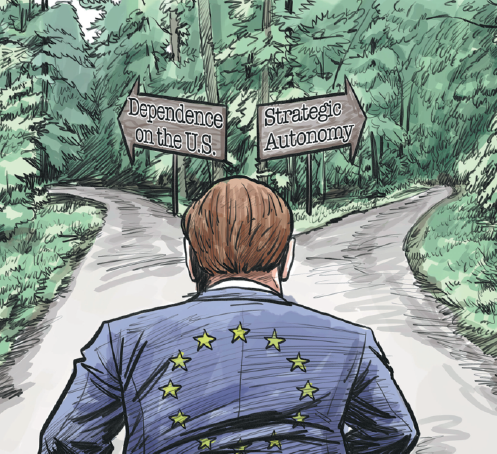
Europe can learn lesson from Ukraine crisis and needs autonomous strategy in regional security order
The prolonged conflict between Russia and Ukraine has caused enormous humanitarian suffering. The international community widely hopes to see de-escalation and the restoration of peace. In early 2025, signs of a temporary thaw emerged as the two parties started to directly engage and talk, offering a glimmer of hope for a negotiated resolution.
The conflict is not only an outcome of the strategic rivalry between the United States and Russia but also the result of longstanding imbalance in European-Russian security relations. If the US and its European allies continue to avoid responsibility for the evolution of the conflict and ignore the dangers of confrontational diplomacy, then hopes for lasting peace will remain elusive.
Looking back over the past three decades since the end of the Cold War, the West has aggressively pursued a liberal international agenda, openly aiming at building a "liberal empire". Driven by liberal ideology, the US has sought to transform former Cold War adversaries and integrate them into a Western-dominated international system through economic liberalization and political democratization.
This marked a fundamental shift in the nature of East-West relations. What had once been a relatively balanced confrontation turned into an overwhelming victory for one side. Against this backdrop, the West supported pro-Western political forces in various countries and sought to promote the transformation of these countries into liberal democracies, thereby consolidating Western global dominance. After the Sept 11 terror attacks in 2001, neoconservatives gained influence and an upper hand in US foreign policy, triggering a radical shift in US foreign policy. The US increased its military presence in the Middle East and implemented so-called democratic reform plans aimed at regime change. In the former Soviet Union republics, Washington continued to foment "color revolutions", severely undermining local political balances.
In the case of Russia, surging international energy prices in the early 2000s led to rapid economic growth and improved national strength. This gave rise to ambitions for restoring national confidence and efforts to reshape its regional influence. During the Cold War, the US and the Soviet Union vied for influence across the developing world, with prolonged and intense confrontations in Eastern Europe. After the Cold War, Western influence gradually expanded into the post-Soviet Union sphere, eroding Russia's traditional buffer zones and increasing its geopolitical vulnerability. Ukraine's full alignment with the West became the last straw that crashed the regional balance and led to the outbreak of the crisis.
In July 2010, Ukraine adopted the Law on the Fundamentals of Domestic and Foreign Policy, which legislatively codified its non-aligned status and commitment to not joining NATO. But in December 2014, Ukraine repealed the law and reinstated NATO accession as a national objective. Since then, the domestic process of NATO accession accelerated in Ukraine. In May 2021, the US government publicly expressed support for Ukraine's NATO membership — an unprecedented move.
Russia continued diplomatic engagements and conducted military exercises to send political signals. Yet these "attention-seeking exercises" were not only ignored but also dismissed by the US and its NATO allies. At the time, the US, under President Joe Biden, was eager to restore traditional alliances and projected a "tough "posture toward Russia. This gave rise to a dangerous cycle of escalating hostility characterized by provocations and counterreactions. To defend its strategic credibility, Russia launched what it termed a "special military operation".
The Ukraine crisis quickly escalated into an undeclared war between the West and Russia — or what many analysts describe as a US/NATO proxy war in Ukraine. Under the Biden administration, mainstream US media placed the blame solely on Russia for the crisis. But this narrative, which seeks to absolve the West of responsibility, obscures the critical role that the US and NATO have played in the conflict. Now entering into its fourth year, the conflict has also been proved to be the result of the deep involvement of external powers.
This tragic humanitarian disaster must end as soon as possible. Peace must be restored without delay. However, given the evident power asymmetry between Russia and Ukraine and the lack of mutual trust, a cease-fire or peace settlement is unlikely to emerge from the internal dynamics of the directly involved parties alone. Therefore, restoring peace will require external conditions to be created and the removal of external obstacles to peace.
In theory, at least four external conditions must be met to achieve peace in the Russia-Ukraine region. First, a compromise between the US and Russia; second, mutual understanding between Russia and Europe; third, the emergence of a new international peace movement; and fourth, broader recognition from the international community. The first two conditions depend primarily on the balancing of interests among the parties and will be determined by the strength and capabilities of the parties to the conflict. The latter two require broader international engagement to break the spiral of escalating hostility and to uphold shared global values. Among these conditions, a US-Russia compromise is likely to be the first, and the most crucial step. While there have been repeated setbacks, dialogue between the two sides has resumed and is progressing.
In contrast, Europe still clings to the idea of defeating Russia on the battlefield and remains trapped in the illusion of achieving "peace through strength".European countries must reflect on whether or not NATO's eastward expansion over the past two decades has made Europe safer. The answer is likely negative. If security had improved, military spending would have declined, but the fact is many European countries are now drastically increasing their military spending. Moreover, Europe must ask whether blindly following the US in pursuing a confrontational policy has brought stability or rewards. Currently, Washington has already begun bypassing Europe on certain Ukraine-related issues and is engaging directly with Russia and Ukraine. Under such circumstances, Europe must take the initiative to seek a more autonomous strategic space based on its own interests, or risk being marginalized in the future regional security order.
The author is a research fellow at the Institute of American Studies at the Chinese Academy of Social Sciences. The author contributed this article to China Watch, a think tank powered by China Daily.
Contact the editor at editor@chinawatch.cn.





