



Urban renewal initiative key to revitalizing cities
Addressing problems such as deteriorating housing, aging infrastructure high on agenda









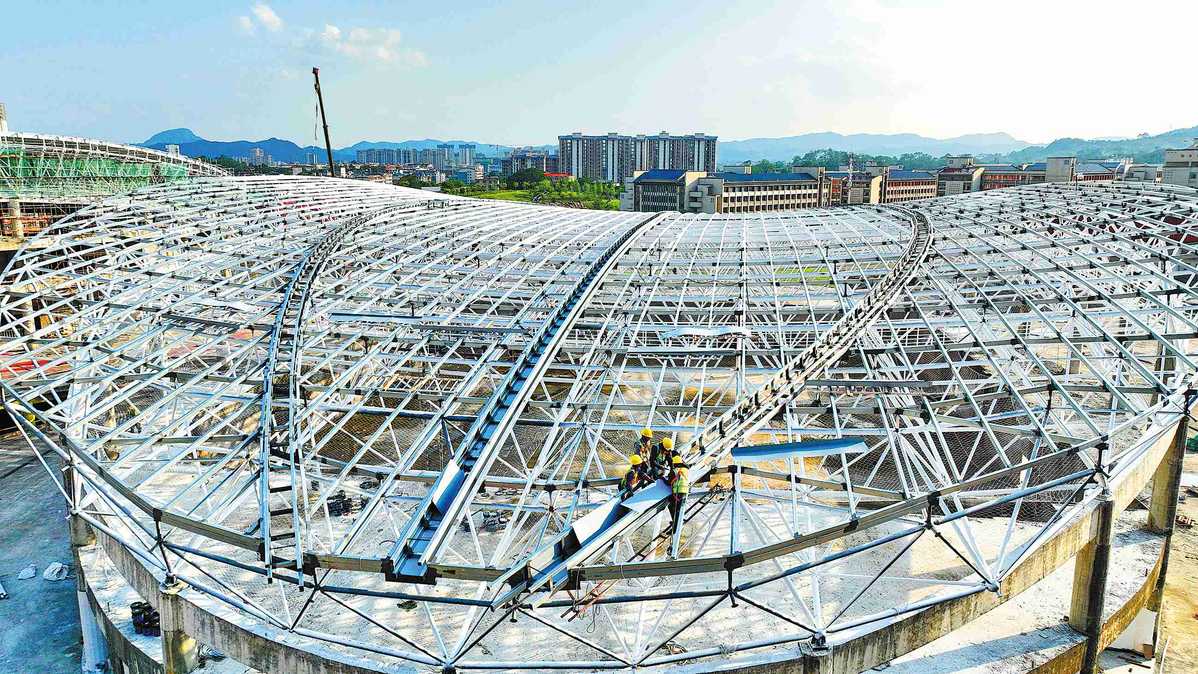
China is ushering in a large-scale urban renewal initiative, which not only involves improving people's quality of life, but also serves as a crucial driver for expanding domestic demand and provides support for the sustained recovery of the real estate market, officials and analysts said.
Over the past few decades, China has experienced the largest and fastest urbanization process in human history. Its urbanization rate, which measures the ratio of permanent urban residents relative to the total population, reached 67 percent last year, said the National Bureau of Statistics.
"However, the rapid advancement of urbanization has also given rise to 'urban problems', such as deteriorating housing and infrastructure, inadequate underground pipeline networks and cramped public spaces," said Yang Baojun, president of the Urban Planning Society of China.
In its latest push to tackle these issues, China issued a guideline in mid-May pledging increased policy and financial support for urban renewal projects, which range from gas pipeline upgrades and elevator installations to the renovation of old factories into commercial zones.
The guideline, issued by the general offices of the Communist Party of China Central Committee and the State Council — the country's Cabinet — set its sights on achieving significant progress in its urban renewal initiative by 2030. They aim to improve safety conditions, enhance service efficiency, elevate living environments, develop business models and preserve cultural heritage.
"The country's early understanding of urban renewal had been relatively limited, initially focusing on the mere renovation of old residential communities," Yang said. "The initiative was later extended to cover old neighborhoods, old industrial zones and urban villages."
The new guideline, by addressing a wide range of issues — from basic livelihood needs to urban function and structure optimization — aims to lay a solid foundation for the sustainable growth of China's cities, Yang added.
Experts believe that the government's broader vision for high-quality urban renewal initiatives has the potential to unleash new growth drivers, from upstream industrial revitalization to the cultivation of diverse consumption scenarios and the transformation of the real estate sector.
Transforming historic districts, aging factories and cultural blocks creates vibrant, experiential consumption environments — such as boutique retail, hospitality and cultural venues, said Wang Binwu, an associate researcher of the policy research center with the Ministry of Housing and Urban-Rural Development.
In Suzhou, Jiangsu province, the renovation of Shiquan Street has resulted in a two-hour extension of nighttime business hours, leading to a 30-50 percent increase in shop revenues. In Wuxi, the transformation of abandoned factory buildings into a cultural and technology industrial park has attracted over 100 enterprises, generating annual tax contributions exceeding 15 million yuan ($2.1 million), Wang said.
Meanwhile, the renovation of old houses and neighborhoods will better meet people's demand for quality homes, Wang said, adding that regions across China have also prioritized installing lifts in existing residential buildings as a key livelihood project. This initiative has particularly benefited the elderly and mobility-impaired.
The ministry pledged in December to complete the renovation of aging urban residential communities built before the end of 2000 by the year 2025.
China renovated 280,000 aging residential communities from 2019 to 2024, benefiting more than 120 million people, according to the ministry.
"By boosting land values, fiscal revenues, household assets and consumption, urban renewal investments can become a powerful engine for driving sustainable economic growth," Wang said.
Looking ahead, urban renewal is a long-term, ongoing process, and relying solely on government fiscal resources is not enough. Experts therefore suggest the need to explore institutional innovations that can attract more social capital to participate in and support this endeavor.
In the past, urban renewal efforts were largely government funded. Given the government's diverse responsibilities and resource constraints, relying solely on government investment is unsustainable, said Dong Yu, executive vice-president of the China Institute for Development Planning at Tsinghua University.


















