



Catalyst for change









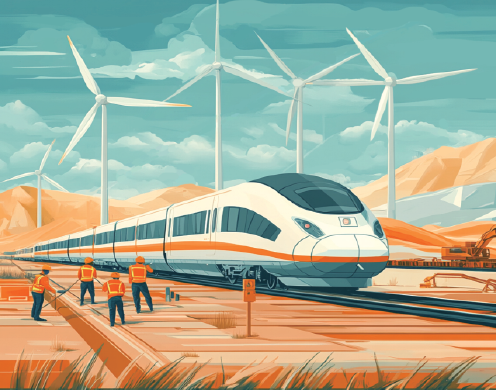
Peaceful cooperation and win-win cooperation represent the real spirit of the Belt and Road Initiative
The Belt and Road Initiative proposed in 2013 is a pivotal framework for China's neighborhood cooperation in the new era, and an attempt to build a new type of regional cooperation mechanism. The initiative is also a platform for China to expand its economic diplomacy and to push a new round of comprehensive opening-up.
Since its inception, the BRI has been committed to enhancing policy, infrastructure, trade, financial and people-to-people connectivity, with the aim of building a community with shared interests, shared responsibility and shared future for participating countries based on political mutual trust, economic integration and cultural inclusiveness.
The BRI is a platform for promoting win-win cooperation and sustainable development, and its fundamental goals include raising the levels of people's livelihoods in the countries involved, improving the distribution of incomes, optimizing industrial structures, and promoting urbanization. In essence, the precondition for realizing these development goals is economic growth.
The economic rationale for high-quality Belt and Road cooperation is roughly the same for economic growth. There is only one source of economic growth, or one source for the growth of income: the increase in labor productivity, namely the increase in the economic output a worker can produce in a given amount of time. And there are two direct causes for higher labor productivity: technological advancement and the division of labor and trade.
Examples of technological advancements that have raised labor productivity are abundant, not least in the era of artificial intelligence, when human society is undergoing profound and sweeping changes. In the absence of technological progress, the division of labor among different groups of people and specialized production and exchanges can also create "trade benefits" and thereby increase economic output. That is why economists universally uphold technological innovation and free trade and investment.
Innovation is created by people, and people's actions require incentives. Trade benefits derive from the division of labor and exchanges, of which the prerequisite is the trust in contracts. The foundation of incentives and trust is mainly the institutional arrangements related to preferences and behaviors of people. Institutions can trigger productive incentives or cause exactly the opposite. Meanwhile, whether in theory or in reality, the depth of division of labor and specialized production is highly correlated with the size of markets. In other words, the higher the quality of institutional arrangements, the wider their coverage, the bigger the trade benefits.
That is why economic and trade cooperation promoted by the BRI is of great significance. Cooperation refers to the collective actions of many countries or economies to transcend the limitations of their respective market sizes and expand trade through the deepening division of labor. The aim is to enable all participants to enjoy the larger benefits brought by expanded markets and trade.
One of the key conditions for translating potential benefits from trade into reality is for all participants to take collective actions, namely to form bilateral or multilateral institutional arrangements that remove barriers to the division of labor and trade based on consultations.
Thus, one primary path of advancing high-quality Belt and Road cooperation is institutional building. By May 2025, more than 150 countries and over 30 international organizations have signed Belt and Road cooperation documents with China, facilitating the standardization of customs clearance and tax agreements and lowering the institutional costs of trade.
The theories and goals are concrete, and so should the path to realizing the goals be. China advances Belt and Road cooperation through a four-pronged approach: material, institution, currency and concept.
In terms of material, China gives play to its advantages in infrastructure and equipment manufacturing to drive international capacity cooperation through domestic industrial upgrading, and forge a cross-regional production network and highly integrated markets based on infrastructure interconnectivity.
China boasts vast production capacity and a huge domestic market, while many other developing countries involved in the BRI are rich in resources and labor force. BRI cooperation can deepen the division of labor, extend industrial chains and enhance integration of production factors, thus forging a close-knit community of shared interests and development for all participating countries.
Meanwhile, we need to guard against the potential risks from infrastructure investment, particularly low investment returns and security issues.
Beyond the "hard connectivity" of infrastructure, there is also the "soft connectivity" that refers to the institutions or rules that govern international division of labor and trade. In a sense, the quality and implementation of institutions and rules will determine the outcome of Belt and Road cooperation.
As participating countries, with their varied systems at home, have signed many bilateral or multilateral trade and investment agreements, and may have close or distant relations with non-BRI countries, coordinating trade rules through establishing institutional infrastructure and achieving institutional innovation is a major challenge for Belt and Road cooperation.
The BRI is designed to create more opportunities for Global South nations to participate in the making of global rules. By strengthening bilateral and multilateral cooperation, China and other Global South countries are working to reform the current international system of rules, fostering more neutral and equitable international institutions that better safeguard the interests of developing nations.
With a large number of participating countries and different national conditions, it is crucial to deepen the understanding of the initiative's significance for enlarging the benefits of all stakeholders. There are various misconceptions of and defamation against the BRI: some label it as "neocolonialism", and some regard it as China's attempt to build a system in parallel with the Western one.
In reality, peaceful cooperation, mutual learning and win-win cooperation are the real spirit of the Silk Road, which is the legacy of the traditional Chinese philosophy. As Confucius said, to establish oneself, one should help others establish; to achieve one's goals, one should help others achieve theirs. This ancient adage has been adapted into the concept of "Confucius improvement", referencing the "Pareto improvement".
"Pareto improvement" refers to an improvement to a society that "makes at least one person better off without making anyone worse off". It is a desirable target due to the obvious reason that someone gains while no one loses. However, that is still not good enough because such a situation does not benefit every member in society. In this sense, "Confucius improvement" can be viewed as an upgraded version of "Pareto improvement", which meets the development needs of the era, and reflects China's pursuit of common development.
Today, changes of the world and of the times are unfolding like never before. One of the unprecedented challenges facing the world is political interventions that impede global and regional development, such as trade protectionism that goes against basic economic laws, and "discriminatory regionalism" in the form of building "small yard, high fences", all of which will inflict damage on all participants of free trade. The fundamental goal of the BRI is to promote an equal and orderly multipolar world and universally beneficial and inclusive economic globalization, and achieve lasting peace and common prosperity for humanity.
The author is an academic member at the Chinese Academy of Social Sciences and dean of the School of International Politics and Economics at the University of Chinese Academy of Social Sciences. The author contributed this article to China Watch, a think tank powered by China Daily. The views do not necessarily reflect those of China Daily.
Contact the editor at editor@chinawatch.cn.





