



Tariff response injects stability in global trade









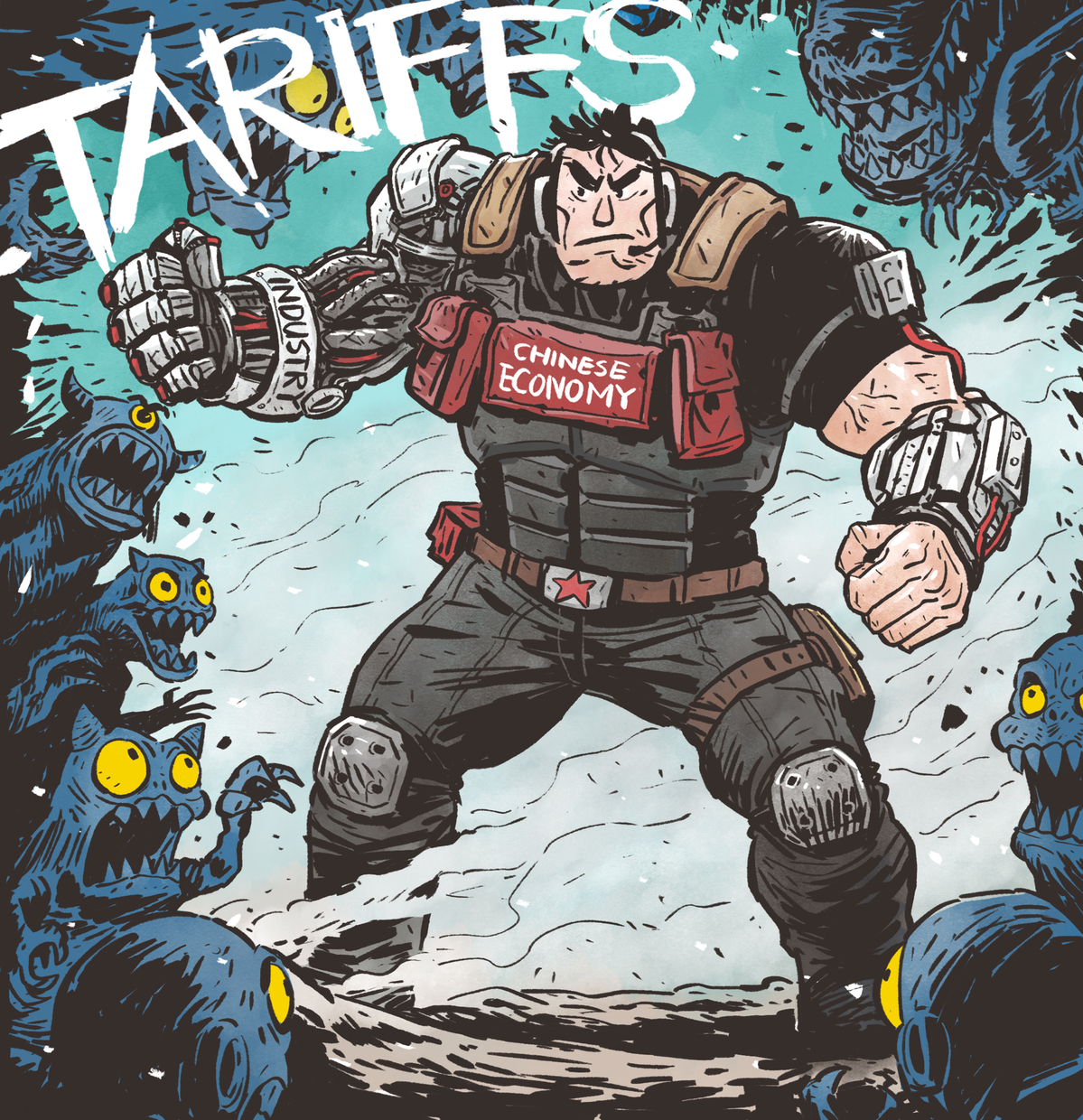
On April 2, United States President Donald Trump declared a so-called "Liberation Day" for the country, brandishing tariffs as weapons and launching surprise attacks across global trade. Trump claimed these measures were necessary to reclaim "economic sovereignty", revive US manufacturing and reduce trade deficit. His arbitrary tariffs sent shock waves through the global trading system, forcing many countries to urgently reassess potential losses and seek coping countermeasures.
As the world's largest goods trading nation, China has borne the brunt of these anti-globalization headwinds and has inevitably been affected. Yet, instead of backing down in the face of US unilateralism and protectionism, China has taken a clear and firm stance, directly countering and refuting the flawed logic and bullying behavior of the US.
China has voiced its position and taken action across multilateral platforms such as the WTO, bilateral frameworks like free trade agreements, and multilateral mechanisms. These efforts underscore China's commitment to upholding international rules and order while highlighting the global harm of the US' actions. China's response has resonated with many of its trade partners, contributing to greater international coordination and offering much-needed stability for global supply chains.
As the world's top manufacturing nation, China's industrial performance holds significant weight for its economic trajectory. In the first quarter, China's value-added industrial output above designated size grew by 6.5 percent year-on-year, an increase of 0.7 percentage point compared with the full-year growth rate of the previous year, marking a notable acceleration. Among the three major sectors, the mining industry grew 6.2 percent year-on-year, manufacturing by 7.1 percent, and the production and supply of electricity, heat, gas and water by 1.9 percent. The value-added output of the equipment manufacturing sector rose 10.9 percent year-on-year, accelerating by 3.2 percentage points from the previous year. High-tech manufacturing grew 9.7 percent, an acceleration of 0.8 percentage point. Of the 41 major industrial categories, 36 registered growth in added value, with notable gains in railway, ship, aerospace and other transport equipment manufacturing (up 20.8 percent), electrical machinery and apparatus (up 12 percent), and computers, communication and other electronic equipment (up 10.6 percent). These products not only support China's high-quality development, but also create favorable conditions for global economic growth. In many of China's trade relationships, mechanical and electrical products represent a significant share, providing reliable and cost-effective intermediate goods that support industrialization around the world.
China's consumer market has also maintained a steady recovery in recent years. As consumer demand shifts toward higher-quality products, global producers of consumer goods are vying for a share of the Chinese market. In the first quarter, China's total retail sales of consumer goods reached 12.4671 trillion yuan ($1.7 trillion), up 4.6 percent year-on-year, an acceleration of 1.1 percentage points compared to the full-year growth of the previous year. The country's online retail sales totaled 3.6242 trillion yuan, an increase of 7.9 percent year-on-year. Of this, online retail sales of physical goods reached 2.9948 trillion yuan, up 5.7 percent, accounting for 24 percent of total retail sales of consumer goods.
E-commerce has expanded consumer choice, particularly in rural areas where consumption growth outpaced urban markets. Amid export pressure, companies like JD.com have pledged to help export-oriented firms sell their would-be-exports at home, and Hema has opened its platform to foreign trade enterprises. Under the guidance of the Ministry of Commerce, retail giants like Yonghui, CR Vanguard, and Lianhua have launched support programs to help exporters expand internally. These initiatives are not reactive moves triggered by reciprocal tariffs, but rather a continuation of efforts to integrate domestic and foreign trade. By narrowing the gap between internal and external markets, China is advancing its dual circulation strategy and improving resource efficiency, competitiveness and sustainability.
In the face of tariff shocks, New York Federal Reserve President John Williams, a voting member of the FOMC, expects a significant slowdown in US GDP growth, possibly falling below 1 percent in 2025, down from 2.8 percent in 2024. He predicts the unemployment rate will rise from 4.2 percent to 4.5-5.0 percent by year-end, while inflation could climb to 3.5-4 percent. University of Michigan's April consumer sentiment index dropped 11 percent from the previous month and 30 percent since December. Inflation expectations surged to their highest level since 1981. Fearing rising prices, many US consumers rushed to buy essential items, anticipating further price hikes. This panic buying triggered a herd effect, exacerbating shortages and increasing reliance on foreign imports for restocking. Trump believes the trade deficit reflects a loss, but in reality, by printing dollars that can no longer buy goods, many US consumers have been deprived of the very "loss" they once had the option to choose.
The widely accepted notion that "no one wins in a trade war" should not be undermined by the unchecked rise of unilateralism. US tariffs directly harm export businesses and consumers, while eroding trust in international trade norms and in the US itself. Faced with US threats and implementation of various unilateral tariffs, including reciprocal duties, China, the EU, Canada and others have responded swiftly and firmly. China's countermeasures were notable for their speed and volume, including targeted tariff increases on US imports. Yet China deliberately refrained from further escalation after hitting a certain threshold, refusing to play the US' "numbers game". These actions, grounded in China's Foreign Trade Law and other legal frameworks, represent a firm stand against economic coercion and echo the concerns of many developing nations.
It is important to recognize that US tariffs are mere tools to pressure other countries into concessions. Yet in responding, nations may inadvertently undermine the existing multilateral framework. During a video call with WTO Director-General Ngozi Okonjo-Iweala, Chinese Commerce Minister Wang Wentao emphasized that WTO members must jointly defend an open, rules-based multilateral trade system. Okonjo-Iweala stressed that any outcomes of consultations with the US should adhere to the WTO's most-favored-nation principle — meaning that any tariff reductions granted to the US should also apply equally to all other WTO members.
Although the current era of globalization is evolving, the underlying trends of reduced communication costs and greater interconnectivity, driven by technology and innovation, remain irreversible. In the digital economy, the global flow of resources is becoming faster and more efficient, spurring industrial cooperation and innovation. Driven by global consensus on reducing greenhouse gas emissions, competition and collaboration between China and the US in this field have accelerated innovation. As technology and market demand expand, EVs have emerged as a star of global manufacturing, catalyzing commercialization in related sectors like autonomous driving, batteries and vehicle networking.
The writer is deputy director and research fellow at the Institute of American and Oceanian Studies, Chinese Academy of International Trade and Economic Cooperation, Ministry of Commerce.
The views do not necessarily reflect those of China Daily.


















