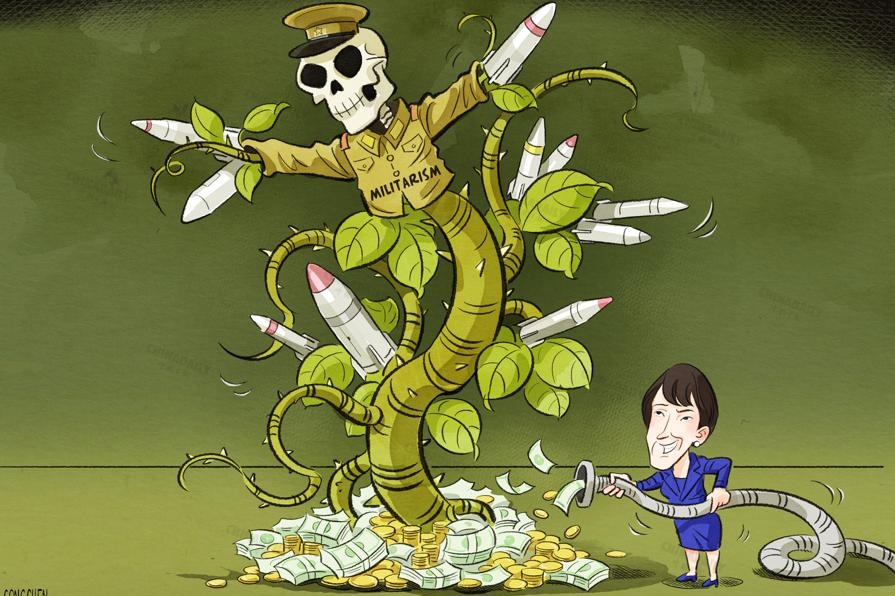
Asia's security its own business, no external party should interfere










In 2012, two American scholars published "A Tale of Two Asias" in Foreign Policy magazine, arguing that Asia was caught in a structural dilemma: growing economic integration on one side, and rising security tensions on the other. They argued that while Asian countries were becoming increasingly tied to China economically, they were relying more on the United States for security.
But this narrative does not reflect the reality, as the past decade has only made clearer. What it overlooks is a simple but essential fact: Asia's security tensions are not naturally occurring or beyond the region's control. They have been stirred up and manipulated by external powers — most notably, the US.
Under the pretext of "freedom of navigation", Washington has repeatedly intervened in the South China Sea, stirring up tensions in sensitive areas such as Ren'ai Reef. Meanwhile, the US has been accelerating the formation of exclusive military and security blocs through mechanisms such as the US-Japan-Philippines trilateral partnership, AUKUS, and the Quad, all aimed at reviving Cold War-style confrontations in the region. These moves are part of its broader "Indo-Pacific strategy" to reshape the regional security architecture to contain China.
On the Taiwan question, external forces have repeatedly challenged the one-China principle, complicating and destabilizing the situation. Some Western narratives go further, blaming Asia's security challenges on "historical grudges" or "nationalist impulses", while downplaying the disruptive role of outside interference.
China's actions in promoting regional integration, stability, and development speak for themselves. The Belt and Road Initiative has helped transform Asia's economic landscape. Once landlocked and isolated, Laos is now better connected regionally thanks to the China-Laos Railway. The Jakarta-Bandung high-speed rail project has improved connectivity in Indonesia. For years, China has remained the Association of Southeast Asian Nations' largest trading partner, offering economic certainty amid global uncertainty.
In Central Asia, China's cooperation with five countries spans security, trade, and cultural exchanges. From joint anti-terrorism efforts to infrastructure development through the China-Europe Railway Express, and education partnerships through institutional platforms, China has become a key partner in the region's progress.
Institutionally, the Regional Comprehensive Economic Partnership — the world's largest free trade agreement covering one-third of the global economy — demonstrates Asia's preference for cooperation over confrontation. Even with the unresolved historical disputes and security sensitivities, Asian countries are choosing dialogue and rules-making over division.
All of this reflects China's long-standing push for building an "Asian community with a shared future". Countries such as Laos and Cambodia have even integrated this vision into their national development plans. This shows a deepening regional understanding — one in which security and development go hand in hand, built through mutual respect.
If Asia can come together to sign the RCEP, it certainly has the capacity to shape its own security future. The obstacle does not lie within the region, but in the persistent interference of external powers.
In fact, Asia has long demonstrated its desire and capacity to shape a peaceful future. As early as 1955, the Bandung Conference brought together 29 Asian and African countries to call for peaceful coexistence, mutual respect for sovereignty and noninterference in internal affairs.
China's Global Security Initiative offers a clear pathway to this. Practical guidance for implementing the spirit of Bandung, its success is not just theoretical — in March 2023, China facilitated the normalization of relations between Saudi Arabia and Iran in Beijing, proving that peaceful relations can be achieved through dialogue and mutual respect.
Asia's future will not be dictated by external powers nor confined by outdated narratives. It will be built on regional ownership, peaceful coexistence, and shared prosperity. China is committed to working with its neighbors to realize this vision — not just through words, but through concrete actions that foster stability, cooperation and trust.