Verses evoke a golden era
Heritage that spans centuries gives Jiangnan culture a certain cachet, Yang Yang reports in Hangzhou.









Editor's note: China Daily reporters leverage local expertise to devise different itineraries that showcase a blend of historical landmarks and natural wonders in highly recommended cities and sites, offering practical guidance to experience the country.
More than 1,500 years ago, poet Lu Kai, living in the south, sent a sprig of plum blossom to his friend Fan Ye in the north with a line from a poem: "I have nothing to offer here in Jiangnan, but a sprig of spring."
Today, Lu's words are often quoted to portray an obvious truth: Spring is the best time to travel to Jiangnan for its unparalleled views that have inspired countless painters and poets.
Jiangnan literally means "south of the river". Geographically, it refers to the region located in the lower reaches of the Yangtze River — mainly along the southern bank — including Suzhou, Yangzhou, Nanjing and Zhenjiang in Jiangsu province and Hangzhou, Jiaxing and Huzhou in Zhejiang province.
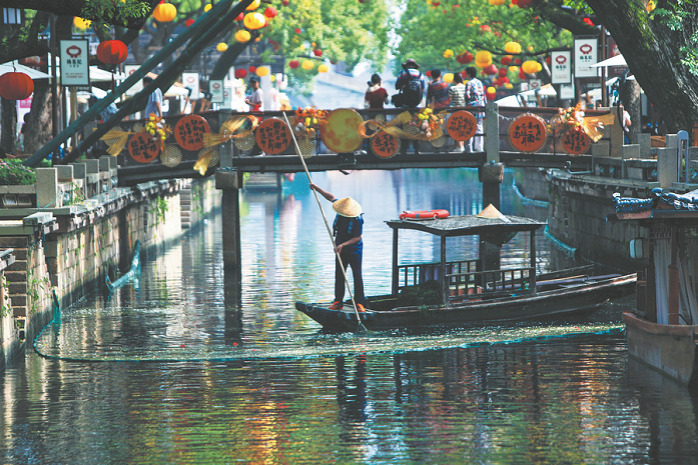
As a cultural concept, Jiangnan, an aquatic heartland crisscrossed with a network of rivers and lakes, represents a gentle, graceful and retained style, as apricot blossoms and drizzle always remind one of Jiangnan.
In terms of economic development, Jiangnan represents a region of wealth, innovation and highly-developed manufacturing industries, commerce, culture and society.
As Rome was not built within a day, the shaping of Jiangnan has also evolved over many centuries.
Three major waves of southward mass migration — from the 4th to the 12th centuries — brought royal families, government officials, scholars, literati and talented individuals from the north to Jiangnan. Along with them came advanced culture, reshaping the spiritual essence of Jiangnan.
Originally good at fighting with swords, Jiangnan people quickly absorbed advanced cultures, fostering a social ethos that revered letters and advocated learning.
On the other hand, Jiangnan's liberal and adaptive culture also liberated northern intellectuals from rigid Confucian conventions passed on from the Han Dynasty (206 BC-AD 220).
Philosopher and poet Zong Baihua (1897-1986) described this Jiangnan era as a time of great intellectual freedom, wisdom and passion comparable to the Renaissance of the 16th century in Europe, an era that witnessed an unprecedented flourishing of literature and art.
With the construction of the Grand Canal in the Sui Dynasty (581-618), the waterborne expressway connecting Beijing and Hangzhou, Yangzhou rose as the commercial and cultural hub of Jiangnan, inspiring Tang Dynasty (618-907) poets such as Li Bai and Du Mu to extol its matchless glory that defined an era.
The Southern Tang Dynasty (937-975) built its capital in Nanjing, implementing a policy of governance through culture, treating scholars with exceptional respect, and accelerating the societal shift from martial values to literary refinement.
The Northern Song Dynasty (960-1127) continued this legacy of prioritizing civil over military governance, which created a new breed of scholar-officials — polymaths who combined administrative acumen with artistic genius. After the Northern Song collapsed, the royal family decided to move the capital from Kaifeng in today's Henan province to Hangzhou, continuing its ruling for more than 150 years as the Southern Song Dynasty (1127-1279).
In a documentary about Jiangnan, scholar Mei Xinlin, an expert on the region's literature and art, says: "After establishing Hangzhou as its capital, the Southern Song solidified Jiangnan's status as the cultural heartland of China. ... Particularly in three distinctive forms — poetry, fiction and traditional Chinese opera, where Jiangnan definitely achieved dominance."
However, Jiangnan did not reach its historical zenith until the Ming (1368-1644) and Qing (1644-1911) dynasties, propelled by the great national strength of these two unified dynasties and the vital role of the Grand Canal as the nation's primary north-south artery.
In the Ming and Qing era, Jiangnan's supremacy in imperial examinations, scholarship, education, literature, arts, craftsmanship and publishing became unassailable — a dominance enduring into modern times, writes Ge Jianxiong, a renowned scholar.
Life in Jiangnan grew increasingly opulent and refined. Its cuisine stood out for its delicate freshness and subtle elegance, while Jiangnan gardens — with their artfully winding waters, exquisitely crafted pavilions and naturalistic beauty — became architectural masterpieces.
If there exists an earthly heaven, a celestial realm among mortals, or a utopia beyond the mundane world — its name is Jiangnan.
But where exactly is Jiangnan?
It lies in the verses penned by Tang poet Wei Zhuang:
"Springtime water is clearer than the sky;
on a painted boat, I drift to sleep to the rain's sigh."
In Jiangnan, Song poet Su Shi wrote:
"On a few peach twigs beyond the bamboo flowers bloom.
That the spring has arrived ducks in the warm river are the first to know."
Song poet Liu Yong also wrote about Jiangnan:
"Smoke-like willows grace painted bridges,
Fluttering curtains and jade-green drapes;
A myriad homes rise in tiers."
If you ask a Chinese person where to go in springtime, "to Yangzhou", they may say, as great poet Li Bai from the Tang Dynasty wrote:
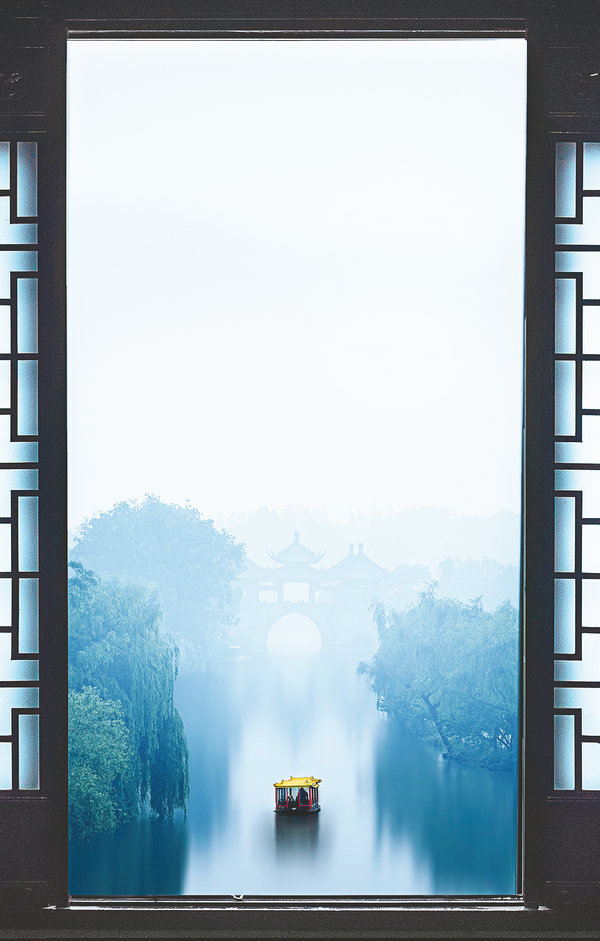
"In March's misty blossoms sailing to Yangzhou."
And Yangzhou, just like apricot blossoms and rain, epitomizes the best of Jiangnan.