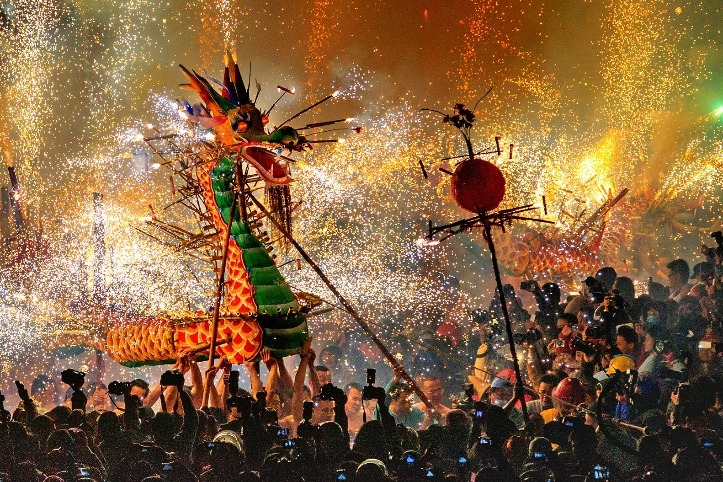
Cultural policymakers and experts from China and Malaysia are now crafting an action plan for protecting and promoting the lion dance, a tradition that has leaped across borders and generations, after submitting a joint bid to UNESCO in late March to recognize the art form as a shared intangible cultural heritage.
The application follows a commitment made in a bilateral statement, signed last year, that said the two countries have agreed to work together on the multinational nomination to inscribe the lion dance on the UNESCO Representative List of the Intangible Cultural Heritage of Humanity.
Confirming the submission in an interview with China Daily, Christina Yeo Ken Yin, undersecretary of the International Relations Division at Malaysia's Ministry of Tourism, Arts and Culture, said, "The application has been smooth so far."
She said the action plan will include measures such as more cross-border performances during festivals, expanded symposiums and a digital archive to facilitate research.
While the lion dance styles of the two countries may differ, the distinctions "don't separate us", Yeo said, but rather "make each other special".
Typically performed during festivals and celebrations, the lion dance — integrating martial arts, dance and music — was brought to Malaysia by Chinese immigrants and has evolved into a cross-cultural spectacle enjoyed by diverse communities in the Southeast Asian nation.
Lee Kok Thow, former president of the Sungai Besi Chinese Hua Ti Dragon and Lion Dance Association in Malaysia, estimated that the country now boasts more than 400 lion dance troupes across all states and federal territories.
In addition, "natives in East Malaysia, such as the Iban and Bidayuh, are increasingly interested in (lion dance performance) and have participated", Yeo said.
This inclusive development not only broadens the reach of the lion dance, but also inspires local artists to innovate. In the 1980s, Malaysian performers reimagined the traditional Chinese lion dance through the creation of the high-pole lion dance, in which artists execute intricate movements atop poles that are up to three meters high and leap gracefully between them. The creative art form was recognized as Malaysia's national intangible cultural heritage in 2007.
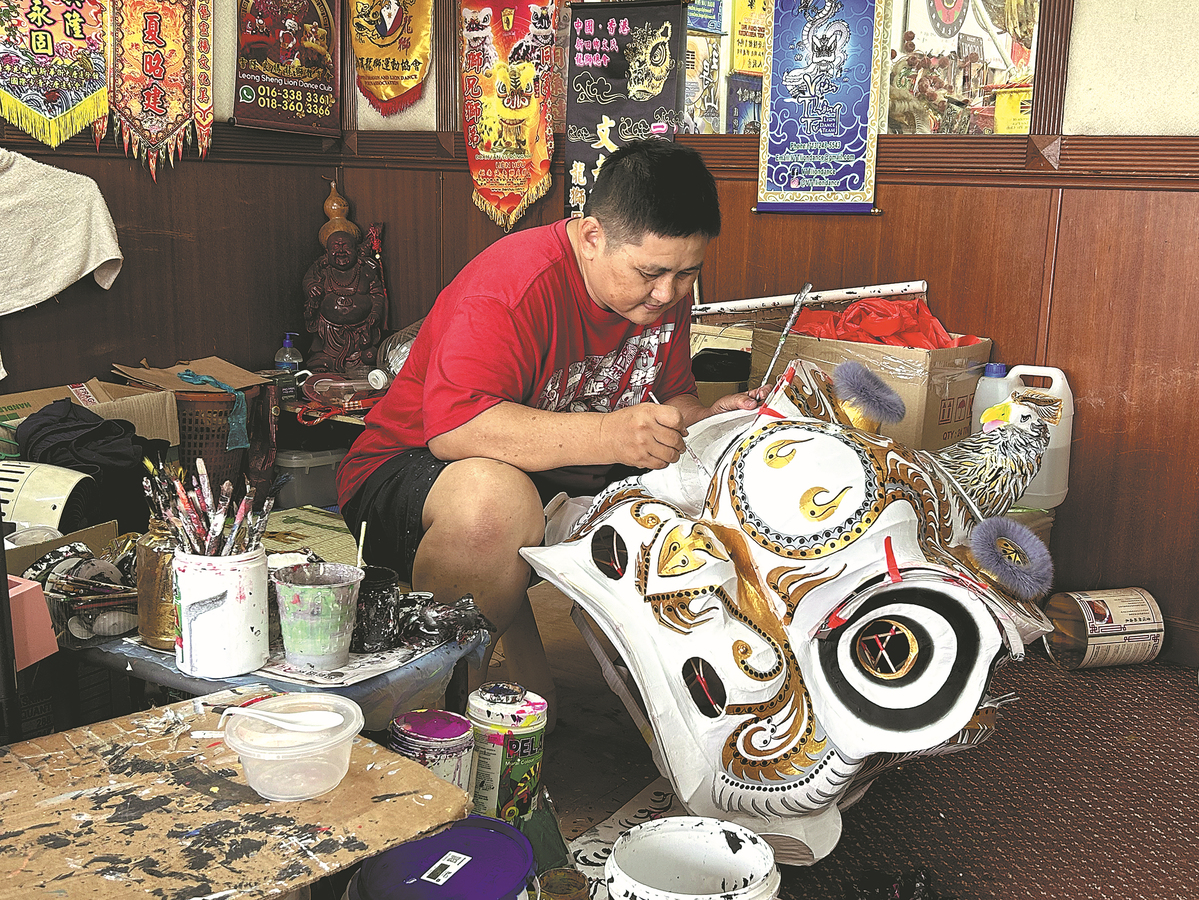
Siow Ho Phiew, renowned as Malaysia's "Lion King" for his masterful performance skills and innovative craftsmanship in the making of lion heads, was deeply involved last month in the third joint heritage nomination workshop held in South China's Guangdong province to finalize the UNESCO application materials. The 70-year-old provided insights into the evolution of the lion dance in Malaysia, particularly regarding the high-pole variation.
Siow said he believes that the joint application will better showcase the art's full evolution, adding that "both nations' lion dance communities not only acknowledge but deeply respect each other's efforts in promoting this heritage globally".
Having trained more than 150 students worldwide, Siow, like his peers in Malaysia's lion dance community, frequently travels around the world, including China, to teach referee certification courses or participate in competitions and exchange programs.
For instance, two associations from Malaysia clinched second and third places at an international high-pole lion dance competition held in China's Hong Kong Special Administrative Region in March.
"Wherever there are overseas Chinese, there's the lion dance," said Chin Yew Sin, president of Malaysia's Oriental Culture Research Centre. He suggested that China and Malaysia expand their cooperation to include more Southeast Asian countries where the lion dance is popular, such as Thailand and Indonesia, to enhance regional cultural exchanges.