Tariffs complicate LA's post-fire recovery









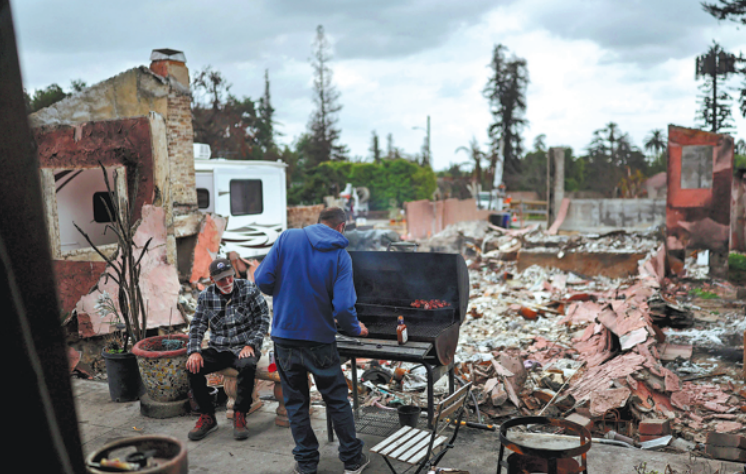
Emerging from the devastation caused by the January wildfires, people in Los Angeles are determined to rebuild a more resilient city.
That mission brought together policy leaders, climate experts and community advocates at the second annual Los Angeles Climate Week (April 6-13), to address the challenges of post-fire recovery amid a shifting global economic landscape.
Those gathered warned that the path to reconstruction is being complicated by the ongoing trade war, with US tariffs imposed on key construction and clean energy materials, many of which are imported from major trading partners such as China and Canada.
Curtis Jewell, a former director of strategic alliances at Sony Pictures Entertainment and now a global partnerships expert, voiced concern over the politicization of climate relief and its intersection with trade policy.
"I've been disappointed in the Trump administration because there have been conditions put on some of the climate relief (efforts) to make sure that there is political alignment," Jewell told China Daily at the climate week's opening event.
He noted that imposing tariffs on essential goods during a time of recovery adds an unnecessary burden and could significantly delay reconstruction efforts.
"Trade policy shouldn't get in the way of climate relief; it needs to function regardless of political leanings," he said. "The simple fact is that global economies as a whole, but the US economy specifically, are going to be consistently negatively impacted by them (the tariffs)."
In recent months, construction costs in California have risen sharply, driven by material shortages, labor constraints and escalating tariffs on imported goods. A key contributor is the surge in Canadian lumber prices — an essential material for rebuilding residential neighborhoods lost to the fires.
Last year, the US imposed countervailing duties on Canadian softwood lumber, which pushed prices higher just as rebuilding efforts began in earnest.
Los Angeles' rebuilding efforts are occurring at a crucial time. As the city gears up to host major international events — the 2026 FIFA World Cup, the 2027 Super Bowl and the 2028 Summer Olympics — its role as a global showcase for urban sustainability is under the spotlight.
However, the availability and affordability of construction materials and green technologies will determine the pace and effectiveness of this transformation.
Many of those materials, including windows, roofing components and ventilation systems, are imported from China and other countries. The existing global supply chain was built on an arbitrage model that allowed US consumers to access goods at competitive prices. However, rising tariffs have disrupted that balance, Jewell said.
The solar energy sector, vital to Los Angeles' ambition of becoming a green energy hub, has been hit especially hard. In December the Biden administration doubled tariffs on solar components imported from China, bringing Section 301 tariffs to 50 percent for polysilicon, wafers and solar cells.
The policy shifts have triggered price increases across the solar supply chain. A report by Anza noted that US solar module prices rose by 4 percent in December, reaching 26 cents per watt. Modules using cells from Cambodia, Malaysia, Thailand and Vietnam saw a 7.7 percent month-over-month price increase at the end of 2024.
"Although the US has long prioritized sourcing American-made solar systems, the reality is that almost no equipment manufacturer uses 100 percent domestically produced components," Jewell said. "All I know is that the tariffs add a complicated layer to the recovery efforts, and I think it's going to take local and international cooperation to figure out the way forward."
Despite the Trump administration's intentions to reduce US reliance on Chinese manufacturing, some companies have chosen to maintain or expand their operations in China due to supply chain stability and access to materials.
"The unpredictability of US trade policy has created uncertainty for businesses on both sides of the Pacific," Jewell added. "If we really want to rebuild greener, smarter, and faster, then we need strategic collaboration — not economic warfare."