



Nation edges closer to nuclear fusion
Sichuan, Shaanxi firms among leaders in cutting-edge tech seen powering future AI needs









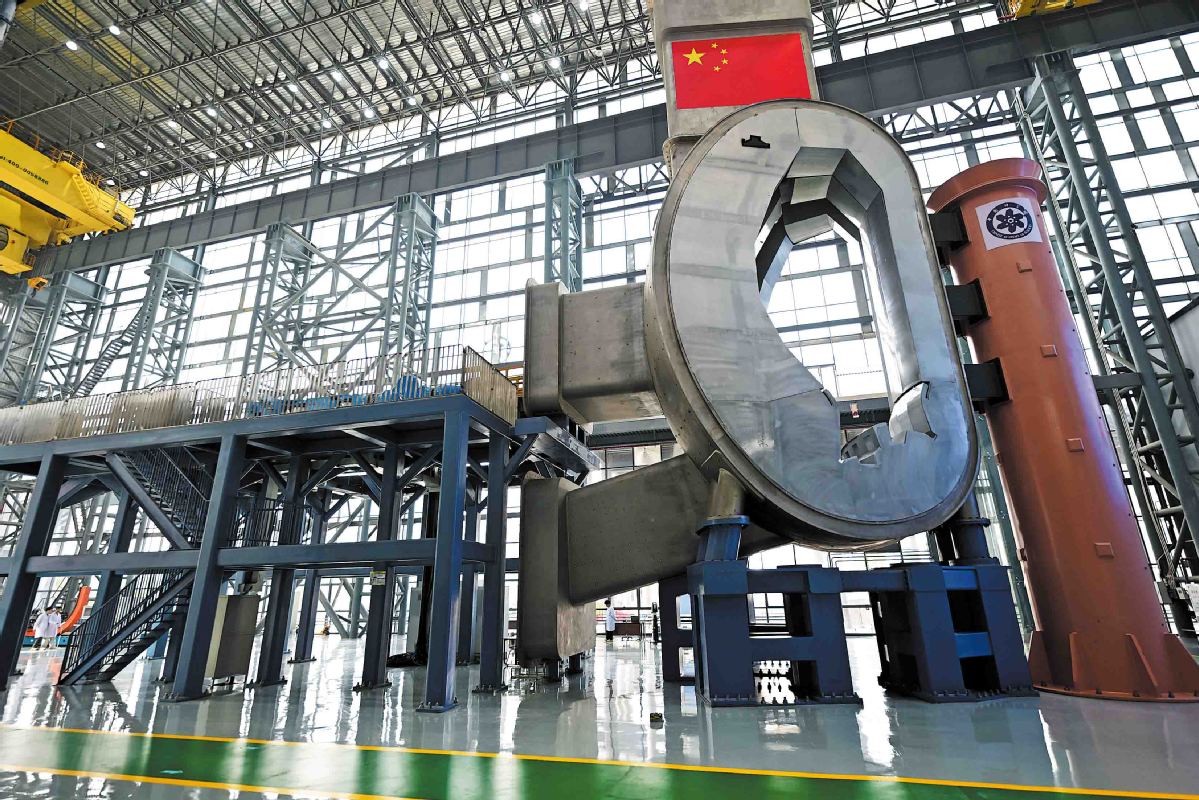
CHENGDU — Armed with cutting-edge fusion energy technologies and bold venture backing, a generation of young Chinese innovators is aiming to shrink the power of the sun into scalable, affordable and investable projects.
As artificial intelligence's insatiable energy demands threaten to challenge the capacity of global grids, nuclear fusion has emerged as an ultimate moonshot solution.
Now, in a high-stakes race, fusion tech leading nations, particularly the United States and China, are racing to translate their recent lab breakthroughs into engineering know-how and practical applications.
Bustling renovation at an industrial site in Chengdu, Sichuan province, is underway. The site is designed to be a compact fusion device base, pioneering linear field-reversed configuration technology, a novel approach to creating a flexible, modular "miniature artificial sun".
"Traditional approaches require sustained 'ignition of the sun'," said Xiang Jiang, chairman of HHMAXEnergy, a startup founded in 2022.The linear configuration, also adopted by US fusion firm Helion Energy, serves to bypass the technical hurdles of prolonged stable operation in conventional fusion devices.
"If traditional tech is like a sprawling subway system, we plan to build a nimble, high-speed maglev train," Xiang said.
In Xi'an, Shaanxi province, located 700 kilometers north of Chengdu, a firm established by former members of Tsinghua University's fusion lab has achieved a remarkable feat. Not only did they build an experimental fusion device in just 279 days, but they then doubled the plasma current within three months.
"We're not changing direction," said Chen Rui, founder and CEO of Startorus Fusion. "We're redefining the approach."
In Shanghai, a team is pushing the boundaries of magnetic field strength for nuclear fusion. Energy Singularity, focused on high-temperature superconducting tokamak technology, realized a tech breakthrough in March. Its magnet reached 21.7 tesla, surpassing the previous record held by Massachusetts Institute of Technology and Commonwealth Fusion Systems in the US.
The company has announced ambitious plans to complete its next-generation tokamak by 2027, targeting a 10-fold energy gain — a critical milestone for commercial fusion viability.
In 2024, the Chinese authorities prioritized support for breakthroughs in core technologies for future energy systems, with nuclear fusion as a focal point.
This top-tier directive has been widely hailed as "the starting gun for China's race to commercialize controlled nuclear fusion".
Shanghai is doubling down on its nuclear ambitions by forging a world-class hub for nuclear equipment manufacturing and cutting-edge fusion research and development, while locking in double-digit annual growth for its nuclear power sector through 2025.
"Commercial fusion could have become viable in around 2050, but leaps in high-temperature superconductors, AI and advanced materials might accelerate this timeline," said Duan Xuru, chief nuclear fusion scientist at China National Nuclear Corp.
A significant catalyst for the swift advancement of commercial nuclear fusion in China is its robust and tangible achievements in nuclear fusion scientific experiments.
In January, the Experimental Advanced Superconducting Tokamak in Hefei, Anhui province, maintained a steady-state high-confinement plasma operation for a remarkable 1,066 seconds, setting a new world record and marking a breakthrough in the quest for fusion power generation.
Last month, HL-3, another "artificial sun" tokamak facility in Chengdu, reached a milestone by achieving atomic nucleus and electron temperatures both exceeding 100 million C, marking a new phase of combustion experiments.
Despite these ambitious plans, the industrialization of nuclear fusion still faces key technical challenges, according to industry insiders.
Current devices operate only at the 100-second level, far below long term operational needs. The extreme fusion environment, such as high temperatures and intense neutron irradiation, requires state-of-the-art resistant materials, which remain underdeveloped. Also, achieving net energy gains requires higher device efficiency and better system coordination.
Xiang likened the challenges to building an "alchemy furnace".
"Mastering fusion while engineering a reactor resilient to million-degree heat and sudden shocks is a task demanding industry-wide collaboration," said Xiang.
Despite growing venture capital interest in nuclear fusion, investment in China remains lacking. "Over the past five years, China's private funding in the sector totaled just $500 million, far below the roughly $5 billion invested in the US during the same period," said Chen.
Kang Jianshu, executive director of LightSilver Capital, acknowledged that nuclear fusion requires investors to adopt a long-term approach, which is suitable for those investment institutions genuinely committed to deep-rooted hardcore technologies.
"Capital seeking short-term returns or rapid commercialization would find itself fundamentally incompatible with this sector," said Kang.
LightSilver Capital is an investor in HHMAX-Energy.
"Our investment horizon can span eight to 10 years," Kang added. "Patience is the key."
Beyond its long-term goal, HHMAX-Energy has also adopted a "value-creation along the way" strategy to generate some returns for investors throughout the lengthy process.
This involves exploring commercial applications of neutron sources in medical and industrial fields, such as cancer radiotherapy, nuclear pharmaceutical isotope production, neutron imaging and nuclear waste treatment.
Xinhua




















