Hedge against pressure










MA XUEJING/CHINA DAILY
Europe's diplomacy should strive for greater independence
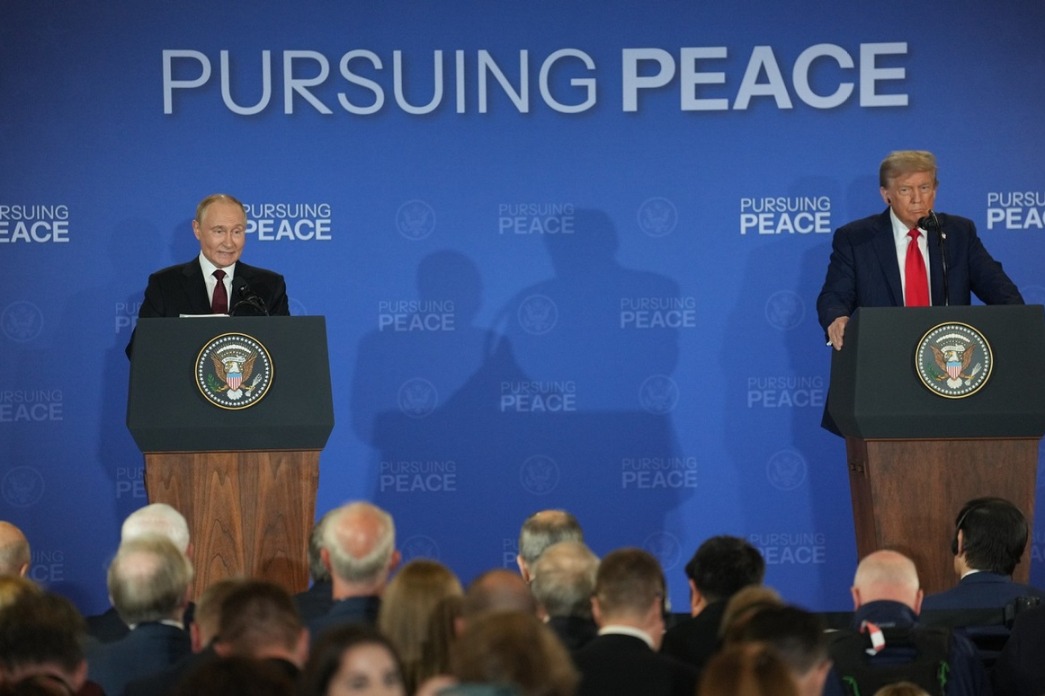
One of the most challenging events for Europe this year is the return of Donald Trump as the president of the United States. In its outlook for 2025, The Economist rightly calls this a "bombshell moment". From a European perspective, the situation is indeed dire. Trump's position could hardly be stronger. The Republican Party has a majority in both chambers of Congress, and Trump also won the popular vote: more US citizens voted for him than for any other candidate. Europe, on the other hand, looks weak: Germany's ruling coalition disintegrated at the end of 2024, elections are scheduled for February, and it will take weeks, if not months, to form a new government. France had no fewer than four prime ministers in 2024, and none of the three major political groups has a majority in parliament. Austria has only an acting chancellor, and Spain's government is hanging by a thread. This gives extra clout to the re-elected President of the European Commission Ursula von der Leyen, who seems ready to seize the opportunity. But under EU rules, she has little to no say in foreign, security and defense policy.
The European economy is not in good shape either. Of the world's three largest economies, China grew by 5 percent in 2024, the US by about 3 percent, and the European Union by about 1 percent.
Europe is therefore ill-equipped to deal with a US president who regularly surprises with injudicious statements. Pundits debate whether to take him literally, seriously, both, or neither. What this means for the tariffs on EU goods, the demands for higher defense spending by European NATO states, and the resolution to the Ukraine crisis within "one day" or "six months" — all of which he has announced — is unclear at best.
Yet until recently there was remarkably little debate among European policymakers about how to deal with Trump. It is therefore timely to consider how Europe should manage its relations with the rest of the world, especially China, at a time when the transatlantic relationship is becoming more challenging.
At present, there seem to be three main schools of thought. Politicians, especially in major European states, hope that with good arguments and personal flattery, they can convince Trump that their participation in NATO is in the US interest and that tariffs against European partners are misguided. This view is widespread in Germany, which, unlike the United Kingdom and France, has renounced nuclear weapons. At a time when Russian President Vladimir Putin has repeatedly made statements that do not seem to rule out the use of such weapons, Germany is particularly dependent on the US nuclear umbrella. By contrast, some European governments, in Hungary, Slovakia, and perhaps soon Austria, seem to believe that should Washington turn away from Europe, a more nationalist and Russia-friendly international security architecture is called for. Few, so far, are advocating a third solution: a long overdue greater independence for European diplomacy.
Until Trump's re-election, many in Europe believed that his first presidency would prove to be a blip. Now, however, it increasingly appears that the US is on a sustained "America First" course, only briefly interrupted by the Joe Biden administration. This would also mean a return to policies aimed at aggressively reducing the large US trade deficit with the EU — a particularly uncomfortable stance for Germany, with which the US has a large deficit, and which would thus bear the brunt of tariffs on European goods. To hedge against Trumpian pressure tactics, it would therefore be in Germany's interest to lead the way toward a more independent European policy. Such a policy would not seek equidistance between Washington and Beijing, but would rely more on China's predictability and less on idiosyncratic decisions in Washington.
The diplomatic mainstay of the new German government, likely to be headed by Christian Democratic Union leader Friedrich Merz, will be the transatlantic relationship with the US. On economic issues, however, Merz will also listen to German business. If tariffs were to seriously hamper German trade with the US, the top destination of German exports, he might be amenable to seeking improved ties with China.
Such a closer relationship would be in the interests of both Germany and China, two major beneficiaries of globalization. German companies are leading the way. While the coalition government promoted "de-risking" from the Chinese economy in its July 2023"Strategy on China", German companies have done just the opposite, investing record amounts in China in 2023 and at least the first half of 2024. On the economic front, China and Germany could thus jointly promote globalization, free trade and economic exchanges between the EU, China and the Global South. In diplomacy, they could advocate international relations based not on Trump-style bilateral deals, but on multilateralism, the United Nations Charter and the Five Principles of Peaceful Coexistence, including mutual respect for sovereignty and territorial integrity, mutual non-aggression, and mutual non-interference in each other's internal affairs. This would mean for both partners to clearly object and respond to deviations from the Five Principles wherever they occur.
The author is a former member of the German Foreign Service, advisory professor at Tongji University and visiting scholar at the Center for Cultural Studies on Science and Technology in China of Technical University Berlin. The author contributed this article to China Watch, a think tank powered by China Daily.
The views do not necessarily reflect those of China Daily.
Contact the editor at editor@chinawatch.cn.