African nations push back against French military presence









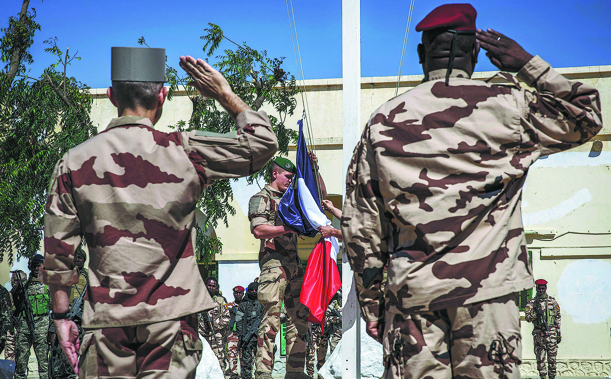
The recent moves by two West African countries to end foreign military presence on their soil mark another blow to France's influence in the continent.
President of Cote d'Ivoire Alassane Ouattara, in his New Year address, announced that French forces would withdraw from the country in January.
Similarly, Senegalese President Bassirou Diomaye Faye declared that all foreign military bases in the country would be closed by 2025, an announcement observers said was essentially aimed at France. "There will soon be no more French soldiers in Senegal," Faye told French daily Le Monde in November.
Analysts attribute the current trend to a combination of Africa's growing demand for sovereignty, rising anti-West sentiment, and the shift in France's African strategy as its influence wanes.
"It mainly boils down to issues of sovereignty," said Fidel Amakye Owusu, CEO of DefSEC Analytics Africa, a security consultancy based in Accra, Ghana.
"The military presence of France is unpopular with the local people, given the vestiges of colonialism. The younger generation is not comfortable with it," he told China Daily.
Dai Zhixin, vice-dean of the Institute of French and Francophone Studies and research fellow at School of Global and Area Studies of Renmin University of China, said African nations are rethinking the continuity of foreign troops' presence, mainly out of national security considerations.
The security situation in the Sahel — a region south of the Sahara desert, stretching from Senegal in the west to Sudan in the east — has deteriorated in recent years, particularly after the chaos in Libya in 2011. The turmoil resulted in a proliferation of weapons being smuggled into the Sahel and empowering militant groups across the region, fueling conflicts.
France, along with international forces, has intervened to combat extremism in the continent. In 2013, it launched Operation Serval in Mali, replaced in 2014 by Operation Barkhane in partnership with the G5 Sahel countries, namely Burkina Faso, Chad, Mali, Mauritania and Niger, an alliance that was largely diluted after the departures of Mali, Niger and Burkina Faso in 2022 and 2023.
"Foreign forces can heighten insecurity and even provide a rallying point for extremist groups by strengthening their anti-colonial narrative," Dai said.
"While France's interventions in the Sahel have achieved some success in countering extremists, they have not translated into lasting peace, and long-term stability remains elusive," Dai said. "Meanwhile, dwindling French forces has created a security vacuum in the region," he added.
On Jan 11, France handed over its second army base in Abeche, east Chad, following the first such move in mid-December. Chad, long regarded as a stable security partner, ended its military agreement with France in November, calling it "obsolete".
Li Yincai, an associate research fellow in African Studies at the Shanghai Academy of Social Sciences' Institute of International Relations noted that France's influence in the region has noticeably declined in recent years.
"France has historically had the largest military presence in Africa, but its power has diminished significantly over the past two decades," Li said.
Despite many African nations becoming independent from the 1950s onward, France maintained a strong military and political influence in the continent, with some arrangements seen as domineering. "Francophone Africa did not gain full independence" as France continued to exert a degree of political and economic control over its former colonies, including stationing military forces, holding foreign reserves of these nations in France, and wielding indirect influence over their natural resources, Owusu said.
French President Emmanuel Macron said in a speech on Jan 6 to French ambassadors that African countries had "forgotten to say thank you" to France for its decadelong military efforts in fighting extremists.
Chad's President Mahamat Idriss Deby Itno hit back by saying that Macron is "in the wrong era". He added that he wanted to express his outrage at the remarks "which border on contempt for Africa and Africans".
Li of the Shanghai Academy of Social Sciences said Macron's comments signal France's broader sense of loss and humiliation, as it gradually exits the continent.
"France has invested over a century in the regions, pouring in substantial resources, only to be seen as a relic of the colonial era and ultimately forced to leave," Li said.
Owusu of DefSEC Analytics Africa said Macron's remarks were uncalled for. "While it is good to appreciate military cooperation (between Africa and France), it should not come across as France doing African states a favor," he said.
He said France has long exploited Africa's resources, with significant mining interests in countries such as Niger, Mali and Senegal. "These resources are often granted to France without fair competition due to post-colonial arrangements," Owusu said.
"Economic, political, cultural and historical factors have contributed to this new wave" of France withdrawing troops from the African continent, he added.
Owusu said African countries should unite on the global stage. "When there is regionalism, they can have a united front in bargaining with great powers in order to gain," he said.
Over the past decade, France has been forced out of over 70 percent of the African nations where it once maintained a military presence, news network France 24 reported.
"Budget constraints and shifting geopolitical priorities have driven the wave of France's withdrawal of military presence in Africa," Li said.
Despite continued counterterrorism efforts, the region has seen a rise in coups, including in Mali, Burkina Faso, and Niger — all former French colonies and the military leaders in these countries have asked French forces to leave.
In line with new realities, France has been devising a reconstructed Africa strategy. In November, Macron's special envoy for Africa, Jean-Marie Bockel, presented a report on the evolution of France's military role on the continent. In June 2024, it announced the creation of a command to reorganize its forces in Africa. In February 2023, Macron called for France to establish "a new, balanced relationship" with Africa.
"In the future, the West's approach toward Africa should prioritize mutual benefit," Dai of Renmin University of China said, adding that "Africa should focus on both internal reforms and regional integration to enhance autonomy, and find a development path that suits their needs".