


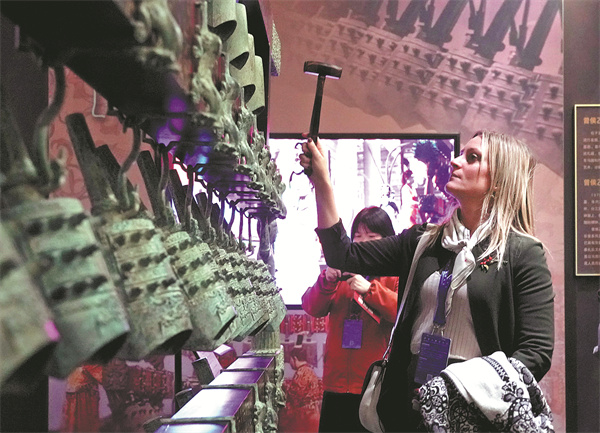
A lecture series hosted by Chinese Archaeological Museum has offered a unique window into major discoveries and the latest research on the origins and early development of Chinese civilization.
"Today is the Winter Solstice. A warm welcome to everyone visiting the Chinese Archaeological Museum," museum director Liu Guoxiang told the attendees of a lecture on Liangzhu culture on Dec 21.
The museum's "Tracing the Origins of Chinese Civilization" lecture series began in June 2024, featuring distinguished experts who were invited to speak every Saturday on the third floor of the museum.
The lecture on Dec 21 was delivered by Wang Ningyuan, a senior research fellow at the Zhejiang Provincial Institute of Cultural Relics and Archaeology and a leading expert on Liangzhu culture.
At the Liangzhu ruins, time seemed to have stood still for 5,000 years until its discovery in 1936. Located in East China's Zhejiang province, it gained UNESCO World Heritage status in 2019, a testament to the continued existence of Chinese civilization.
More than 350 sites of the Liangzhu culture have been discovered in the lower reaches of the Yangtze River, shedding light on one of the earliest urban societies in East Asia.
Among the most significant findings are the ancient Liangzhu city, large expanses of prehistorical rice paddies, a trove of jade artifacts and agricultural tools such as plows.
The ritual item yucong, a jade tube with a quadrilateral exterior and a circular interior, is a hallmark of Liangzhu culture, which, according to archaeological discoveries, also spread to other parts of China.
During the middle period of Liangzhu culture, the ritual center, city walls and water management system were all planned in a unified manner.
The social structure transitioned from female-dominated power to male authority, while the belief system shifted from dragon-shaped patterns to a unified divine emblem, Wang says.
"Within Liangzhu city, the population comprised nobles and high-level artisans, revealing the emergence and evolution of early state-level social organization. Liangzhu provides a prime example for research on the origins of Chinese civilization," the expert adds.
Wang reveals significant progress in Liangzhu archaeological research. DNA analysis of charred rice samples revealed at least six sources of origin.
Stable isotope and DNA studies found individuals within the city came from as far as the Central Plains and the Haidai region, centered in today's Shandong province.
"Liangzhu city was an urban center where resources of all kinds were brought in from external regions, and populations gathered across vast areas. Its influence and level of development are beyond imagination," Wang says.
Wang took questions from the audience, including an elementary school student, a middle school teacher, and a pharmaceutical researcher.
Concerning how Liangzhu culture came to an end and how its iconic yucong spread across China, Wang explains that environmental research suggests frequent flooding in the late Liangzhu period may have disrupted rice cultivation, leading to population migration to surrounding areas.
The yucong and the ideas it represented subsequently influenced other parts of China.
"This is a vivid example of the formation of China's multiregional and unified civilization," Wang adds.
Liu, also secretary-general with the Society for Chinese Archaeology, spent over 30 years working on Neolithic archaeology at the Chinese Academy of Social Sciences' Institute of Archaeology. He began the lecture series after taking up the position at the Chinese Archaeological Museum.
The speakers are mostly directors of archaeological institutes or leaders of prominent archaeological projects across China. They strive to present their findings in simple and accessible language, in a bid to make archaeology interesting and approachable for the public.
Before each Saturday lecture begins, Liu increasingly sees familiar faces among the audience.
After the lectures, many attendees tell him they have gained a deeper understanding of what makes China and felt closer to archaeology than ever before. Some have expressed their desire to volunteer for the lecture series.
"I hope every lecture becomes a bridge, allowing the public to feel the depth and pride of Chinese civilization through dialogues tracing its origins," Liu says.








